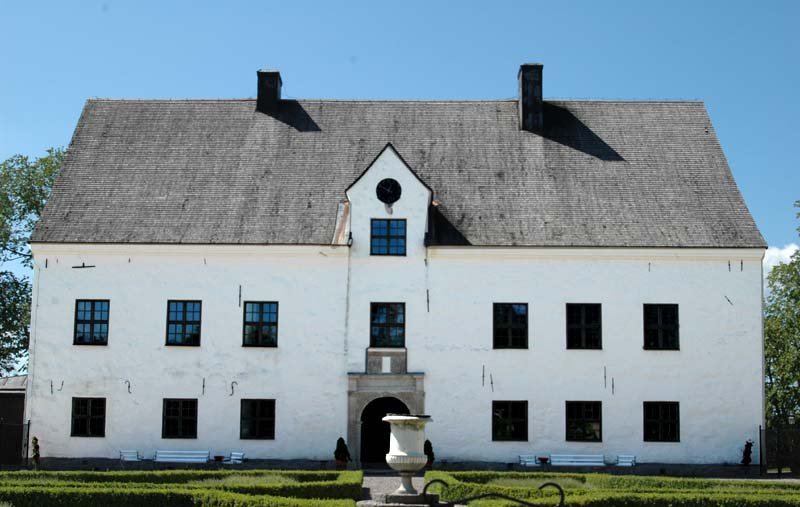

Bjärka-Säby gamla slott, situated in Bjarka-Säby, Vist socket, Hanekind's parish in Östergötland, Sweden, is 2 miles south east of Linköping and 4 kilometres north of Bestorp in Linköpings stift. The main structure of the castle, built in stone in the 1630s, stands alongside two wing structures constructed in wood in the early 1700s. The castle's main building comprises three floors, including a lived-in attic, and is covered with a gable roof. The wing buildings have one floor and are covered with a hip roof.
This southeastern wing building was later converted into living quarters and remains in use. The exterior still retains a 17th-century style, but the interior has been completely renovated. Today, guests can rent the old castle for events such as weddings.
Originally, Bjärka was owned by Johan Pettersson in the 1300s, who redeveloped the royal farm in Vadstena into a nunnery for the Order of Saint Birgitta. In 1367, Bo Jonsson Grip acquired Bjärka, and he started building a fortress called Bjärkaholm on a small island in Stångån, but this fortress was never completed, and Bo Jonsson died in 1386.
His daughters' inheritance included Bjärka and Säby, which were passed to the Natt och Dag clan. Säby historic castle was initially built around the middle of the 16th century in wood and not particularly grand. A more opulent stone manor was begun around 1560 by Per Nilsson Natt och Dag. The main portal bears the year 1560.
By the end of the 17th century, Biarca faced financial troubles. Karl XI made reductions of the Adel's and, in particular, the High Nobility's assets, contributing to Carl Persson (Natt och Dag) falling into financial difficulties and having to relinquish the estate to Germund Cederhielm. Germund Cederhielm immediately began a modernization of the manor.
The castle underwent further transformations under Germund Cederhielm’s grandson, Germund Carl Cederhielm. Bostadsflygeln was later modernized by Germund Carl Cederhielm in Gustavian style, but, in comparison, made few other major changes. According to Carl Fredrik Broocman’s visit in the middle of the 18th century, Säby housed 60 tons of arable land, 800 loads of hay, plenty of barley, a significant forest, good fishing, a well-tended garden with an orangery, a good vegetable garden, a deer park with some deer, and a mill with two millstones, one water mill, a saw mill, and a spinning mill.
Sources: Wikipedia, OpenStreetMap, Wikidata, Wikimedia Commons
Written by Nik Frost
Discuss this with the author and others
No comments yet. Be the first to start the conversation.