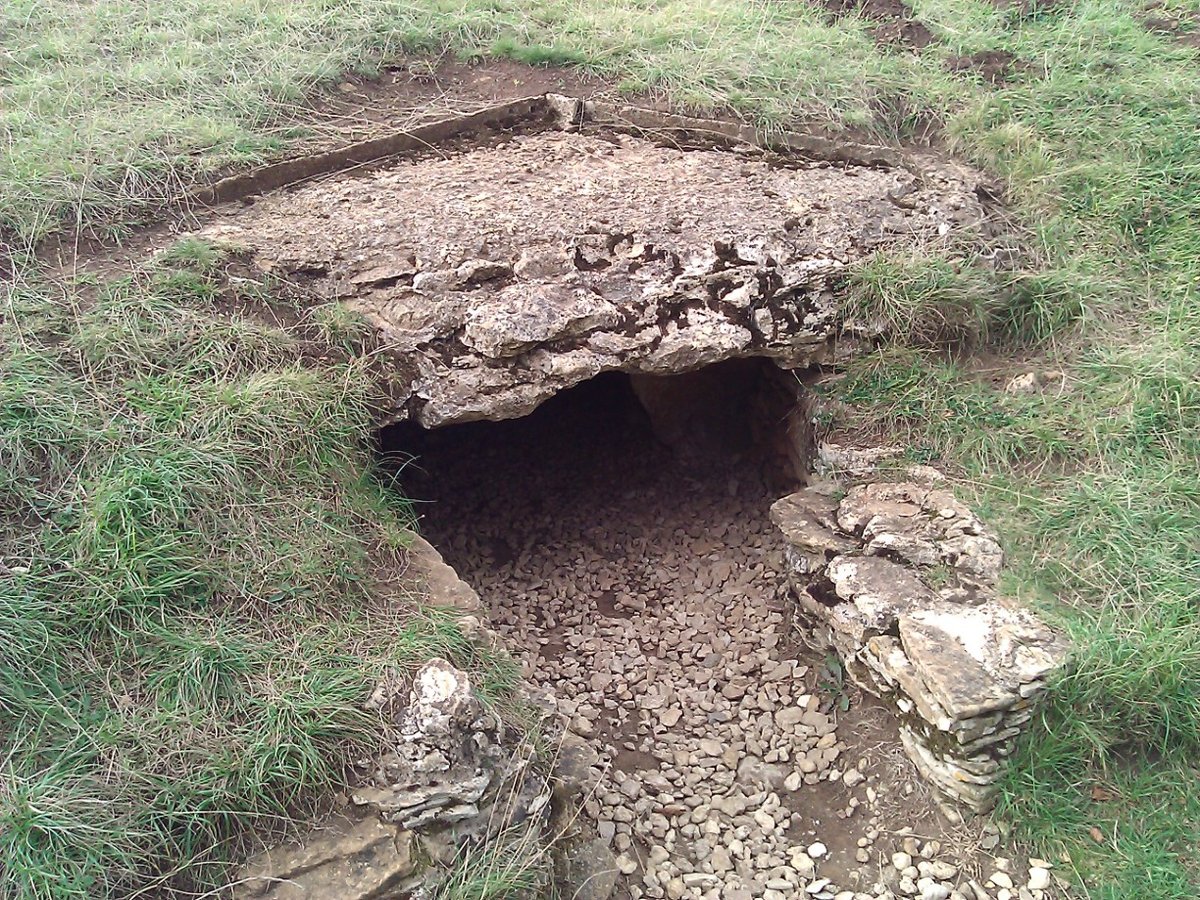
Belas Knap is a Neolithic, chambered long barrow located near Winchcombe and Cheltenham in Gloucestershire, England. It is an 'outstanding example representing a group of long barrows commonly referred to as the Cotswold-Severn group'. This regional tradition is characterized by trapezoidal structures with false entrances and side chambers. (Source: English Heritage designation listing statement, 1, 2, 4) However, contrary to its grand appearance, the main entrance of Belas Knap is actually a deception.
This entrance, complete with intricate dry-stone walling and large limestone jambs and lintels, serves no purpose for the actual burial chambers. (Sources: 1, 2) The purpose of this false entrance is unclear, with theories suggesting it was meant to deter robbers or to allow the dead to come and go and partake of offerings brought to the tomb by their descendants. (Source: 1) The actual burial chambers are down the long East and West sides of the barrow and at its Southern foot, forming upright stone slabs linked by dry-stone walling.
(Source: 1) Constructed around 3000 BC, Belas Knap measures approximately 55 meters in length, 20 meters in width at its broadest point, and 3–4 meters in height. (Source: 1) Belas Knap is accessible via two primary footpaths from nearby roads. (Source: 2)
Sources: Wikipedia, OpenStreetMap, Wikidata, Wikimedia Commons
Written by Nicolo Ciampini
Discuss this with the author and others
No comments yet. Be the first to start the conversation.