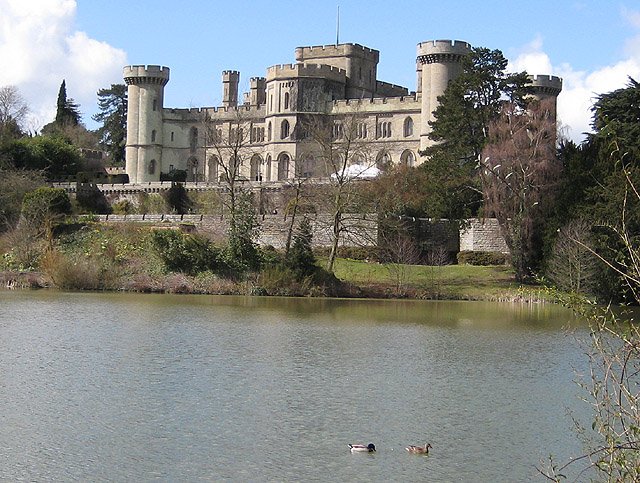

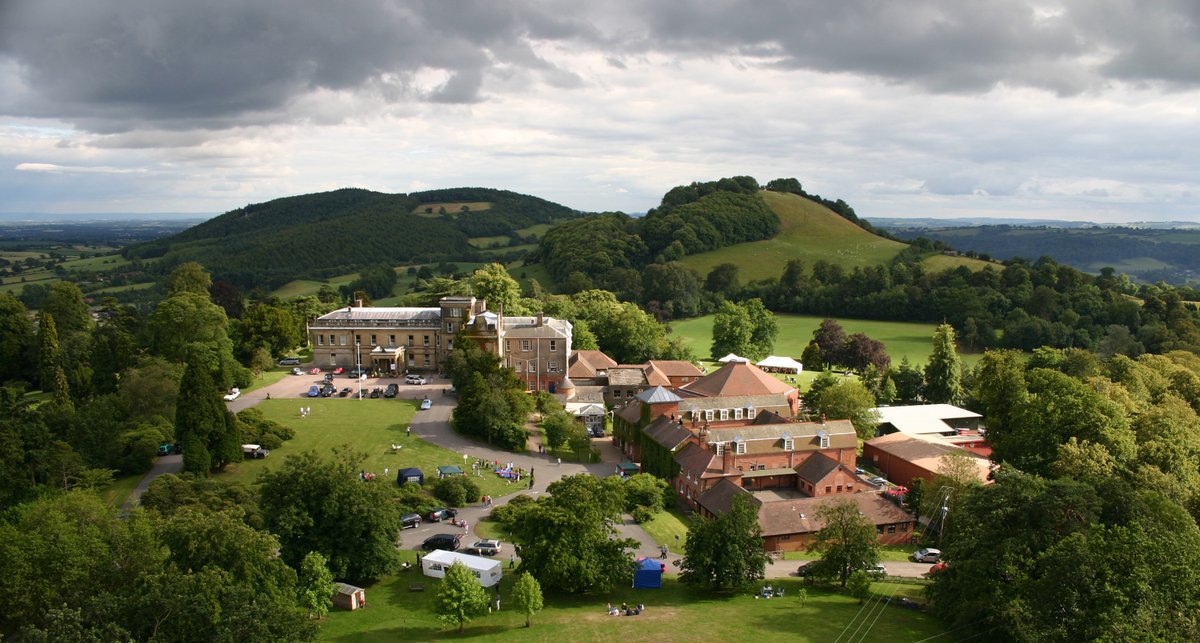
Eastnor Castle was built between 1811 and 1820 for John Cocks, 1st Earl Somers. The castle was designed by Robert Smirke - the main architect of the British Museum - to resemble a medieval fortress guarding the Welsh borders. Constructed of ashlar stonework with a lead and slate roof concealed behind an embattled parapet, it cost £85,000, the equivalent of approximately £5.1 million in 2024 prices.
Later in the 19th century, critic Charles Locke Eastlake described the building as a massive and gloomy-looking structure that was a "picturesque mistake" as a residence. To preserve its character, the windows were made exceedingly small and narrow, which Eastlake noted resulted in much inconvenience for those living inside. Despite this, major interior decorations were carried out by A. W. N. Pugin in 1849–1850, including the decoration of the Gothic drawing room, with further changes made by George E. Fox in the 1860s.
The castle remains a private home and is currently the residence of James Hervey-Bathurst. Since 2020, the family has occupied only a small part of the building, mostly the kitchen which was enlarged in 1992. The estate also features an 18th-century flour mill that was restored in the 21st century to make the machinery workable again.
Historical events have left their mark on the land, including the presence of Nissen huts used to house American troops in 1944. Today, the estate features an ironwork bridge over a weir restored in 2021 and a section of the Berlin Wall installed in the grounds in 2025. The castle is also used as a wedding venue and a venue for Land Rover to test-drive vehicles.
Sources: Wikipedia, OpenStreetMap, Wikidata, Wikimedia Commons

Written by Nicolo Ciampini
Discuss this with the author and others
No comments yet. Be the first to start the conversation.