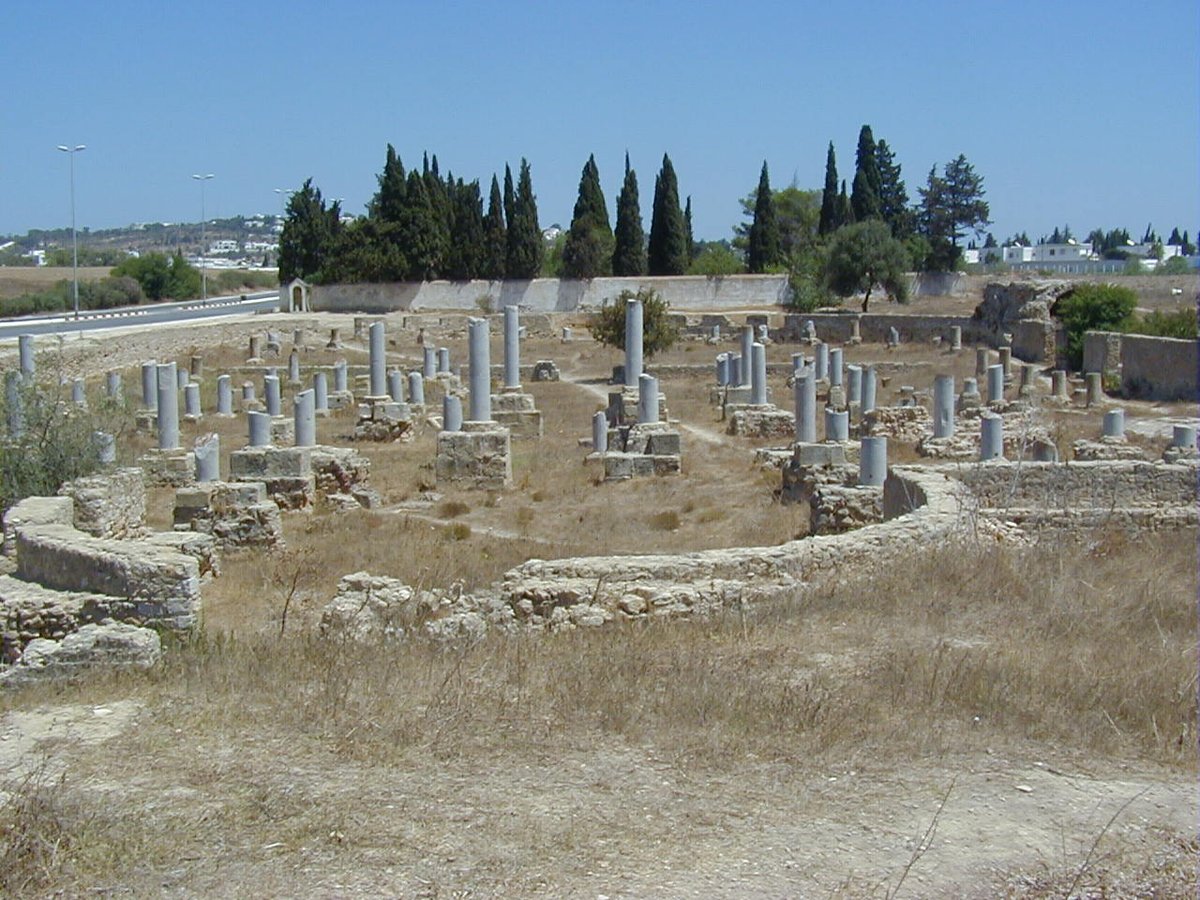

Deep within the heart of ancient Carthage, in Tunisia, rests an extraordinary basilica. Referred to as the Basilica Fausti by certain scholars, it was constructed during the remnants of the Late Antiquity and under the rule of the Byzantine dynasty. This magnificent basilica forms part of the city's most cherished Christian landmarks. Within this architectural complex, one can find two churches, at least one martyrium, several Hypogeums, and a subterranean rotunda. The name 'House of Charity' was given to this monument, derived from the Latin term 'domus caritatis'.
Spanning over 15,000 square meters, the complex encompasses the quadratum populi, measuring 2,925 square meters alone. The main church is adorned with nine naves, the largest of which is a grand 12.80 meters in width and has eleven bays. The building itself is oriented towards the South-West-North-East, its structure measuring 65 meters lengthwise and 45 meters widthwise.
Nestled beneath the surface in the southwest lies a subterranean rotunda, its interior diameter reaching 9.15 meters. This hidden gem can be accessed through two symmetrical staircases, each vaulted and square, making for graceful descent into the heart of the earth.
Sources: Wikipedia, OpenStreetMap, Wikidata, Wikimedia Commons
Written by Mutabor
Discuss this with the author and others
No comments yet. Be the first to start the conversation.