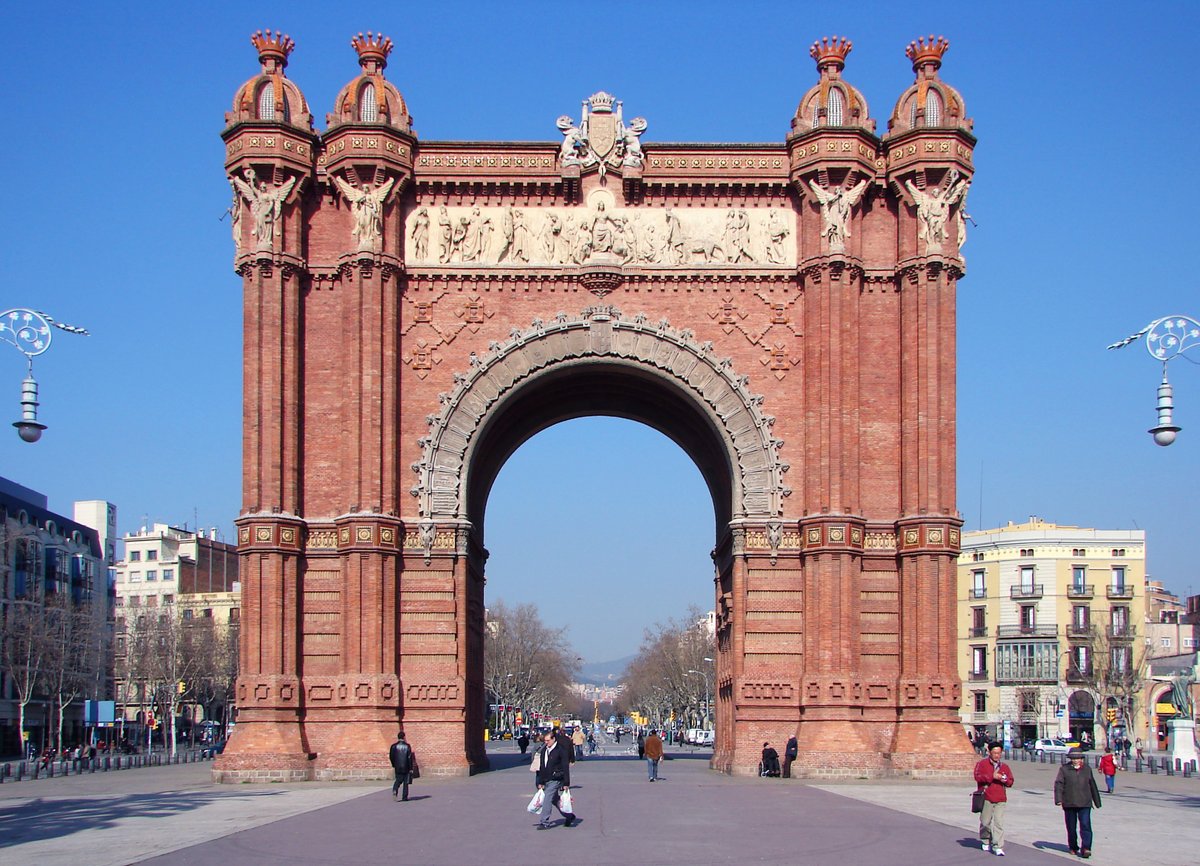

The Arc de Triomf (Catalan pronunciation: [ˈarɡ də tɾiˈoɱf]), translated: Arch of Victory, is a memorial arch in Barcelona, Catalonia, Spain. Situated along Passeig de Lluís Companys, the Arc de Triomf crosses over the wide central promenade and stands as the main access gate for the 1888 Barcelona World Fair. It was designed by architect Josep Vilaseca i Casanovas in the Neo-Mudéjar style.
The Arc de Triomf is known for its reddish brickwork and its various stone sculptures. The front frieze contains the stone sculpture Barcelona rep les nacions (Catalan for 'Barcelona welcomes the nations') by Josep Reynés, along with a stone carving entitled Recompensa ('Recompense'), a work from Josep Llimona’s earliest period, representing the granting of awards to the participants in the World Exposition.
The friezes along the sides of the arch include allegories of agriculture, industry, and trade by Antoni Vilanova and of sciences and arts by Torquat Tassó. The two pillars of the arch feature bats carved in stone, which were the emblem of King Jaume I, who ruled over a period of prosperity in Barcelona. The voussoirs of the arch are made of stone sculpted like a large laurel wreath that supports the coats of arms of the forty-nine provinces that formed the Kingdom of Spain in 1888.
The keystone of both arches presents the coat of arms of the city of Barcelona, above the rest of the shields and in larger dimensions. The Arc de Triomf was built as the gateway to the 1888 World Fair and was intended to welcome people rather than celebrate military victories.
Sources: Wikipedia, OpenStreetMap, Wikidata, Wikimedia Commons
Written by Nik Frost
Discuss this with the author and others
No comments yet. Be the first to start the conversation.