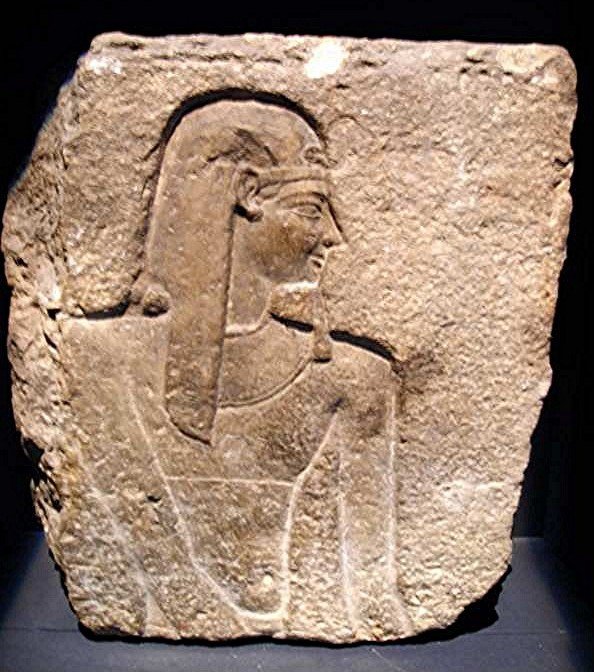

Qift, formerly known as Gebtu, was established on the eastern bank of the Nile and served as an important trading emporium in ancient Egypt. Its proximity to the Red Sea made it a key hub for trade between India, Punt, Arabia Felix, and the North. The city served as the starting point for expeditions to Punt by way of the Wadi Hammamat and for mining expeditions into the Eastern Desert for gold and quartzite.
Under the native pharaohs, the trade of southern Egypt with the Red Sea passed over roads from Qift and Qus. The city's principal male deity was Min, a sky-god whose symbol was a thunderbolt. He became a male fertility deity and was regarded as the male deity of the desert region to the east. During the Middle Kingdom, his cult rose to prominence and he became associated with Horus as Min-Horus, and was later fused with Amen to become Min-Amen-ka-Mut-ef.
Qift was also connected with the deities Isis (Hathor-Isis) and her infant Horus. During the Greco-Roman period, the city was known as Coptos and served as the terminus of a caravan route to Berenice on the Red Sea. Built up by Augustus, the city fell to the Blemmyes in the 3rd century AD and was almost destroyed by Diocletian in AD 292. It was later reconstructed as a Roman city with many fortifications and eventually renamed Justinianopolis in the 6th century.
Sources: Wikipedia, OpenStreetMap, Wikidata, Wikimedia Commons
Written by Mutabor
Discuss this with the author and others
No comments yet. Be the first to start the conversation.