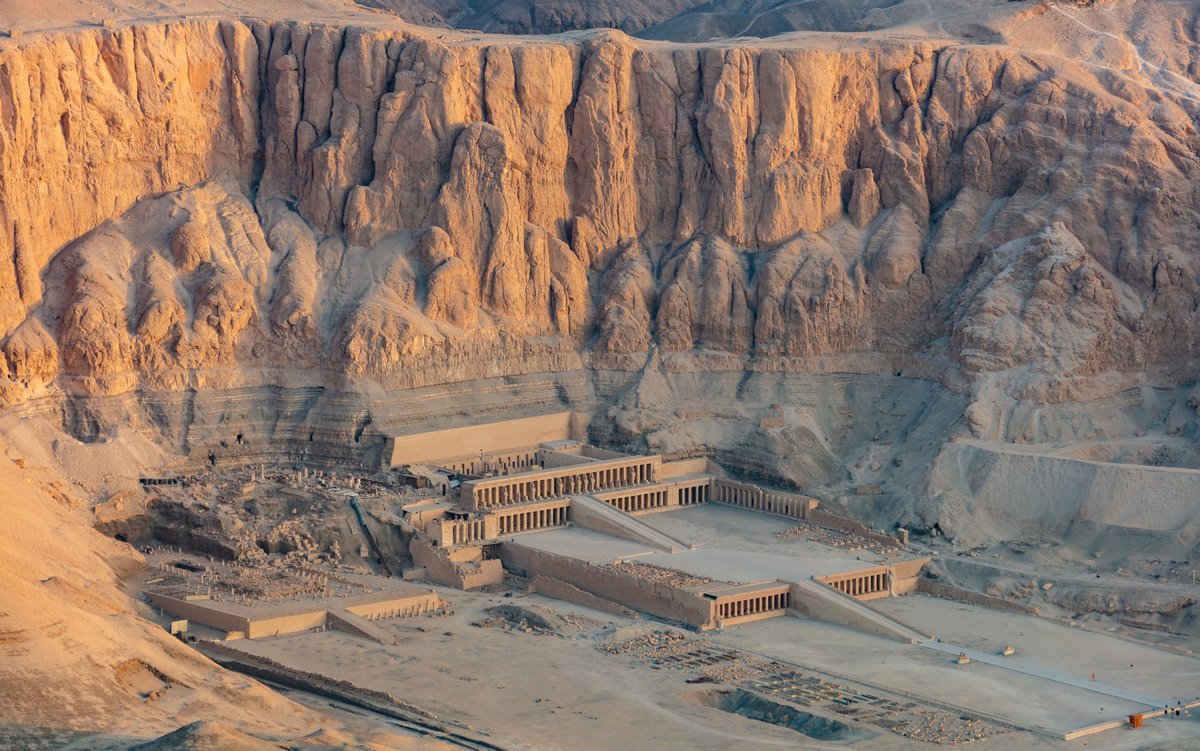
For well over two millennia, Deir el-Bahari, locally known as Al-Dayr al-Bahri, has been a spiritual hotspot, lounging on the west bank opposite swanky city Luxor, snuggled within the Theban Necropolis. This place has deep roots, built by Pharaoh Mentuhotep II during the 11th Dynasty, who fashioned a temple-tomb combo that inspired New Kingdom rulers years later. Talk about trailblazers! This place of worship catered to Hathor, the cow goddess who was big on divine motherhood and feminine power, with her main squeeze, Anubis, keeping the secrets of the next life under wraps.
Hatshepsut, a boss lady and the daughter of Thutmose I, cranked up the holiness a notch during her reign, constructing her burial temple, Djeser-Djeseru, right beside Mentuhotep's holy site following the departure of her regent partner Thutmose III. The temple walls were decorated with intricate bas-reliefs depicting Hatshepsut's divine birth, lucrative trade voyages to the land of Punt, and her affiliation with the patron god Amun-Ra. After her departure, Hatshepsut's body was buried in her fancy tomb, while her mortuary temple turned into a sacred site for her divinized cult.
Later on, several other pharaohs like Thutmose III and Amenhotep III jumped on the bandwagon, expanding the temple before it faced centuries of disregard. But don't fret, the 19th and early 20th centuries witnessed some serious archaeological excavations at Deir el-Bahari under the guidance of French Egyptologists Édouard Naville and Herbert Winlock. These days, the site remains an essential trove of architectural and archaeological gems that share the compelling narrative of ancient Egyptian religious and political life.
Sources: Wikipedia, OpenStreetMap, Wikidata, Wikimedia Commons
Written by Friendly Jane
Discuss this with the author and others
No comments yet. Be the first to start the conversation.