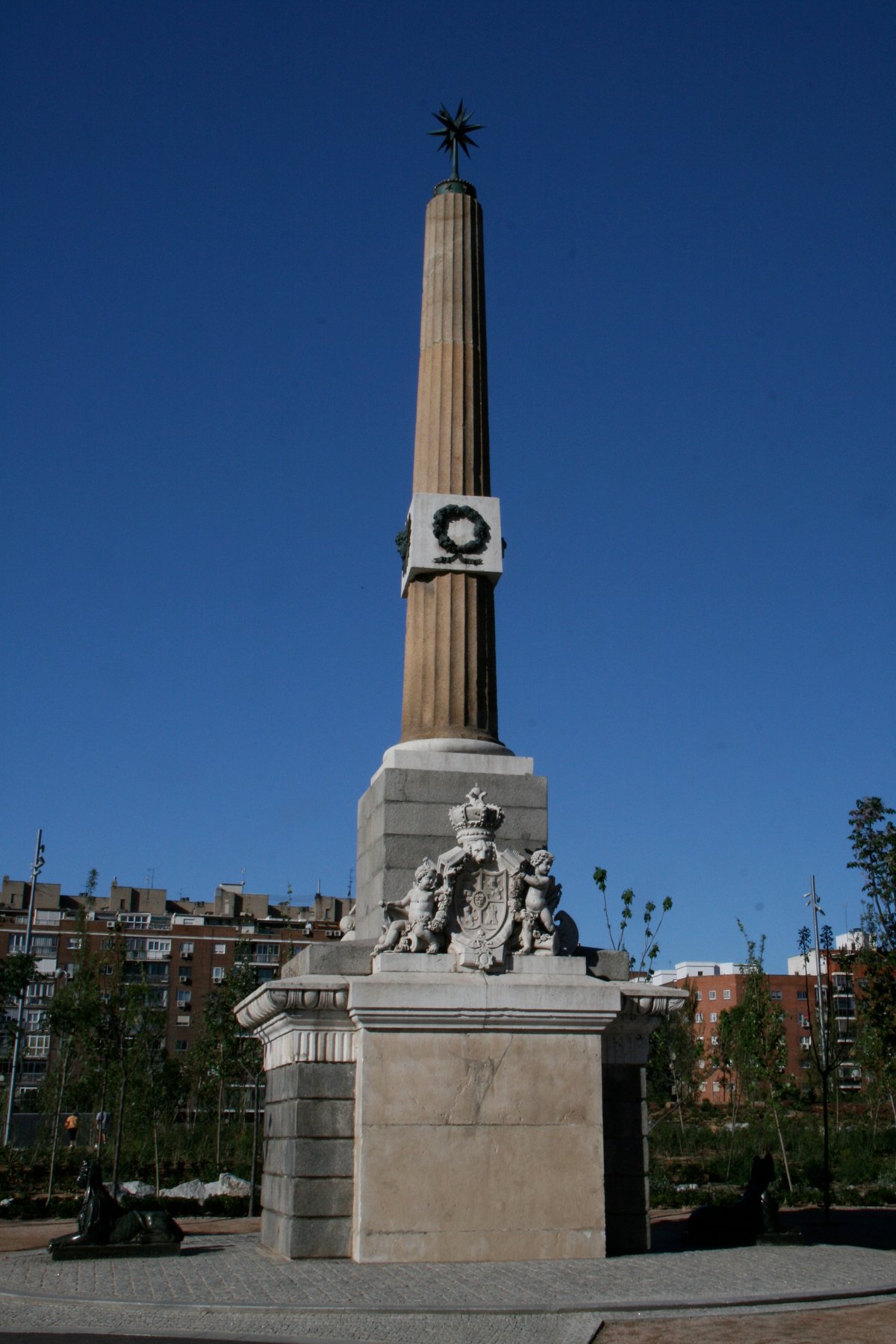

The Obelisk of La Castellana, known as the Obelisk of Fuente Castellana when it was constructed, stands at the edge of Madrid's Parque Madrid Río. Originally positioned in 1838 on the Paseo de la Castellana, it was commissioned by King Fernando VII before his death to celebrate the birth of his daughter, Queen Isabel II. Construction commenced under the regency of María Cristina de Borbón in 1833, and took five years to complete. The project was an impressive example of conmemorative neoclassical architecture constructed in Madrid in the early 19th century.
At the start, the obelisk was intended to be placed at the end of the paseo del Cisne, but it was positioned a little north in a plaza that would eventually be named Plaza del Obelisco and is now the Glorieta de Emilio Castelar. The completed fountain, containing the obelisk, two bronze sphinxes, and a large basin, stood proudly over the newly opened Paseo de la Castellana.
However, the fountain's days were numbered. In 1868, the pilón was replaced by a gardened space, and the sphinxes were relocated to the Retiro. The fountain was dismantled in 1906 to make way for the Monument to Emilio Castelar, and eventually ended up at the Parque de la Arganzuela. In 1914, the fountain was reinstalled in the Plaza de Manuel Becerra, this time with the sphinxes and a circular basin.
The Obelisk of Fuente Castellana was built on shallow land filled with mud, requiring the installation of pilings driven 15 meters deep. The obelisk was the centerpiece of the new park, occupying the central spot of a decorative fountain with a large elliptical pond (106x65 meters) and various water games.
The fountain was closed and water features were halted between 1992 and 1995 for the impermeabilization of the pond. The last remodeling of the fountain took place due to the underground construction of the M-30 highway between 2004 and 2007. The monument was relocated once more as part of the Madrid Río project upon the park's reopening in 2011, to a new spot alongside a promenade with capped cannons.
Sources: Wikipedia, OpenStreetMap, Wikidata, Wikimedia Commons
Written by Nicolo Ciampini
Discuss this with the author and others
No comments yet. Be the first to start the conversation.