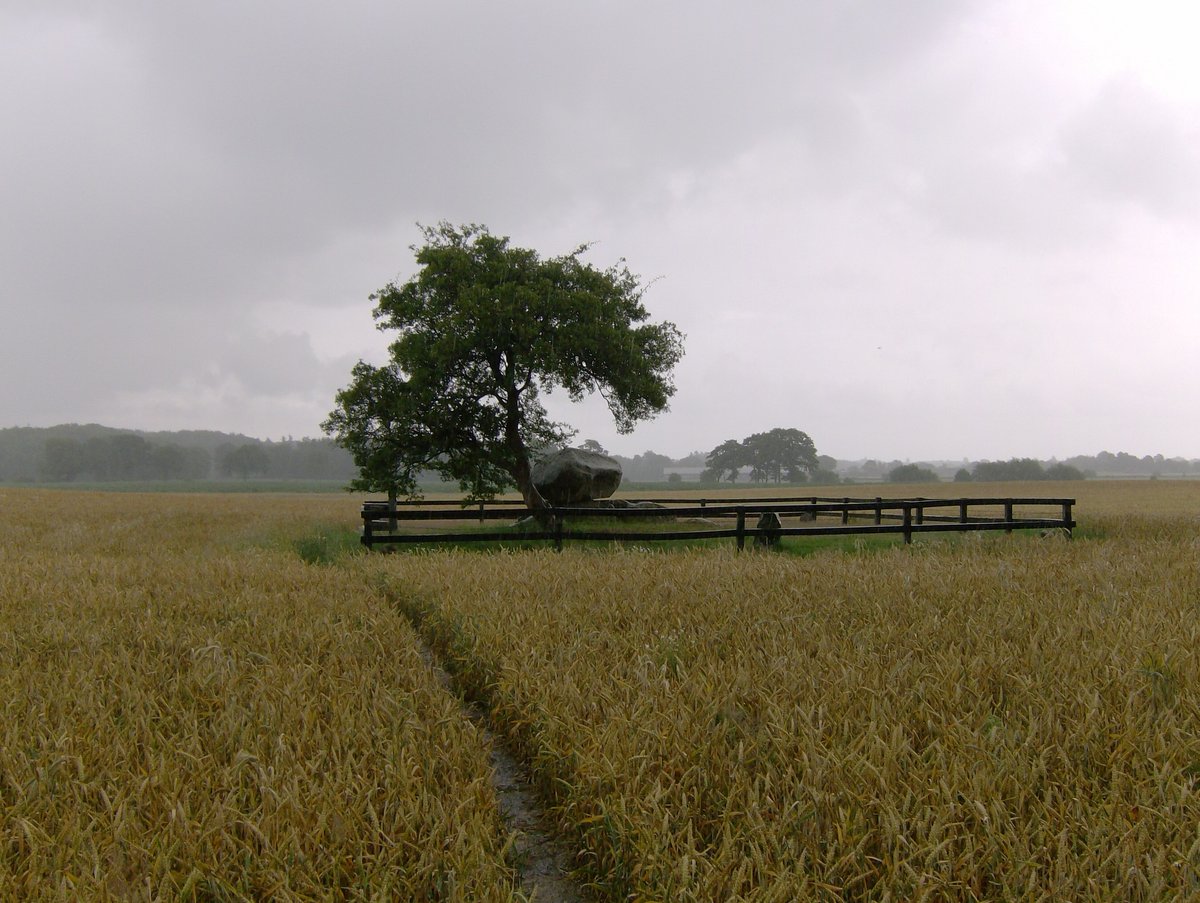
A granite capstone sits heavy over a Neolithic tomb near Helligbek. This is the Poppostein, a megalithic structure built by the Funnelbeaker culture between 3500 and 2800 BCE. It is a sturdy, low dolmen, measuring about 2.4 meters in length, with an interior chamber that measures 2.2 by 1.0 meters. Once covered by a mound of earth, the stones now rest open to the southern sky, bordered by supporting blocks on the narrow sides and at the northern end.
The surface of the capstone bears seventeen small, rubbed depressions. These smooth, bowl-shaped hollows were likely carved by prehistoric hands during ritual acts. Some researchers suggest that the specific chemical composition of this granite led to a belief in the stone's healing properties. It is possible that Neolithic people struck the stone to produce a dust they believed could cure ailments. This intersection of geology and ancient belief transforms a burial site into a prehistoric pharmacy.
Local lore offers a different lineage for the name. Some stories link the stone to Bishop Poppo, who allegedly performed miracles and baptisms in the region during the 10th century. One legend claims a devil hurled a stone at the bishop, while others suggest he preached to heathens from a nearby hill called Kanzel. However, linguists find these stories suspect. They point toward a Low German origin, 'Poppensteen,' where 'Poppe' means child or doll, though the region spoke Danish until the 19th century.
Beyond the individual grave, the site may have functioned as a 'Thingplatz,' an assembly point for the community of Idsted. In pre-Christian times, these stones served as legal markers for judgments and weddings. One theory suggests the depressions on the capstone were made during marriage customs where a sword struck sparks to start a fire - a symbol of blessing for children. This gathering point likely facilitated the region's transition to Christianity, as an old inn once stood nearby to serve the crowds.
Today, the site remains a protected monument. The Danish crown purchased the burial mound in 1859, and the state maintains its preservation. You can still see the six boundary stones placed around the perimeter, their surfaces carved with the Danish coat of arms and the year of the sale. The stones stand as quiet witnesses to thousands of years of shifting faith, from Neolithic rituals to the medieval miracles of Bishop Poppo.
Sources: Wikipedia, OpenStreetMap, Wikidata, Wikimedia Commons


Written by Aurora
Discuss this with the author and others
No comments yet. Be the first to start the conversation.