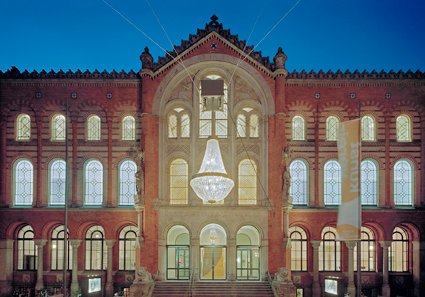
On March 3, 1832, Bernhard Hausmann gathered his circle of art friends in his own gallery to birth an idea: an association to promote visual arts by encouraging public participation and supporting the artists themselves. It was a private venture from the start, a non-profit collective. For its first years, the Kunstverein Hannover leaned into the prestige of the court, finding its patrons among the Viceroys of Hannover. While other movements might have turned inward, this club chose a pro-European orientation. They looked outward toward France, Italy, and Switzerland, inviting international voices into the city's cultural conversation.
By the mid-19th century, the association found a permanent home in the Künstlerhaus in 1856. Every year, the spring exhibitions ran for six weeks, unveiling a massive spread of 400 to 600 works. These shows were windows into the broader continent, featuring artists from the Netherlands and Austria alongside local talent. This internationalist spirit was balanced by a shift in 1907. At the request of the ADKV local group, the association launched autumn exhibitions. These were different - they were local, focusing exclusively on "patriotic" artists born or living within the Kingdom of Hannover.
People joined by purchasing shares, and in return, they received an annual gift. These objects were a tangible connection to the art world, with historical depictions and landscapes making up half of the annual distribution. In the years between 1915 and 1945, the gifts took on more intimate, literary forms. Members received diary pages and letters from Paula Modersohn-Becker, and monographs on figures like Johann Heinrich Ramberg.
As the 20th century matured, Heinrich Tramm became a central figure, serving as the first chairman from 1917 until his death in 1932. He was a man of great influence, shaping the local scene and raising funds from industrial entrepreneurs like Hermann Bahlsen to secure large art purchases. Even as the world fractured, the association maintained its cultural networks. By the mid-1920s, the board began to embrace more radical shifts. Members like Richard Seiffert-Wattenberg and Bernhard Dörries pushed for progressive trends, eventually leading to the first jury-free exhibitions in 1925 and 1926.
These landmark shows broke old rules and embraced the avant-garde. For the first time, the public could see abstract art by Kurt Schwitters and Friedrich Vordemberge-Gildewart within the association's walls. Today, the Kunstverein Hannover remains a non-profit association of roughly 1,500 members, continuing that same long trajectory of mediation and promotion.
Sources: Wikipedia, OpenStreetMap, Wikidata, Wikimedia Commons
Written by Aurora
Discuss this with the author and others
No comments yet. Be the first to start the conversation.