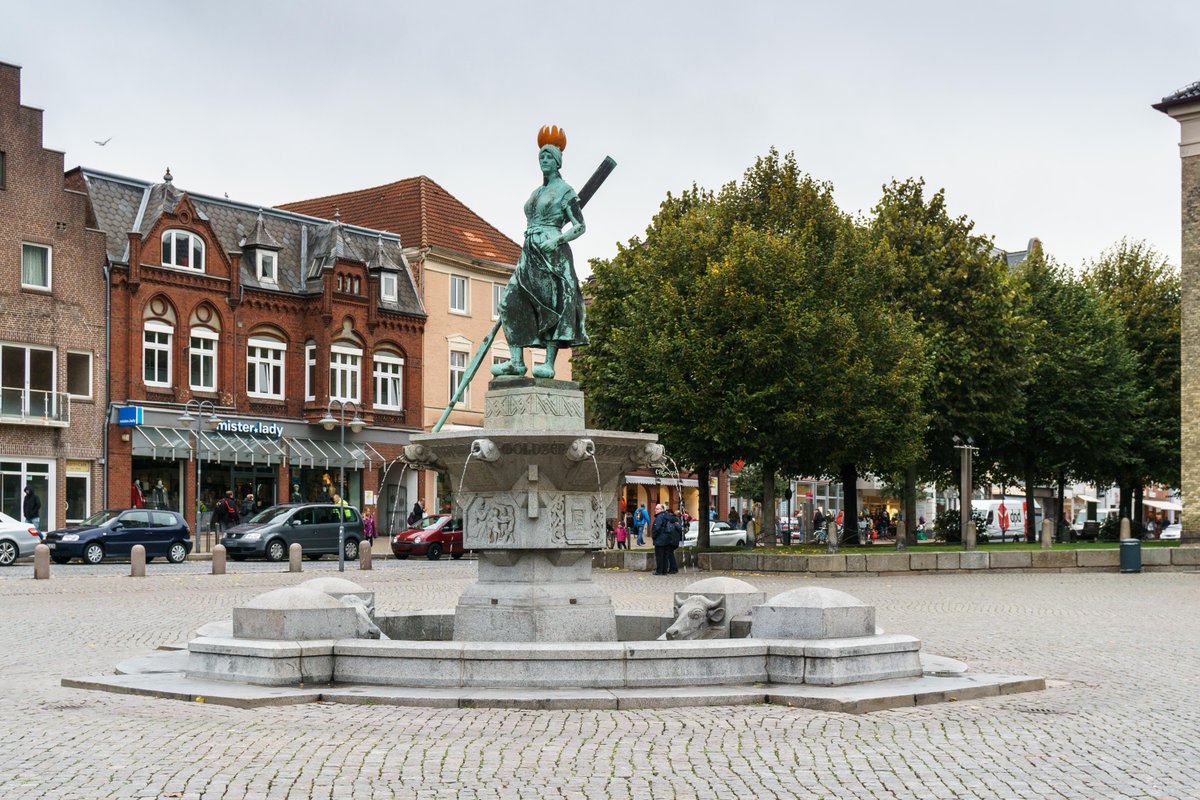
The bronze girl at the center of Husum's market square stands with her back to the crowd, facing the North Sea. She holds an oar and wears traditional Dutch wooden clogs. Most locals call her Tine, a name that has echoed through the streets for over a century, though official records prefer the formal Asmussen-Woldsen-Denkmal.
In 1859, a wealthy local woman named Anna Catharina Asmussen and August Friedrich Woldsen, a shipping merchant and great-uncle of the novelist Theodor Storm, established a trust for the city. A committee to build the monument was founded in 1898. For the face of the monument, the artist Adolf Brütt looked for a real-life inspiration among the townspeople and found Dora Fuchs, a young employee at the local Thomas Hotel.
When the design for the statue reached the ears of the mayor, Adolf Menge, he took issue with the wooden shoes. To him, the footwear were regionally untypical and made a 'poor impression.' He wanted the monument to represent 'proud representation' rather than 'poverty.' He tried to block the clogs, but Brütt stood his ground. The artist argued that a healthy woman's beauty is the greatest wealth regardless of her clothing. The artist won, and when the fountain was inaugurated in October 1902, the girl kept her shoes.
The fountain itself is a study in geometry and local maritime life. The base is built of heavy granite blocks, expanding into an octagonal plate. Around the edges, inscriptions are carved in a medieval Uncial script, and the walls feature reliefs of the coats of arms for the city and the province of Schleswig-Holstein. You can see motifs of a Haubarg and a kindergarten, nods to the trust's ongoing charitable work. Eight fish heads with open mouths serve as the water dispensers, while four ox heads on the basin's edge appear to suck the water back in to keep the level low.
For decades, the fountain was flanked by two wrought-iron candelabras, providing a symmetrical frame for the bronze figure. It wasn't until 1965 that the entire fountain was shifted three meters to the west to make room for a redesign of the marketplace. Today, the statue remains a steady point of reference in the town. She still faces the west wind, a small bronze girl in clogs, marking a victory for an artist's vision over a mayor's aesthetic.
Sources: Wikipedia, OpenStreetMap, Wikidata, Wikimedia Commons



Written by Aurora
Discuss this with the author and others
No comments yet. Be the first to start the conversation.