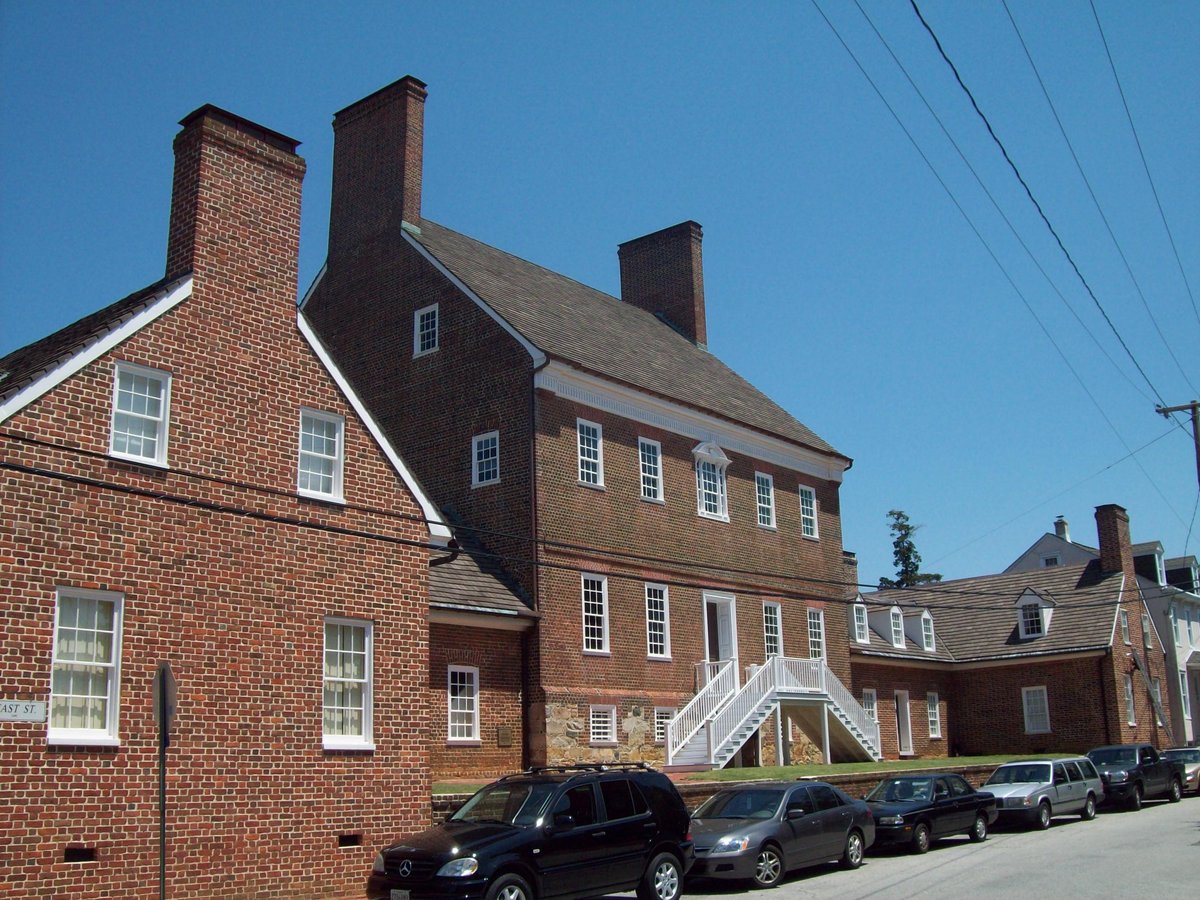
Nestled in the heart of Annapolis is the Brice House, more than just a beautiful relic of the past. Hidden beneath its sturdy brick exterior lie hoodoo caches and spiritual offerings left by African-American slaves who were house servants at the mansion. These items offer a captivating peek into their daily lives and beliefs, a secret that remained hidden until excavations in 1998. The house was built by James Brice, who served as Mayor of Annapolis from 1782-83 and 1787-88 and as acting Governor of Maryland in 1792, and it remains one of the three preserved 18th-century Georgian style brick houses in the city.
The Brice House is a simplified Georgian-style mansion that relies on its elevated site along a narrow street, its scale, and the mass of its brickwork to make it one of the most impressive buildings of its style in the United States. It is a five-part plantation house transplanted to an urban setting. The interior is not symmetrical, featuring an offset central hallway extending halfway into the house. A parlor occupies two bays on the south side, while the ballroom occupies three bays on the north side; the ballroom is among the largest of its kind, larger and more impressive than the ballroom in the similar Hammond-Harwood House.
Interior detailing is late Georgian in style, with designs for the ballroom fireplace thought to have been completed between 1769 and 1772. The house is substantially original in all respects, retaining its plasterwork, glass, woodwork, and flooring. Acquired by Mr. and Mrs. Stanley S. Wohl in 1953, the house underwent restorations in 1953 and 1957. Declared a National Historic Landmark in 1970, the Brice House continues to stand as a significant example of 18th-century architecture.
Sources: Wikipedia, OpenStreetMap, Wikidata, Wikimedia Commons

Written by No Other
Discuss this with the author and others
No comments yet. Be the first to start the conversation.