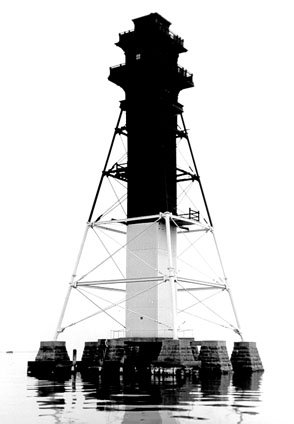

Sitting tall in Baltimore, one of a pair that greets ships into the harbor, is the Craighill Channel Lower Range Rear Light. Back in 1870, Congress appropriated $50,000 to expand the channel, which was named after William Craighill, a lighthouse board member who supervised the surveys for the excavation. While the plan initially involved screw-pile lighthouses, ice in the winter of 1872 - 1873 led to the front light being built as a small caisson structure instead.
The rear light was built on a grid of nine stone piers with a pyramidal iron tower. The central shaft, made of wood timbers sheathed in iron plates, held the staircase to the lantern. This wooden construction faced problems with rotting almost from the start, and as recently as 1994, a Coast Guard study suggested that it be removed. However, with repairs over the years, it remains in place.
The house at the base of the light was reportedly rented out when the light was automated in 1923, and it was finally removed in 1938. Today, the tower remains as a historic protector of Baltimore's nautical history, standing as the tallest lighthouse in the state of Maryland.
Sources: Wikipedia, OpenStreetMap, Wikidata, Wikimedia Commons
Written by Friendly Jane
Discuss this with the author and others
No comments yet. Be the first to start the conversation.