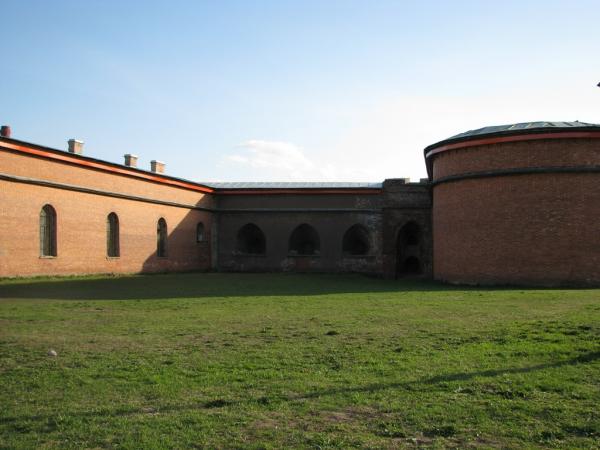
Yusupov Palace - Institute of Railway Engineers Corps - Petersburg State Transport University

Moskovsky Ave., 9b, Saint Petersburg, Russia, 190068

The estate of Prince Yusupov on the Fontanka River in the mid-18th century was one of the wealthiest in the city. On the plot stood a luxurious Baroque palace, whose layout resembled a widely spread letter H. The building, raised on high cellars, combined a central two-story volume with one-story transverse wings, connected by one-story sections. A trellis fence separated the estate from the river.
In 1724, Peter I gifted his associate Yusupov a plot of land between Bolshaya Proseka (Sadovaya Street), the Nameless Yerik (Fontanka River), Tsarskaya Prospekt (Moskovsky Prospekt), and Proseka (Boytsova Lane).
In the 1730s, there stood a one-story wooden house "with nine windows on a high stone basement," built according to a model project by architect Domenico Trezzini. In the 1740s, a stone palace in the Baroque style was constructed. Behind it was a formal garden with ornamental ponds and canals.

The Yusupov estate on the Fontanka River in the mid-18th century was one of the richest in the city. On the plot stood a luxurious Baroque palace, which in plan resembled a widely spread letter H. The building on high cellars combined a central two-story volume with one-story transverse wings, connected by one-story sections. The estate was separated from the river by a trellis fence. On either side of the central driveway alley leading from the palace to Sadovaya Street were large bosquets, the centers of which were marked by ponds of ornamental shapes connected by a canal. A bridge was thrown across the canal along the central axis of the complex. From the ponds to the edges and corners of the bosquets led additional paths bordered by trimmed greenery. The park did not quite reach Sadovaya Street, and the driveway alley passed between small estate buildings facing the street, belonging to other owners. In front of the L-shaped orangery on the Fontanka, there was a small parterre garden with gazebos. The only known image of the palace from that period survives on the axonometric plan by de Saint-Illier.
In 1790, at the request of the owner Yusupov, the palace was rebuilt by architect Quarenghi. Due to the construction of a through embankment and the completion of the Fontanka riverbank improvements, the palace was reconstructed in the 1790s for Prince Nikolai Borisovich Yusupov by architect Giacomo Quarenghi. The architect preserved the palace walls but removed the Baroque decoration and gave the building a classical appearance. He retained the main volumetric divisions of the building (a raised center and lower wings) but completely changed the decorative design of the facades and interiors in the spirit of the time, resulting in a Neoclassical style. On the river side, the architect added service buildings and organized a new enclosed ceremonial courtyard with an entrance from the embankment. Instead of two ornamental wings, he built an open vestibule in the center of the facade with a ramp leading to it. The corner risalits were connected to the raised central loggia, decorated with Tuscan columns. The opposite garden facade was adorned with a six-column portico on a terrace at the first-floor level, accessed by a wide single-flight staircase. The park was redesigned in the landscape style, changing the shapes of the pond shorelines to more natural forms and creating an artificial island. On the site of the former orangery, Quarenghi planned to build a small pavilion with an open semicircular niche facing the Fontanka, a small study, and a hall on the garden side, separated from the rest of the estate by a fence.

In 1810, the Yusupovs sold the palace to the treasury. It housed the Institute of the Corps of Transport Engineers. Between 1836 and 1840, the fence that encloses the building and the adjacent garden on the Sadovaya Street side was made; it was created by engineers Kolman and Trofimovich.

Sources:
https://www.citywalls.ru/house10422.html
https://ru.wikipedia.org/wiki/Дворец_Юсуповых_на_Садовой_улице
Follow us on social media

More stories from Great Architects: Domenico Trezzini

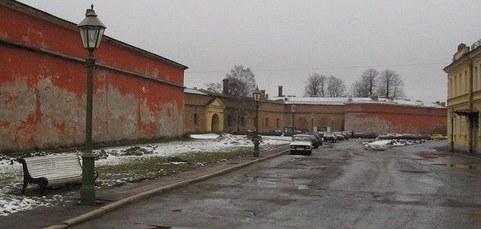
Vasilyevskaya Curtain

ter. Peter and Paul Fortress, 6, Saint Petersburg, Russia, 197198

Part of the fortress wall and a former defensive structure of the Peter and Paul Fortress in Saint Petersburg (Zayachy Island), intended for the defense and protection of the fortress. The curtain wall contains the eponymous Vasilievsky Gate.

Golovkin Bastion

ter. Peter and Paul Fortress, 9, Saint Petersburg, Russia, 197101

The northern bastion of the Peter and Paul Fortress, with its corner, faces directly towards the crownwork. To the east, the bastion adjoins the Kronverkskaya curtain, and to the west – the Nikolskaya.

The Tsar’s Bastion

Peter and Paul Fortress, Tsar's Bastion, Saint Petersburg, Russia, 191186

The Gosudarev Bastion is one of the two eastern bastions of the Peter and Paul Fortress in Saint Petersburg, facing the Neva River. It is connected to the Naryshkin Bastion by the Neva Curtain, and to the Menshikov Bastion by the Petrov Curtain. To the east, the bastion is protected by the Ioannovsky Ravelin and a half-counterguard.

Catherine Curtain

Territory. Peter and Paul Fortress, 6, Saint Petersburg, Russia, 197198

The Catherine Curtain got its name from the Catherine Bastion.

Ioannovsky Gate

X82C+GP Petrogradsky District, Saint Petersburg, Russia

The gates in the Ioannovsky ravelin of the Peter and Paul Fortress in Saint Petersburg. They provide passage from the Ioannovsky Bridge into the fortress through the Petrovskie gates.

Zotov Bastion

terr. Peter and Paul Fortress, 15, Saint Petersburg, Russia, 197198

The western bastion of the fortress, defending the approaches from the Kronverksky Strait, is named after Nikita Zotov. To the east, the Nikolskaya curtain approaches this bastion, while the Vasilyevskaya curtain connects the Zotov bastion with the Trubetskoy.

Kronverkskaya Curtain

ter. Peter and Paul Fortress, 10, Saint Petersburg, Russia, 197101

A section of the fortress rampart, connecting the Menshikov and Golovkin bastions. It faces the Kronverk, from which it gets its name.

Naryshkin Bastion

Peter and Paul Fortress, Saint Petersburg, Russia, 191186

It is located exactly in the center of the southern wall of the Peter and Paul Fortress and faces directly toward the Neva River. This pentagonal defensive structure, with two front walls — facades — and two side walls — flanks, was designed for delivering frontal and flanking fire. It is easily recognizable by its distinctive flagpole tower.

Nevsky Curtain

Peter and Paul Fortress, Saint Petersburg, Russia, 191186

A part (section) of the fortress wall and a former defensive structure of the Peter and Paul Fortress in Saint Petersburg (Zayachy Island), intended for the defense and protection of the fortress, connects the Tsar’s and Naryshkin bastions. It faces the Neva River, which is how it got its name.

Nevsky Gates

Peter and Paul Fortress, Saint Petersburg, Russia, 191186

The gates of the Peter and Paul Fortress in Saint Petersburg, located in the Neva Curtain between the Tsar's and Naryshkin bastions. They connect the fortress with the Commandant's Quay. A monument of classical architecture.

Nikolskaya Curtain

Peter and Paul Fortress, Nikolskaya Curtain Wall, Saint Petersburg, Russia, 197101

The north-western wall of the fortress connects the Golovkin and Zotov bastions. It is also one of the boundaries of the Cathedral Square of the Peter and Paul Fortress.

Petrovskaya Curtain

Territory. Peter and Paul Fortress, 11, Saint Petersburg, Russia, 197101

A section of the fortress rampart connecting the Tsar's and Menshikov bastions. Named after Peter's Gate constructed within it.

Petrovsky Gate

2 Vremeni St., Saint Petersburg, Russia, 197046

The first triumphal gates in Saint Petersburg are located in the Petrovskaya Curtain between the Tsar's and Menshikov bastions. The Petrovskie Gates are the only such structure in the Petrine Baroque style that has survived in Saint Petersburg since the time of Peter I.

Anichkov Bridge and Its Legends

Anichkov Bridge, Nevsky Prospect, Saint Petersburg, Russia, 191025

The bridge over the Fontanka on Nevsky Prospect, with four sculptures of horse tamers, is one of the most recognizable bridges in Saint Petersburg. It was named after a lieutenant colonel whose battalion took part in the construction of the first wooden crossing over the Fontanka. During the construction of the bridge, the battalion was stationed in one of the nearby Finnish villages, which came to be called Anichkova Sloboda. This name was also given to the bridge and to the much later built imperial Anichkov Palace.

The Twelve Collegia Building

Universitetskaya Embankment, 7/9, Saint Petersburg, Russia, 199034

This magnificent building is simply impossible to miss. It is one of the oldest on Vasilievsky Island. An interesting fact is that for nearly two centuries it has housed the state university of Saint Petersburg. Of course, originally the building was intended for completely different purposes. The history of the Twelve Collegia building in Saint Petersburg is closely connected with the development of the state. Its style is a vivid example of early eighteenth-century architecture. Currently, the building is a monument of federal significance.

Galley Harbor

Skippersky Lane, 18, Saint Petersburg, Russia, 199106

In the western part of Vasilievsky Island, there is a unique monument of fortification art — Galernaya Harbor, one of the old landmarks of Saint Petersburg. The Skipper's Canal connects this bay with the Neva Bay.

Summer Palace of Peter I

Building A, Saint Petersburg, Russia, 191186

For the construction of his summer residence, Peter I chose a well-established and advantageously located estate on the cape between the Neva and the Nameless Channel (now the Fontanka River), where the property of Swedish Major E. B. von Konow (Konau) was situated – a small house with a farmyard and a garden. In August 1710, by Peter’s order, construction of a stone building began on the site of the former house, following the design of architect Domenico Trezzini. In 1713–1714, work was carried out on the interior and exterior decoration of the building, in which architect and sculptor Andreas Schlüter may have participated.

Ekateringof Palace

Building 6, letter M, Liflyandskaya St., Saint Petersburg, Russia, 190020

The lost two-story wooden palace on Yekateringof Island, located near Kalinkina Village to the west of the modern Liflyandskaya Street. The architect of the palace was Domenico Trezzini.