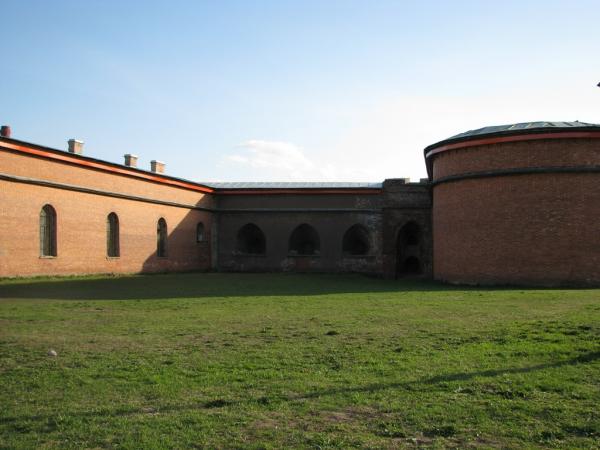
Zotov Bastion

terr. Peter and Paul Fortress, 15, Saint Petersburg, Russia, 197198

The western bastion of the fortress, defending the approaches from the Kronverksky Strait, is named after Nikita Zotov. To the east, the Nikolskaya curtain approaches this bastion, while the Vasilyevskaya curtain connects the Zotov bastion with the Trubetskoy.
The western bastion of the fortress, defending the approaches from the Kronverksky Strait, is named after Nikita Zotov. To the east, this bastion is connected to the Nikolskaya curtain, and the Vasilievskaya curtain links the Zotov bastion with the Trubetskoy bastion.
Nikita Moiseevich Zotov was the first tutor of Tsarevich Peter. Moreover, Zotov took his teaching exam not with just anyone, but with Simeon Polotsky himself. However, the teacher approached the task innovatively. In addition to teaching literacy and reading the Psalter, he boldly introduced "Amusing books with tricks" (illustrations) into the curriculum. Perhaps this explains Peter’s love for various, sometimes peculiar amusements. The tsar truly loved Nikita Moiseevich and affectionately called him "uncle." Zotov was part of the famous Most Jestful, Most Drunken, and Most Mad Assembly. In this blasphemous company, Peter was called the Most Holy Protodeacon, while Nikita Moiseevich held the more significant title of "Archbishop of Pressburg, all of Yauza, and Patriarch of all Kokuy." In the year the fortress was founded on Hare Island, Zotov was in charge of the Tsar’s Near Campaign Chancellery and tried to help with the construction of his bastion as much as he could. But after 10 years, at the age of 70, Zotov completely lost his mind. The count decided to marry the widow of Captain Stremoukhov — Anna. Peter initially did not want to indulge this eccentricity, but eventually, why not. The jester’s wedding of the senile old man was celebrated in fitting style. Zotov did not live to see the completion of the fortress; he died in 1718. But Peter’s amusement did not end there. The tsar forced the new patriarch of the Most Jestful Assembly — Nikita Buturlin — to marry Zotov’s widow.
The wooden-earth bastion was built in 1703; between 1707 and 1709, the right part of the bastion was rebuilt in stone. From 1727 to 1729, by the personal decree of Peter II and under the direction of B. Kh. Minikh and D. Trezzini, the remaining parts of the bastion were reconstructed. It is a defensive structure of pentagonal shape with two front walls — facades — and two side walls — flanks, designed for frontal and flanking fire. A stone ramp — a slope — for raising guns and ammunition onto the fortress wall was built in 1752. Between 1832 and 1834, according to a project by engineer K. I. Opperman, the outer walls were re-faced with bricks and plastered to look like granite. Until the end of the 18th century, the combat casemates of the bastion served as warehouses. Additionally, the bastion housed the services of the Garrison and Secret Chanceries, and its rooms were used as solitary confinement cells until the mid-19th century. Furthermore, it contained workshops and a forge for the fortress Engineering team, the archive of the Main Treasury, the archive of the Provisions Expedition, and later an artillery armament warehouse. At the beginning of the 20th century, there was a fortress sundries shop and workshops of the engineering team.
Sources:
https://wikimapia.org/9606541/ru/place
https://izi.travel/ru/270c-zotov-bastion/ru
http://www.world-art.ru/architecture/architecture.php?id=2540
Follow us on social media

More stories from Great Architects: Domenico Trezzini

Vasilyevskaya Curtain

ter. Peter and Paul Fortress, 6, Saint Petersburg, Russia, 197198

Part of the fortress wall and a former defensive structure of the Peter and Paul Fortress in Saint Petersburg (Zayachy Island), intended for the defense and protection of the fortress. The curtain wall contains the eponymous Vasilievsky Gate.

Golovkin Bastion

ter. Peter and Paul Fortress, 9, Saint Petersburg, Russia, 197101

The northern bastion of the Peter and Paul Fortress, with its corner, faces directly towards the crownwork. To the east, the bastion adjoins the Kronverkskaya curtain, and to the west – the Nikolskaya.

The Tsar’s Bastion

Peter and Paul Fortress, Tsar's Bastion, Saint Petersburg, Russia, 191186

The Gosudarev Bastion is one of the two eastern bastions of the Peter and Paul Fortress in Saint Petersburg, facing the Neva River. It is connected to the Naryshkin Bastion by the Neva Curtain, and to the Menshikov Bastion by the Petrov Curtain. To the east, the bastion is protected by the Ioannovsky Ravelin and a half-counterguard.

Catherine Curtain

Territory. Peter and Paul Fortress, 6, Saint Petersburg, Russia, 197198

The Catherine Curtain got its name from the Catherine Bastion.

Ioannovsky Gate

X82C+GP Petrogradsky District, Saint Petersburg, Russia

The gates in the Ioannovsky ravelin of the Peter and Paul Fortress in Saint Petersburg. They provide passage from the Ioannovsky Bridge into the fortress through the Petrovskie gates.

Kronverkskaya Curtain

ter. Peter and Paul Fortress, 10, Saint Petersburg, Russia, 197101

A section of the fortress rampart, connecting the Menshikov and Golovkin bastions. It faces the Kronverk, from which it gets its name.

Naryshkin Bastion

Peter and Paul Fortress, Saint Petersburg, Russia, 191186

It is located exactly in the center of the southern wall of the Peter and Paul Fortress and faces directly toward the Neva River. This pentagonal defensive structure, with two front walls — facades — and two side walls — flanks, was designed for delivering frontal and flanking fire. It is easily recognizable by its distinctive flagpole tower.

Nevsky Curtain

Peter and Paul Fortress, Saint Petersburg, Russia, 191186

A part (section) of the fortress wall and a former defensive structure of the Peter and Paul Fortress in Saint Petersburg (Zayachy Island), intended for the defense and protection of the fortress, connects the Tsar’s and Naryshkin bastions. It faces the Neva River, which is how it got its name.

Nevsky Gates

Peter and Paul Fortress, Saint Petersburg, Russia, 191186

The gates of the Peter and Paul Fortress in Saint Petersburg, located in the Neva Curtain between the Tsar's and Naryshkin bastions. They connect the fortress with the Commandant's Quay. A monument of classical architecture.

Nikolskaya Curtain

Peter and Paul Fortress, Nikolskaya Curtain Wall, Saint Petersburg, Russia, 197101

The north-western wall of the fortress connects the Golovkin and Zotov bastions. It is also one of the boundaries of the Cathedral Square of the Peter and Paul Fortress.

Petrovskaya Curtain

Territory. Peter and Paul Fortress, 11, Saint Petersburg, Russia, 197101

A section of the fortress rampart connecting the Tsar's and Menshikov bastions. Named after Peter's Gate constructed within it.

Petrovsky Gate

2 Vremeni St., Saint Petersburg, Russia, 197046

The first triumphal gates in Saint Petersburg are located in the Petrovskaya Curtain between the Tsar's and Menshikov bastions. The Petrovskie Gates are the only such structure in the Petrine Baroque style that has survived in Saint Petersburg since the time of Peter I.

Yusupov Palace - Institute of Railway Engineers Corps - Petersburg State Transport University

Moskovsky Ave., 9b, Saint Petersburg, Russia, 190068

The estate of Prince Yusupov on the Fontanka River in the mid-18th century was one of the wealthiest in the city. On the plot stood a luxurious Baroque palace, whose layout resembled a widely spread letter H. The building, raised on high cellars, combined a central two-story volume with one-story transverse wings, connected by one-story sections. A trellis fence separated the estate from the river.

Anichkov Bridge and Its Legends

Anichkov Bridge, Nevsky Prospect, Saint Petersburg, Russia, 191025

The bridge over the Fontanka on Nevsky Prospect, with four sculptures of horse tamers, is one of the most recognizable bridges in Saint Petersburg. It was named after a lieutenant colonel whose battalion took part in the construction of the first wooden crossing over the Fontanka. During the construction of the bridge, the battalion was stationed in one of the nearby Finnish villages, which came to be called Anichkova Sloboda. This name was also given to the bridge and to the much later built imperial Anichkov Palace.

The Twelve Collegia Building

Universitetskaya Embankment, 7/9, Saint Petersburg, Russia, 199034

This magnificent building is simply impossible to miss. It is one of the oldest on Vasilievsky Island. An interesting fact is that for nearly two centuries it has housed the state university of Saint Petersburg. Of course, originally the building was intended for completely different purposes. The history of the Twelve Collegia building in Saint Petersburg is closely connected with the development of the state. Its style is a vivid example of early eighteenth-century architecture. Currently, the building is a monument of federal significance.

Galley Harbor

Skippersky Lane, 18, Saint Petersburg, Russia, 199106

In the western part of Vasilievsky Island, there is a unique monument of fortification art — Galernaya Harbor, one of the old landmarks of Saint Petersburg. The Skipper's Canal connects this bay with the Neva Bay.

Summer Palace of Peter I

Building A, Saint Petersburg, Russia, 191186

For the construction of his summer residence, Peter I chose a well-established and advantageously located estate on the cape between the Neva and the Nameless Channel (now the Fontanka River), where the property of Swedish Major E. B. von Konow (Konau) was situated – a small house with a farmyard and a garden. In August 1710, by Peter’s order, construction of a stone building began on the site of the former house, following the design of architect Domenico Trezzini. In 1713–1714, work was carried out on the interior and exterior decoration of the building, in which architect and sculptor Andreas Schlüter may have participated.

Ekateringof Palace

Building 6, letter M, Liflyandskaya St., Saint Petersburg, Russia, 190020

The lost two-story wooden palace on Yekateringof Island, located near Kalinkina Village to the west of the modern Liflyandskaya Street. The architect of the palace was Domenico Trezzini.