
Good Doctor Aibolit and the real Jewish doctor Tsemakh Shabad
Mėsinių St. 5, 01135 Vilnius, Lithuania
Lithuania: Vilnius: Ruins of the Lithuanian Jerusalem Jermaine
 For Browsing
One of the old nicknames of Vilnius is the Lithuanian Jerusalem: in the 18th-19th centuries, it became the unofficial capital of Yiddishland, the intellectual and spiritual center for Yiddish-speaking people. In the interwar period, nearly a third of its population consisted of Jewish families. It was a true golden age for Yiddish culture: the city was home to Jewish scholars and rabbis, with more than 100 synagogues and prayer houses. During the war, the Jewish community of Lithuania was destroyed by 94% — a horrific figure even in the context of the entire Holocaust, and today almost nothing remains to remind us of its existence. When Jews first appeared in Vilnius is now uncertain — the earliest mention of Jewish merchants, who even had their own guest courtyard, dates back to 1326, but these merchants were likely outsiders. The first Jewish cemetery is mentioned in 1483, but overall, the Grand Duchy of Lithuania, contrary to popular belief, was not very eager to allow Jews within its borders. In fact, Jews in the Polish-Lithuanian Commonwealth were a direct consequence of the "nobles' democracy," or rather the weakness of the Polish-Lithuanian merchant class itself, so magnates preferred to invite foreigners for the despised trade — whether Tatars and Karaites in Lithuania, Armenians in Galicia, or Jews in Crown Poland. Jewish expansion into Lithuania began in 1593 with a decree from King Sigismund Vasa, allowing Jews to own property and open synagogues here. However, the first Vilnius synagogue is known from 1572, and by 1592 it was burned down during a pogrom. The building of the Great Synagogue, which stood until the war, was constructed between 1630-33, and over time it became the center of Yiddishland. But the events that turned Vilnius into the Northern Jerusalem began in the 18th century in Ukraine, in Medzhybizh. This concerns the emergence of a new Jewish movement — Hasidism, which arose largely as a consequence of the Khmelnytsky Uprising: before the war, Jews referred to the pogroms carried out by the Cossacks during the Ukrainian-Polish war as the Catastrophe, in which up to one hundred thousand people died. Just as after the Holocaust in the 20th century, Ukrainian Jews could no longer live as before after Khmelnytsky, speaking of the imminent end of the world and the coming of the Messiah, which became fertile ground for the new teaching. But Khmelnytsky's devastation did not affect Lithuania (including Belarus), so the worldview there was somewhat different: Hasidim, with their reverence for the tzaddik ("righteous one," the spiritual leader of the community), tales, and dances, seemed to the Litvaks like savagery bordering on paganism. Here arose the opposite movement, the Misnagdim ("opposition"), where, as had been customary for centuries, the knowledge of the Torah was paramount. The Litvaks were led by Eliyahu ben Shlomo Zalman, better known as the Vilna Gaon ("genius") — he was born near Brest, studied in Kėdainiai, traveled extensively among European communities, engaging with the most enlightened Jews and studying primary sources, and finally settled in Vilnius in 1745, where, even without being a rabbi, he soon gained enormous authority and influence — his ideas were even embraced by the nobleman Valentin Potocki, who converted to Judaism and was, according to legend, burned at the stake for it in 1749. However, the Judaism of the Vilna Gaon was not only orthodox but also enlightened. The characteristics of the Litvak shtetls gave rise to yeshivas that were enormous for their time. The Vilna yeshiva was even elevated in 1873 to the Jewish Teachers' Institute, while the "ordinary" teachers' institute in Vilnius opened only in 1876. As a result, in the 19th century Vilnius became not an economic center (like Odessa or Kyiv), nor even a spiritual one (like Uman or Berdychiv), but precisely the intellectual center of Yiddishland. Even the well-known Ilya Efron (who, together with Brockhaus, published the famous encyclopedia) was a great-grandson of the Vilna Gaon. In 1864, Jews were allowed to settle throughout the city, but the Northern Jerusalem reached its peak outside the Russian Empire. In 1915 (under the "first" Germans), the Jewish Philharmonic was formed (also serving as a drama theater and the sports society "Maccabi"), the building of which now houses the Jewish Museum on Novogrudskaya Street. And in the former income house of Yanov on Bolshaya Pogulyanka, the Jewish Scientific Institute opened in 1925, which since 1940 has been located in New York and is engaged in researching the cultural heritage of European and American Ashkenazi Jews (primarily the Yiddish language, literature, and folklore). There were Jewish hospitals, sports halls, gymnasiums, old people's homes, and much, much more. Even from the remnants of the Lithuanian Jerusalem, one could walk for a whole day.
Jermaine Loading stories…
Mėsinių St. 5, 01135 Vilnius, Lithuania
Lithuania: Vilnius: Ruins of the Lithuanian Jerusalem Jermaine 
Agrastų St. 15A, 02243 Vilnius, Lithuania
Lithuania: Vilnius: Ruins of the Lithuanian Jerusalem Jermaine 
J. Basanavičius St. 16, 03224 Vilnius, Lithuania
Lithuania: Vilnius: Ruins of the Lithuanian Jerusalem Jermaine 

Sudervės St. 28, 07191 Vilnius, Lithuania
Lithuania: Vilnius: Ruins of the Lithuanian Jerusalem Jermaine 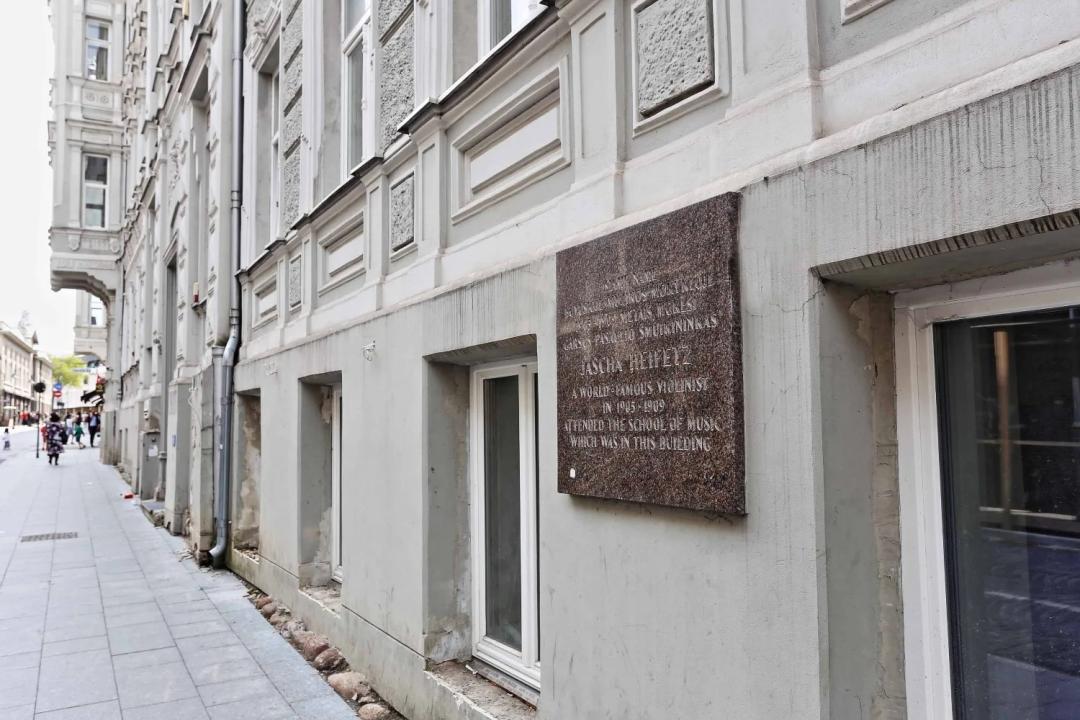
Vilniaus St. 25, 01402 Vilnius, Lithuania
Lithuania: Vilnius: Ruins of the Lithuanian Jerusalem Jermaine 

Olimpiečių St. 1, 09200 Vilnius, Lithuania
Lithuania: Vilnius: Ruins of the Lithuanian Jerusalem Jermaine