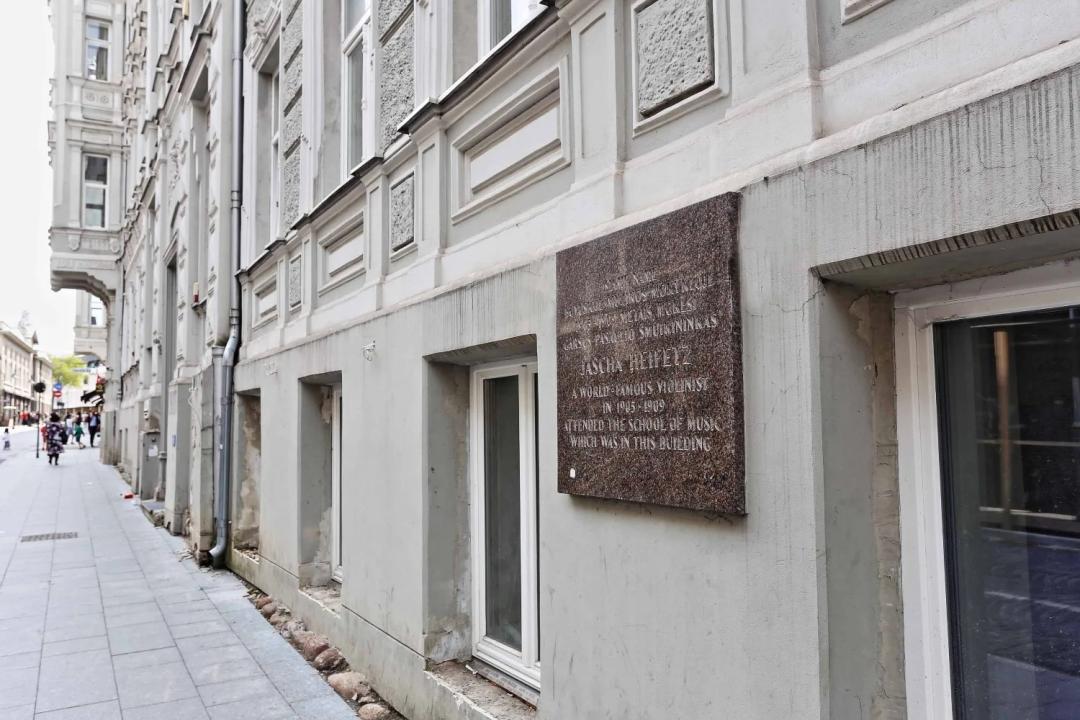
The first headquarters of the Institute for Jewish Research (YIVO)

J. Basanavičius St. 16, 03224 Vilnius, Lithuania

YIVO is an organization that preserves, studies, and teaches the cultural history of Jewish life throughout Eastern Europe, Germany, and Russia, as well as orthography, lexicography, and other research related to Yiddish.

In 1925, Max Weinreich founded the headquarters of YIVO (the Institute for Jewish Research) in one of the rooms of this building. This organization preserves, studies, and teaches the cultural history of Jewish life throughout Eastern Europe, Germany, and Russia, as well as orthography, lexicography, and other research related to Yiddish. It was founded in 1925 in Vilna in the Second Polish Republic (now Vilnius, Lithuania) as the Yiddish Scientific Institute (Yiddish: ייִדישער וויסנשאַפֿטלעכער אינסטיטוט, Latinized: Idisher Visn), where the word "Idisher" means both "Yiddish" and "Jewish".

Soon, YIVO became the largest Jewish scholarly institution in the world. Members of the institute’s honorary presidium included world-renowned outstanding scientists and public figures: A. Einstein, Z. Freud, E. Bernstein, and others. YIVO played an important role in the development of Jewish (Yiddish) philology and the preservation of Jewish heritage in Eastern Europe.

Its English name became the Institute for Jewish Research after moving to New York, but it is still mainly known by its Yiddish acronym. YIVO is now a partner of the Center for Jewish History and acts as the de facto recognized language regulator of the Yiddish language in the secular world. The YIVO system is commonly taught at universities and is known as klal shprakh (Yiddish: כּלל־שפּראַך, literally "standard language"), and sometimes as "YIVO Yiddish" (Yiddish: ייִוואָ־ייִדיש).

YIVO is dedicated to spreading knowledge about the current history of Jewish life, with special attention to the history and culture of Eastern European Jewry — the ancestors of a significant portion of Jews in the modern world.

Sources:

https://www.yivo.org/about-1

https://en.wikipedia.org/wiki/YIVO
 

Follow us on social media

More stories from Lithuania: Vilnius: Ruins of the Lithuanian Jerusalem

Good Doctor Aibolit and the real Jewish doctor Tsemakh Shabad

Mėsinių St. 5, 01135 Vilnius, Lithuania

Who didn’t read about the kind Doctor Aibolit in childhood, the one who treated unfortunate little animals? He is one of the most famous characters created by Korney Chukovsky. However, the hero is not just a product of the author’s imagination; in his traits, the children’s writer forever immortalized his good friend and truly kind doctor Cemach Shabad. Who he was and how he earned both a fairy tale and a monument, read here.

Mass killings in Ponary (Paneriai) (more than 70,000 people)

Agrastų St. 15A, 02243 Vilnius, Lithuania

Mass shootings by the Nazis and Lithuanian collaborators of the Jews of Vilnius, Soviet prisoners of war, and resistance fighters in the forest near the village of Ponary (also known as Upper Ponary) during World War II. It should be emphasized that among the victims of Ponary were fifteen thousand Poles, including, among others, the Vilnius intelligentsia, such as professors of the Stefan Batory University in Vilnius, as well as fighters of the Home Army:

Vilnius Gaon - a brilliant thinker and great researcher

Žydų St. 5, 01131 Vilnius, Lithuania

The Vilna Gaon, or Eliyahu ben Shlomo Zalman, holds an exceptional place in Jewish history as one of the most outstanding thinkers and scholars of his time. His life and works left an indelible mark on the religious and intellectual tradition of the Jewish people. Vilnius, which in the 18th century was the cultural and spiritual center of Eastern European Jewry, became the place from which the ideas and teachings of the Gaon spread throughout the world. The era in which the Vilna Gaon lived was a time of significant change in Europe. It was a period when the Enlightenment and scientific discoveries actively influenced European society, including Jewish communities. In this environment, the Gaon occupied a unique position, combining a deep commitment to traditional Jewish teachings with an interest in science and philosophy. The historical context in which the Gaon lived was characterized by significant changes and challenges for the Jewish people. Against the backdrop of frequent pogroms, persecutions, and forced migrations, Jews sought to preserve their cultural and religious identity. In these conditions, the importance of leaders like the Gaon grew many times over. Their authority and knowledge were essential for maintaining communities and passing traditions on to future generations. Thus, examining the life and legacy of the Vilna Gaon is important not only for understanding 18th-century Jewish thought but also for assessing how his ideas continue to influence the modern Jewish world.

The incredible story of Count Potocki, who became a Jew and was burned for his faith

Sudervės St. 28, 07191 Vilnius, Lithuania

Among the people who converted to Judaism, there were many prominent figures. For many, such a step meant signing their own death sentence. Count Valentin Potocki (Ger-Tsedek) — a Polish nobleman who became a Jew — a young man disillusioned with Catholicism, is an example of such a proselyte. He was burned at the stake by the verdict of the Vilnius church court for converting to Judaism.

The Violin of Jascha Heifetz

Vilniaus St. 25, 01402 Vilnius, Lithuania

There have always been plenty of them, little Jewish boys with violins in their hands, whom weighty and authoritative masters helped to grow. But few managed to rise so boldly, live so brightly, and die so lonely, leaving behind an immortal memory. In 1901, Jascha Heifetz was born in Vilnius, recognized as one of the greatest violinists of the 20th century. Jascha Heifetz’s biography is divided into two parts: a small but outstanding early Russian period and a great overseas success. Europe and America could follow the mature violinist, but knew nothing about his childhood, which was impressive. Heifetz was literally made for biographers.

Vilnius Ghetto

Žydų St. 3, 01131 Vilnius, Lithuania

The Vilnius Ghetto was one of the Jewish ghettos established by the Nazis in Lithuania during World War II. During its two years of existence, its population, which numbered about 40,000 people, was almost completely annihilated. Only a few hundred inmates managed to escape by fleeing to the forests and joining Soviet partisans or hiding with sympathetic local residents.

Shnipishki Jewish Cemetery

Olimpiečių St. 1, 09200 Vilnius, Lithuania

The first Jewish cemetery in Vilnius, established in 1487 and closed in 1831. It is now inactive. The area covers the entire territory where the current Sports Palace stands, which was built directly on the cemetery grounds. The cemetery land was originally legally purchased by the Jewish community and belongs to it. (After Lithuania regained independence, despite new laws, the deed of sale-purchase for the land on which the cemetery is located has never been revoked.)