
At the beginning of 1914, just a few months before the outbreak of World War I, American violinist Albert Spalding accidentally met his famous colleague Fritz Kreisler, who was at the height of his fame. The latter looked somewhat depressed and admitted that he was considering ending his artistic career. The American was extremely surprised, as Kreisler was considered at that time the world’s leading violinist and was not yet forty years old. When asked what prompted such thoughts, Kreisler said that he had recently been to Russia and attended a class evening of Leopold Auer at the Petrograd Conservatory. Among many talented youngsters, he was especially struck by a thirteen-year-old boy. Kreisler found his playing so perfect that all other violinists simply had nothing more to do in comparison.

Of course, this story, which became a legend, is not without exaggeration, especially since Kreisler continued to delight his admirers for a long time after that, and other violinists of different generations certainly did not remain without work. Nevertheless, the great artist’s intuition did not deceive him.
The boy, whose name was Jascha Heifetz, indeed grew into an incomparable artist, considered by many to be the greatest of our century.
Joseph (Jascha) Heifetz was born on January 20 (old style) – February 2 (new style), 1901, in Vilnius. He received his first violin lessons at the age of three from his father, Reuven Heifetz — a self-taught violinist from the town of Pulawy (Poland), who played at weddings. From the age of four, he studied under one of the best violinists and teachers in the city, I. Malkin, a pupil of Auer, who taught at the Vilnius Music School of the Russian Musical Society. Heifetz’s talent developed rapidly. In 1906, he first performed at the exhibition “Art in the Life of Children,” and on December 7 performed Zingel’s “Pastoral Fantasy” at a school evening, and on December 12 — Berio’s “Aria with Variations.”

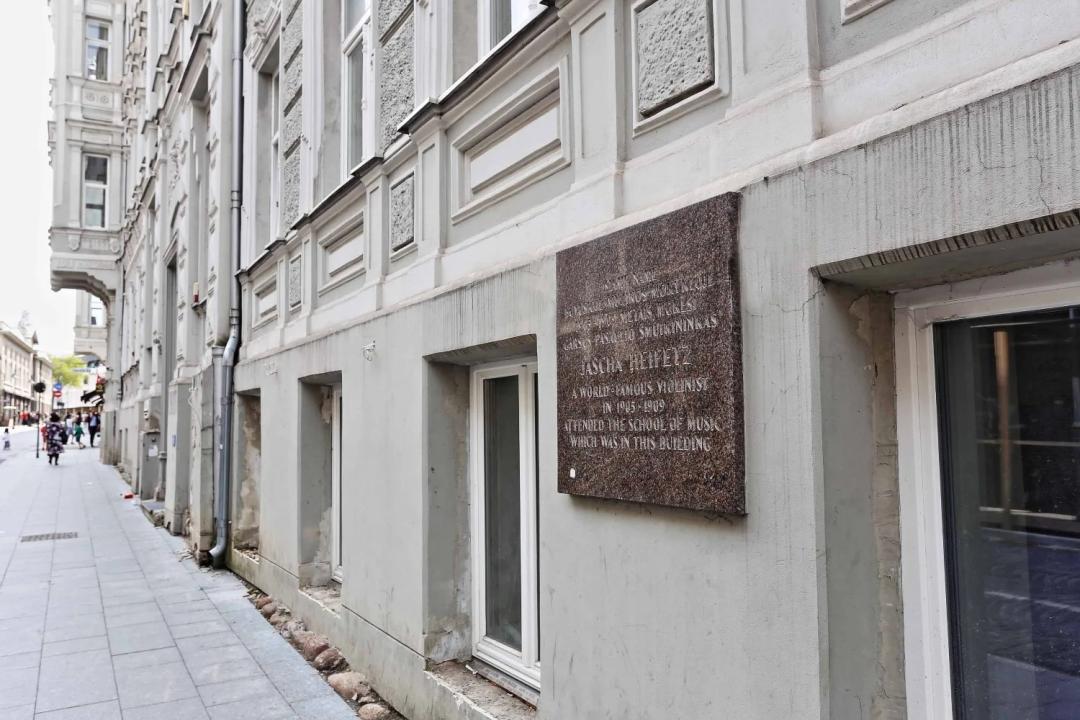
From 1906 to 1909, virtuoso violinist Jascha Heifetz studied at the Vilnius Music School, which at that time was located at house number 25 on Vilniaus Street.
In 1908, he played Wieniawski’s “Ballade and Polonaise,” and Auer, who heard him, highly praised the young violinist’s playing. The following year, Jascha performed Mendelssohn’s concerto with an orchestra in Kaunas. That same year, he graduated from the music school. The Vilnius Jewish Society provided great assistance in Heifetz’s education. It also funded the family’s move to St. Petersburg and the young man’s admission in 1910 to the St. Petersburg Conservatory in Auer’s class.
During his first year, Heifetz studied with Auer’s assistant, I. Nalbandyan, then transferred to the professor’s class. On April 17, 1911, Heifetz made his debut in the Small Hall of the conservatory. This same concert was performed in mid-May at the Pavlovsky station. Soon concerts followed in Odessa, as well as in Warsaw and Łódź. That year, the first record was released featuring the playing of the ten-year-old artist — Schubert’s “Bee” and Dvořák’s “Humoresques.”
The beginning of Heifetz’s worldwide fame was marked by seven concerts in Berlin, where he performed with the Berlin Philharmonic Orchestra under the direction of V. Safonov and A. Nikisch. Another eight concerts took place in other German cities — Dresden, Hamburg, as well as in Prague. Despite playing on a 3/4 size violin, Heifetz amazed listeners with a full sound of extraordinary beauty and expressiveness, brilliant virtuosity and ease of execution, energy, and impeccable taste. Critics already noted his serious achievements in interpretation.
In the summer of 1912, Jascha spent time with Auer in Loschwitz (near Dresden), where he performed Bach’s Double Concerto together with Seidel. German critics called Heifetz “the Angel of the Violin.” On November 4, in Grünwald, the young musician’s playing was recorded on phonograph cylinders (now kept at the Pushkin House in St. Petersburg). That same year, he performed in Warsaw at the Artists’ Exhibition. In 1913, he performed in Moscow, Vilnius, Leipzig, and Vienna. On January 21 the following year, he played Glazunov’s concerto for the first time in St. Petersburg under the composer’s baton. During these years, the entire Heifetz family (they also had two daughters, one of whom studied piano at the St. Petersburg Conservatory) lived off Jascha’s earnings. Auer encouraged the boy’s performances, believing they would not harm him, as he considered him already a formed artist. The family was caught in Germany at the outbreak of World War I. The young violinist was offered to give concerts for the benefit of wounded German soldiers, but he refused. Then the Heifetz family members were declared prisoners and only managed to return home after four months.
In 1915, Heifetz performed repeatedly in Petrograd. He was already a recognized virtuoso, astonishing with the perfection of his playing and impeccable style. The summer of 1916 was spent with Auer in Norway. An American impresario, captivated by his playing, signed a contract with the young violinist for performances in the USA the following year.
The route to America due to the war went through Siberia. On July 8, the Heifetz family (except the daughters) sailed from Vladivostok to Japan, and from there to America.
On October 27, Heifetz made his debut at Carnegie Hall with incredible success. Critics noted that “the large audience included all professional violinists within a 200-mile radius,” that Heifetz’s art “transcends the boundaries of the possible,” that it was a “radiant prophecy,” that Heifetz was a “true genius,” a “concentration of the highest violinistic and musical qualities,” and that his playing was “penetrating beauty.”
Indeed, the main quality characterizing Heifetz was perfection in everything. In short, he was the “Paganini of the 20th century.” Heifetz became the “idol of the American public” and gave more than thirty concerts in New York alone in one year. His art was captured on ten records. The following year, nine more recordings appeared. All of them captured his playing on the Tononi violin, which Heifetz had played since the age of thirteen.
At one of the first concerts, a gentleman approached him and offered Jascha to play on a Stradivarius violin owned by that man, and Heifetz readily agreed. Two years later, Heifetz bought the violin from that gentleman, who did not wish to reveal his name, for a good price. Over time, he bought another Stradivarius and before the war supplemented his “violin arsenal” with a Guarneri violin. These three violins served Heifetz until the end of his career, although he occasionally played other violins.
Jascha quickly “Americanized,” spoke without an accent, drove a luxurious sports car, played tennis and ping-pong, and soon acquired a motorboat. In general, this period of life resembled a belated childhood — his normal childhood had been taken away by his prodigy career.
This inevitably affected the violinist’s self-discipline and quality of performance. He writes in his autobiography: “There came a time when a lack of discipline in practice caught up with me. In 1921, after one of my concerts in New York, music critic W. J. Henderson from the New York Times published a critical review. He wrote that I had fallen in the opinion of the public and in his opinion and that I must watch myself, that it is not enough to play the piece — one must think about it. That I have a duty to myself and to music that will never be repaid. I knew that this man wished me well; what he described was a painful blow for me because it was true. I began to practice seriously, I abandoned my youthful extravagance. I will always be grateful to Henderson. He knocked the nonsense out of me and set me on the right path. Critics can sometimes do useful things. He died a few years ago, and I will always regret not having met him.” Apparently, one must be an extraordinary person to take such a lesson and write about it this way. In 1925, Heifetz became an American citizen, and in 1929 he married the famous American movie star Florence Arto. The following year their daughter Josephine was born, and in 1932 their son Robert.
By the late 1930s, the violinist claimed to have circumnavigated the globe four times and twice reached the moon in terms of the length of his routes. In 1920, he performed for the first time in London, and the following year made a large tour of Australia. In 1922, 1924, and 1925, he again gave concerts in England; in 1923, he had a long tour in the East. In 1926, he toured South America and the Middle East. He played with the best orchestras in the world and received the highest fees among performers. In 1933, the premiere of M. Castelnuovo-Tedesco’s Second Violin Concerto “The Prophet,” dedicated to Heifetz, took place. The New York Philharmonic Orchestra was conducted by A. Toscanini, who highly valued the violinist’s talent.
Heifetz always behaved cautiously, including in political matters. This allowed him to maintain good relations with the Soviet regime. He was not considered a White émigré or a defector and was one of the few to visit the USSR during the first Soviet-American thaw in 1934. Passing through fascist Germany, he refused to perform there. The artist’s six concerts in Moscow and Leningrad, performances before conservatory students (where he also answered questions), were met with great success. His playing largely overturned established ideas and had a noticeable influence on performance and pedagogy.
At that time, the famous critic M. Sokolsky wrote: “What impresses most in Heifetz’s playing is his technique, an enormous, admirable virtuoso mastery. This technique is extremely diverse, mathematically precise and even. His tone is amazingly strong, rich, and deep. Heifetz knows no insurmountable difficulties in his art. The ease with which he overcomes all technical obstacles is captivating. Moreover, the effortlessness and freedom of Heifetz’s mastery, though somewhat cold and strict, are such that they can sometimes mislead; an uninitiated listener might truly believe that what Heifetz plays is easy and simple. But one must really know, for example, what exceptional difficulties Paganini’s 24th Caprice presents for a violinist to fully appreciate the utterly dazzling, fabulous mastery with which he performs this piece.”
In 1938, Heifetz appeared in the feature film “Shall Play Musik,” playing himself. This is the first video recording of the great artist’s playing. In 1939, the violinist performed Walton’s concerto dedicated to him for the first time.
In 1940, he bought a house in Beverly Hills, as well as a small cottage nearby in Malibu on the ocean shore. That same year, he began teaching at the University of Southern California and toured South America. During World War II, Heifetz, together with Rachmaninoff, Panov, Andersen, Piers, and other musicians, performed frequently in hospitals and before soldiers.
In 1945, Heifetz divorced his wife, and in early 1947 married Frances Spiegelberg. The following year their son Joseph was born. In 1950, a film about Heifetz was shot — a meeting with students of the University of California. The second thaw in Soviet-American relations, which occurred in the 1950s, passed without Heifetz; by then his political loyalties belonged entirely to Israel. To a significant extent, his funds were used to build a concert hall and conservatory in Haifa.

Heifetz was a versatile musician. He played piano excellently, often accompanied his classmates in Auer’s class, worked for a time as a conductor at the Metropolitan Opera in New York, and composed music for some films.
Heifetz was a cheerful person, as they say, “the life of the party.” He greatly enriched not only the library of musical recordings but also the musical folklore.
Once Soviet musicians asked him what he thought of David Oistrakh.
— He is undoubtedly the best Soviet violinist and the second best violinist in the world, came the reply.
— Who is first? — the natural question arose.
— Well, there are many firsts.
Alongside the classical violin repertoire, Heifetz included many popular melodies in his concerts. Among friends, he did not disdain the accordion. He even composed a popular song of his time, “When You Make Love to Me” — initially under a pseudonym, but later he could not resist revealing his authorship, to the horror of many of his adoring philharmonic elderly ladies.
Gradually, Heifetz reduced his tours. A major event was his performance of Beethoven’s concerto on December 9, 1959, at the UN during one of the organization’s anniversaries.
In 1962, Heifetz divorced his second wife and further reduced the number of his solo concerts — that year he performed only six times but recorded a lot of chamber music. In 1968, he practically stopped performing. In an interview, Heifetz said: “I have exhausted my share of touring. I no longer have interest in this career.” The last performances of Heifetz, recorded on film, took place in 1970. In 1972, Heifetz gave a farewell concert in Los Angeles. Three years later, the maestro underwent shoulder surgery, which deprived him of the ability to play. Heifetz died in Beverly Hills on October 16, 1987.
Sources:
https://jewish.ru/ru/people/culture/917/
https://www.lzb.lt/ru/2021/02/02/120-лет-со-дня-рождения-яши-хейфеца-импер/


Written by Jermaine
Discuss this with the author and others
No comments yet. Be the first to start the conversation.