

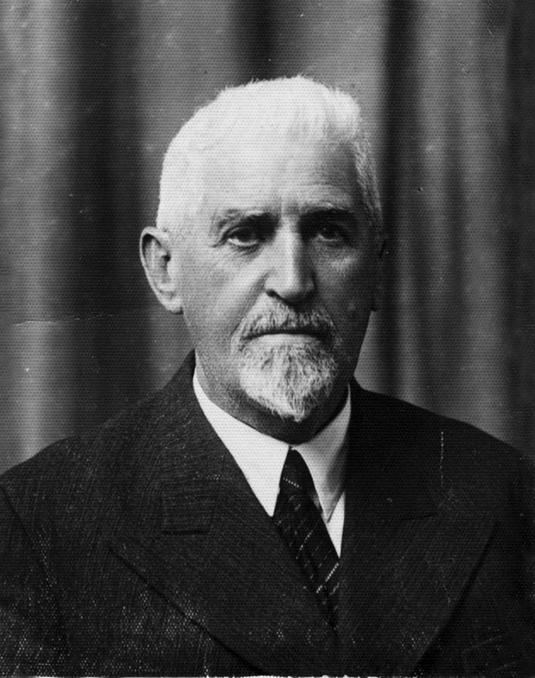
Tsemah Yoselevich Shabad, or as he was called in the Russian manner, Timofey Osipovich, was originally from Vilnius. He was born in 1864, but already in 1881 moved with his parents to Moscow. There he first graduated from gymnasium, and then from the medical faculty of Moscow University. After receiving his diploma as a doctor and pharmacist, he started a practice in Moscow, and later, as an epidemiologist, went to the Volga region to fight a cholera epidemic.
Since 1894, Timofey Osipovich returned to Vilna (as the capital of Lithuania was called at that time) and continued to engage in private medical practice, which resembled more of a selfless labor without sleep or rest, and also served in the Jewish hospital.
The doctor treated everyone who came to him and never took money from the poor. He went on calls at any time, in any weather. On his initiative, free cafeterias were opened in eleven schools in Vilna — more than a thousand children ate lunch there every day; shelters for orphans and children's health camps were established. Shabad organized a city campaign called "A Drop of Milk." Its essence was that needy mothers of infants were given clothes and food free of charge.
He created a branch of the "Society for the Protection of the Health of the Jewish Population" in Vilna, headed the branch of the "Jewish Colonization Society," which helped settlers move to Turkish Palestine. Gradually, he earned a reputation not only as a good and experienced therapist but also as a selfless and kind person. He provided help regardless of social status or occupation, treating both crooks and vagrants.
Korney Chukovsky wrote in 1967 in his memoirs "How I Wrote the Fairy Tale 'Doctor Aybolit'": "I wrote it a very, very long time ago. And I conceived the idea to write it even before the October Revolution because I met Doctor Aybolit, who lived in Vilna. His name was Doctor Shabad. He was the kindest person I ever knew in my life. He treated poor children for free. Sometimes a thin little girl would come to him, and he would say to her:
— Do you want me to write you a prescription? No, milk will help you, come to me every morning, and you will get two glasses of milk. And in the mornings, I noticed, there was a whole queue for him. Children not only came to him themselves but also brought sick animals. So I thought, how wonderful it would be to write a fairy tale about such a kind doctor. Of course, Doctor Shabad did not go to Africa; I made up the part about him meeting the evil robber Barmaley."
Yes, not being a veterinarian, Timofey Osipovich could not refuse help to animals either. Thus, the kind Doctor Aybolit appeared.
In 1905, Doctor Shabad supported the revolution, for which he spent 6 months in prison and was then exiled from the country. He studied at the universities of Vienna, Heidelberg, and Berlin. He continued his medical career in Germany. Founder of the Health Society, several Jewish general education schools. He was one of the founders of the Jewish Scientific Institute. He returned to Russia in 1907. Member of the Vilna lodge "Unity," which was part of the Grand Orient of the Peoples of Russia. Later a member of the Vilna city municipality. During World War I, he served as a military doctor at the front. Moreover, Timofey Osipovich always stood up for the poor. From the very beginning of his practice, he encountered terrible conditions in the poor quarters. Therefore, he not only treated for free but also organized free meals for the poor, proposed distributing dairy products to young mothers (the "Drop of Milk" campaign), opened children's shelters, published hygiene pamphlets, and, of course, advocated for accessible medicine for low-income city residents. During the Second Polish Republic, he was elected to the Vilna city municipality (1919) and the Polish Sejm (1928–1930) from the Nationalities Bloc (Ukrainians, Jews, Germans, and Belarusians of Poland), which won 55 seats.
But this did not help the doctor himself. By cruel irony, during one of the operations, Timofey Osipovich accidentally cut himself, which led to blood poisoning. The doctor could not be saved; he died at the age of 71.

This is the kind of person who inspired Korney Ivanovich to create such a beloved character. Doctor Aybolit fully embodied the selflessness and kindness of his prototype.
Interestingly, the slogan "Cleanliness is the key to health" in a slightly modified form repeats the principles of Timofey Osipovich. He taught his patients: "Neatness is a condition for survival." Largely thanks to this, in the quarters where Shabad practiced, and later in the Vilnius ghetto, there were practically no outbreaks of infectious diseases. He managed to do enormous work on medical and hygienic education of the population and wrote many journalistic articles on hygiene.
Shabad did not see the horrors of World War II, as he died in 1935 from blood poisoning. Thirty thousand people followed his coffin. Shops and government offices were closed that day.
And 72 years later, in Vilnius, on a street near the Old Town where the kind doctor once lived, a bronze monument appeared. Most city visitors simply pass by, not understanding who it is and considering the monument just an element of urban design, a small city sculpture. It is a man in a coat and hat, and next to him a girl holding a cat in her arms.
The inscription on the pyramid next to it reads: "To the citizen of the city of Vilnius, Doctor Tsemah Shabad, the prototype of the kind Doctor Aybolit."
As for the monument, it was installed on the initiative of the famous descendants of Doctor Aybolit: Tsemah Uriel Vaynreich, Maya Plisetskaya, Anna Pavlova, and Mikhail Botvinnik. The funds for the creation of the monument were provided by the international "Litvaks Fund" — as Jews who lived and live in Lithuania call themselves.
The figures of Shabad and the girl with the cat in her arms stand right on the sidewalk: there is no pedestal or fence. This creates the impression that the doctor is alive and real, standing among people. He went out for a walk, as he used to, and stopped to talk with a patient. By the way, the sculptor Romas Kvintas did not choose the monument’s subject by chance. He embodied in bronze one of the stories from Shabad’s life.
Once he was called to a girl from a poor family. Timofey Osipovich, after examining the patient, diagnosed: "Systematic malnutrition," and, having gone home, brought her broth and bread. When the girl recovered, she brought and gave the doctor the most precious thing she had — her cat. There is another similar story: "One morning, three crying children came to the doctor. They brought him a cat whose tongue had been pierced by a fishing hook. The cat was wailing. Its tongue was covered in blood. Timofey Osipovich armed himself with forceps, inserted some kind of spacer into the cat’s mouth, and with a very skillful movement pulled out the hook."
Sources:
https://ru.wikipedia.org/wiki/Shabad,_Timofey_Osipovich
https://dzen.ru/a/Yn0H5kmCRFKAENtn
https://www.lzb.lt/ru/2015/02/05/famous-litvaks-tsemah-shabad/
https://lt.baltnews.com/vilnius_news/20160912/1016161503.html
https://www.chukfamily.ru/kornei/prosa/articles/how-i-wrote-the-fairy-tale-doctor-aybolit



Written by Jermaine
Discuss this with the author and others
No comments yet. Be the first to start the conversation.