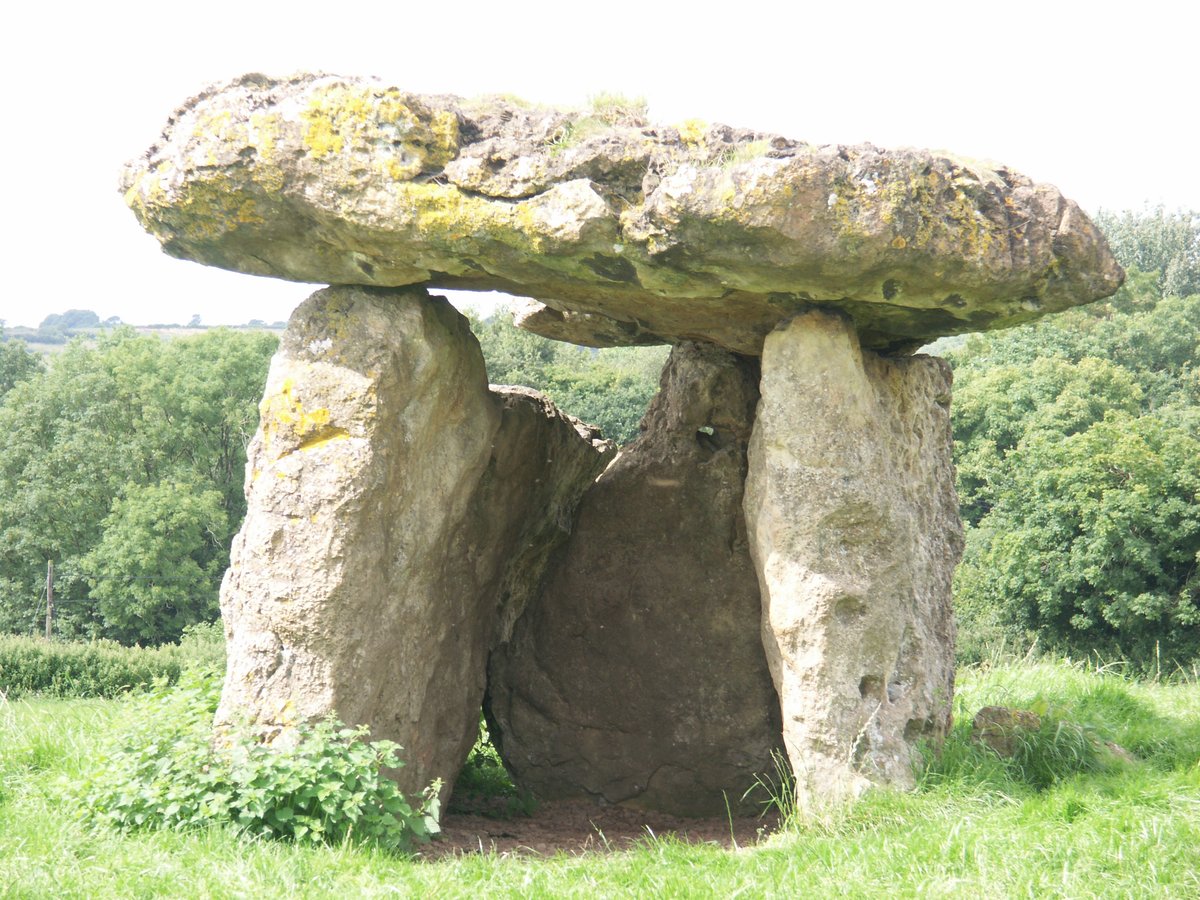
The St Lythans burial chamber, located in the Vale of Glamorgan, Wales, is a single stone megalithic dolmen built around 4000 BC. It stands at the eastern end of a 27-metre long, 11-metre wide earthen mound, forming part of a chambered long barrow. This chamber tomb is a dolmen, the most common form of megalithic structure in Europe. The tall stone, still twisted from the weight of the earth pressing down on it, has three upright stones supporting a large, flat capstone.
All the stones are made of mudstone, probably sourced locally. The capstone, which slopes downwards from southeast to northwest (the left side of the entrance towards the back right), measures 4 metres long, 3 metres wide, and 0.7 metres thick. The two facing, rectangular uprights have been smoothed off, and there is a port-hole at the top of the triangular rear stone. The burial chamber has a minimum internal height of 1.8 metres. It is in an east/west alignment, with the entrance facing east.
This site is in a field called Maesyfelin and lies about half a mile west of the hamlet of St Lythans, near Dyffryn Gardens, and about one mile south of Tinkinswood burial chamber.
Sources: Wikipedia, OpenStreetMap, Wikidata, Wikimedia Commons
Written by Nicolo Ciampini
Discuss this with the author and others
No comments yet. Be the first to start the conversation.