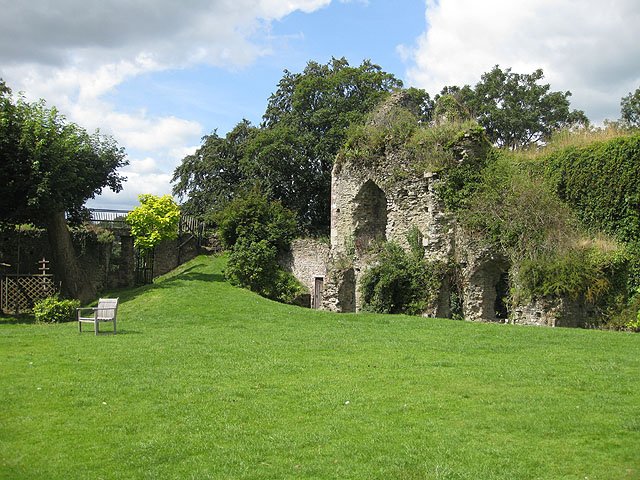

Usk Castle sits on a hill overlooking the town of Usk in Monmouthshire, south-east Wales. The site has a long history of military significance, as the Romans established an early Legionary fortress here before relocating it to Caerleon. Following this, the Normans established the castle and town around 1120. The Welsh captured the site in 1138 and again in 1174 during a period of open conflict in the Welsh Marches.
Various Marcher Lords held the castle, including Richard Fitz Gilbert de Clare, who was killed north of Abergavenny in 1136 while seeking to strengthen the defenses. Another holder, Gilbert de Clare, 7th Earl of Hertford, was killed at the Battle of Bannockburn. Adam of Usk was born at the castle. After the rebellion of Owain Glyndŵr (1400–1405), the castle passed to the Duchy of Lancaster, and no further redevelopment was undertaken for some time, allowing it to gradually decay.
In the 1680s, the gatehouse was adapted into a house, now known as Castle House. Today, the remains of the castle are substantial and include a dovecote tower. The gardens feature unusual elements, including the site of a small narrow-gauge railway from the 1930s and two disarmed Elia naval mines from World War II set on plinths. While the house is a private residence, the castle gardens are open to visitors on three days each week.
Sources: Wikipedia, OpenStreetMap, Wikidata, Wikimedia Commons



Written by Nicolo Ciampini
Discuss this with the author and others
No comments yet. Be the first to start the conversation.