

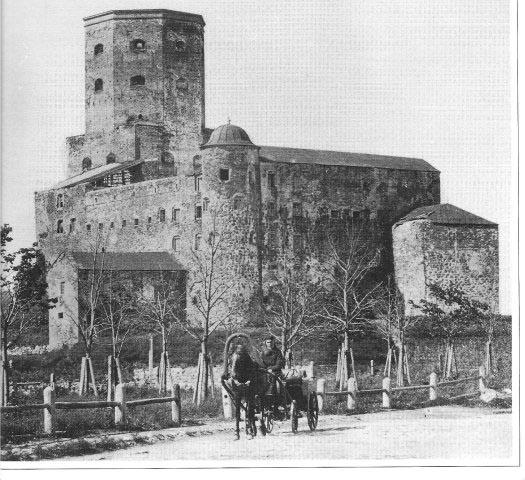
The history of the monument to Marshal Torgils Knutsson, the founder of Vyborg Castle, is full of adventures, just like his own life. In 1203, he ordered the construction of a new outpost of Swedish expansion on the narrow isthmus between Lake Ladoga and the Gulf of Finland with a single purpose — to cut off Novgorod from the trade route to the Baltic Sea. The next step was the construction of the Landskrona fortress at the mouth of the Neva, but it lasted only a year, while Vyborg survived and flourished. The regent of the underage King of Sweden, occupied with state affairs, most likely never visited here and ended his days on the scaffold, executed by his own protégé on a false accusation.
The monument romantically named "The Bronze Knight" is considered the first monument of Vyborg and is one of the city's unique attractions. The sculpture of this military figure was installed in 1908 on the modern square of the Old Town Hall in Vyborg. However, the monument was destined to be erected twice and, in general, to go through a rather difficult path.
The author of the monument is the Finnish sculptor Karl Wilhelm "Ville" Valgren. In his execution, the Swedish Marshal Torgils (Torkel) Knutsson is depicted standing on a high round granite pedestal. The figure’s face is turned toward Vyborg Castle, which he founded. The posture of the figure was given a bold and martial appearance. The marshal’s right arm is slightly extended to the side, its hand gripping the hilt of a rapier lowered downward. In his left hand, he holds a shield pressed to his thigh. Knutsson wears a battle helmet on his head. The Swedish shield is shaped like a triangular "petal" and its height-to-width ratio is 2 to 1. In old times, such a shield was meant to protect a mounted warrior from chin to knees. Triangular shields appeared in the 13th century. The shield bears a heraldic lion. On the feet of the founder of Vyborg Castle are simple "awl-shaped" spurs on a strap passed under the heel and over the top of the foot. The monument is small and concise but has a quite expressive silhouette. In scale, it successfully fits into the open medieval city square.
The initiative to erect a monument to the founder of Vyborg Castle — Torgils Knutsson — was taken by the Vyborg architect and keen antiquarian Jakob Ahrenberg. At that time, he was developing a project to restore the ruined Vyborg Castle. The architect was passionate about a romantic interpretation of Vyborg’s history and was literally at its origins. Ahrenberg was firmly convinced of the historical authenticity of the monument. Like many domestic intellectual patriots, the architect saw an urgent need to carry out activities to popularize knowledge about the history of the native land and preserve it. Jakob Ahrenberg actively participated in organizing the construction of the monument to Torgils Knutsson. On December 5, 1884, a literary evening was held, during which fundraising for the monument began. The money collected from ticket sales — 300 marks — went toward the monument. Ahrenberg was so enthusiastic about the idea that he agreed to carry out the project for reconstructing the square in front of the monument to the Swedish marshal free of charge. The architect sketched and measured the ancient buildings of Vyborg. He also depicted all the medieval residential houses and even structures that had survived multiple fires and reconstructions. Jakob Ahrenberg’s charitable work was colossal. The funds raised allowed an order to be placed with Finnish architect Ville Valgren for making a model, which, unfortunately, stood for a long time and deteriorated: the clay dried out and cracked. The sculptor made a new model. But this work was already valued at as much as 3,000 marks. Then financial difficulties began with the installation, followed by others.
Valgren went to his homeland — Paris. He created the monument in his Parisian workshop. Preparatory work was completed in 1887. A year later, a cast of bronze-plated plaster was delivered from Paris directly to Vyborg.
Discussions with the clients about casting were ahead. Since the summer of 1888, the model was exhibited in the Vyborg museum under the names "Knight," "Courage," and other quite harmless titles. But a series of major difficulties began.
The fact is that the idea of erecting a monument to the Swedish conqueror did not please the military commandant of Vyborg — Major General Mikhail Lavrentyevich Dukhonin, who was also supported by Governor-General Count Fyodor Heyden. Here is what Ahrenberg wrote in his memoirs: “Heyden knew perfectly well that the plaster statue was ready and was in Vyborg. But if he was weak enough to fear Dukhonin, he was also magnanimous enough not to declare war on art...”
The media began to vigorously discuss and constantly stir up the topic of erecting such a monument in Vyborg. The petition to install the monument was rejected. Moreover, it provoked Emperor Alexander III to issue the Highest Decree on July 15, 1890, "on the non-erection of monuments in public places without the Highest permission." Fortunately for the initiator and organizer Ahrenberg, two circumstances accelerated the process of erecting the monument, which, alas, were also tragic. Pharmacist Johann Casimir von Zweigberg died in 1896. He bequeathed 167,000 Finnish marks to Vyborg and specified that the money could be spent on decorating the city. The municipality formed a monetary fund from the bequeathed money, part of which — 30,000 marks — was used for casting the monument.
The general strike of 1905, which triggered revolutionary processes in the country, and the Sveaborg uprising in 1906 showed that Russian revolutionaries were actively engaged in the Grand Duchy of Finland. All this somewhat eased the political situation. After the Vyborg city council appealed to Emperor Nicholas II, permission was granted to erect the monument, despite opposition from Russian military and civil authorities.
In 1907, the sketch of the monument to Torgils Knutsson — the Swedish marshal and founder of Vyborg Castle — received the highest approval in Tsarskoye Selo. Sculptor Valgren again went to Paris, where the monument was cast in bronze. In 1907, Ville wrote to Jakob: “Old Torkel Knutsson is being cast in bronze these days — on your initiative, the order for the hero was made 20 years ago... Honor and glory and thanks to you, my friend.”
The original granite pedestal for the monument was designed by architect Karl Segerstadt. The landscaping and preparation of the square in front of the Old Town Hall took place in spring 1908.
The monument to Torgils Knutsson was solemnly unveiled on October 4, 1908. The event was timed to coincide with the celebration of Swedish Day in Vyborg. This day was then celebrated for the first time by the public and was observed in all cities of the Grand Duchy of Finland, as well as in St. Petersburg. The holiday had no political undertones. People simply celebrated the day of Swedish culture and identity.
During World War II, Vyborg repeatedly changed hands between countries: in 1940, Finland handed the city over to the USSR; in 1941, Finnish troops occupied Vyborg; in 1944, at the end of the Soviet-Finnish war, it again became part of the Soviet Union. Remarkably, throughout all these years, the monument remained in its original place.
But the post-war year 1948 came, and the city authorities of Vyborg asked the command of the signal battalion stationed in Vyborg Castle to dismantle the monument to Torgils Knutsson from the square, which was promptly done. No one knew where it was taken. The monument was searched for a long time by employees of the Vyborg Local History Museum. Only in 1975 did they manage to find the heavily damaged monument. It lay in one of the sheds of the city improvement plant of Vyborg, located on the eastern shore of Salakka-Lahti Bay.
That same year, it was moved to Vyborg Castle, where the museum was located. Even there, it was stored in the basement under the main tower of St. Olaf for a long time. Finally, in 1991, restoration of the monument began.
The revived monument was unveiled in the year of the 700th anniversary of Vyborg Castle — July 2, 1993. However, already the following year, in spring 1994, vandals broke off and stole the rapier. Some time later, the rapier was laid at the foot of the monument by the thieves themselves, and workers of the Vyborg Shipbuilding Plant attached it back to the figure, placing it in the right hand of Torgils Knutsson — the Swedish marshal and founder of Vyborg Castle.
Sources:
https://peterburg.center/maps/pamyatnik-torgilsu-knutssonu-v-vyborge.html



Written by Jermaine
Discuss this with the author and others
No comments yet. Be the first to start the conversation.