

The history of military conflicts between Russia and Sweden is full of events that significantly changed the fate not only of the warring states but also of the people who took part in these confrontations. Starting from the early Middle Ages, irreconcilable neighbors disputed with each other. The eternal "Baltic question" was the cause of clashes between Russia and its no less aggressive northwestern neighbor. In these battles, both sides forged their military glory, and both fully tasted the bitterness of defeat, but the participants in these military events were, of course, primarily warriors and commanders.
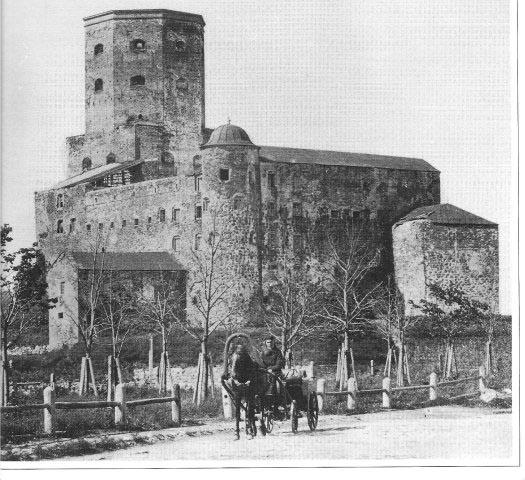
Anyone interested in the history of Vyborg knows the name of the Swedish hero, knight Knut Posse. The personality of this figure is shrouded in numerous legends and is truly iconic. Much less often can one hear about his opponent. And although the Russian voivode Daniil Vasilyevich Shchenya suffered defeat and failed to take Vyborg, this is probably the only serious failure in his military career. It cannot diminish the significance of this figure, both for the history of the Moscow state and for the entire military history of the Middle Ages!
In the spring of 1492, still in the midst of the Russo-Lithuanian war, "by the order of Grand Prince Ivan Vasilyevich, a town was founded on the German border, opposite the German town of Rugodiv on the Narva, on Divichya Hill on the Sluda, quadrangular, and named Ivanograd." Ivanograd (Ivangorod) became a stumbling block for many years in the international relations of Rus with the Baltic region countries. The development of Russian maritime trade seriously worried the Hanseatic League. Relations with Sweden were also complicated; like the Hanse, the Swedes were alarmed by the appearance of a rapidly developing Russian city on the Baltic. And the alliance of Ivan III with the Danish king made another Russo-Swedish war inevitable.
In July 1495, Russian advance detachments were sent to Karelia. Having destroyed the small wooden-earth Swedish fortress Kivennapa, by September a strong Moscow army approached Vyborg itself.
Its strength, according to both domestic and foreign researchers, was about 10,000 men. Sometimes figures of 60,000 or even 80,000 fighters are mentioned, but this picture does not seem realistic. The large size of the Russian army made its composition heterogeneous; it included Moscow, Novgorod, and Pskov regiments. The core of the Moscow detachments were the "boyar children," i.e., service nobles. Mostly horsemen, they were likely well-armed and experienced. The commanders of the Pskov and Novgorod detachments were the governors of these regions. In the year 7004 (1496), the great prince Ivan Vasilyevich of all Rus sent his voivodes Prince Daniil Vasilyevich Shchenya, Yakov Zakharich, and Prince Vasily Fedorovich Shuisky with the Pskovian army against the Germans on Swedish land near the city of Vyborg."
It is worth mentioning artillery separately. By the end of the 15th century, it had already become a separate branch of the military. The centers of Russian cannon production were Pskov and Moscow. As in all of Western Europe, unreliable iron guns were being replaced by new bronze ones in Rus. Russian artillery for the first time equaled European standards. Under the guidance of foreign specialists, Russian craftsmen produced not only small field cannons but also gigantic siege and fortress guns that amazed with their size. It is known that in the Vyborg campaign of 1495, the Russian army included a large "detachment," whose main weapon was a cannon 24 feet long.
At the head of the entire Russian army stood voivode Daniil Vasilyevich Shchenya, and this was his first campaign as a military operation commander. Apparently, Ivan III considered the voivode's combat experience sufficient to appoint him to such a high and responsible post. At the time of the siege, he was about 36 years old.
The defense of Vyborg was commanded by knight Knut Jonsson Posse of a noble Swedish family. By that time, he also had extensive combat experience, having participated in many battles, including the Battle of Brunkeberg against the forces of Danish King Christian I in 1471. The city's garrison, according to various sources, numbered from 1,000 to 3,000 men. These were the castle knights/commandant's retinue, the city guard, peasant militia from the Nyland region, as well as a detachment of 500 German mercenaries hired by Sten Sture to defend Vyborg, under the command of Captain Hartvig Winholt. Bishop Magnus of Åbo sent his small detachment of Swedes, knights serving the state, under the command of Magnus Frille, to the fortress. According to Swedish historian Erik Hunburg, a significant part of the rest of the Finnish nobility also gathered in Vyborg, though their number is not specified.
Despite the army's size, the siege was a difficult test for the Russian voivode. The local population was hostile to the invaders. A significant part of the forces had to be allocated to defend the stretched communications. Knut Posse initially conducted quite active defense. There are reports that he even wanted to meet the Russian army "in the field." Undertaking desperate sorties, the commandant sought to disrupt communications between the Russian detachments, one of which was on the mainland east of Vyborg, the other apparently having crossed to Linnasaari. However, soon the commandant's ardor cooled. The Swedish detachment organized to attack Vatikivi (today the place where the Saimaa Canal joins the Vyborg Bay, 10 km from the castle island) fell into an ambush and was almost entirely destroyed. Many warriors were captured, including commander Magnus Frille. Although this attack took place at night, the Russians were prepared for it. In modern terms, the commandant's mobile detachment was defeated and no longer troubled the voivode.
After Vatikivi came the first assault on the fortress. Referring to the commandant's report, Erik Hunburg writes: "Soon the main army prepared itself, positioning around the city with countless infantrymen with ladders, poles, and bundles, and innumerable horsemen, occupying a good half-mile around the city, and they advanced on the city, storming it with heavy artillery and other artificial means, and soon they considered the city taken, and pressed so hard that they came out with two waving banners beyond the Dominican monastery along the river and on the seashore. Almighty Lord had mercy and helped us; many of them were killed and wounded, and they retreated back to their camp. As soon as they moved east, another army approached from the west and surrounded the castle, having 400 horsemen, not counting infantry. When they now wish to storm the city—the will lies in the Lord's hand; we will do all we can." From these words, it is clear that the assault, planned in two directions, almost became victorious. Something prevented the voivode from coordinating these detachments to attack simultaneously.
After the unsuccessful assault, Daniil Shchenya ordered a strict blockade. Undoubtedly, the voivode wished to repeat the assault, but the army needed rest and preparation. Winter was approaching, and the cold seriously worried the army since there was nowhere to quarter. Therefore, Daniil Vasilyevich Shchenya did not delay preparing a new attack. Artillery came into play. As mentioned, the Russian "detachment" was a serious formation. Most likely, by this time it had already arrived at the walls of Vyborg, and the guns were deployed for siege bombardment. When artillery fire managed to damage several towers of the eastern wall, the voivode launched a decisive assault.
The events of November 30, 1495, known to us as the "Vyborg Thunder," are well studied and described by Swedish and Finnish historians. Although sources about them are extremely scarce, the picture painted by these researchers seems quite realistic. In my work, I will not describe the stages of the assault in detail but want to focus on the actions of the Russian voivode. Of course, today we do not know what orders commanders gave at that time; in our conclusions, we can rely only on the events described in the sources. So, choosing the eastern wall for the assault, Daniil Shchenya doomed his subordinates to a frontal attack. But could he have acted otherwise? The Stone City was surrounded on three sides by the waters of the bay. The time reckoning of those years lagged by 9 days behind the current calendar, so the assault on November 30 corresponds to December 9 by today's calendar. The ice on the bay was not yet solid enough to support attacking columns. The voivode ordered the use of assault ladders instead of the traditional fascine and earth "ramps" that the Russians built during other sieges. Climbing the walls, the Muscovites and Novgorodians managed to capture several towers. The Swedes resisted fiercely, but numerical superiority and military skill were on the side of the Russian warriors. The city was doomed, but at a certain moment, everything went wrong.
Today it is believed that Knut Posse, personally commanding the defense, gathered forces for a final attack and drove out the Russians who had taken refuge in the Tower of St. Andreas. Moreover, the tower captured by the Russians caught fire. By the commandant's own order, the attacking Swedes "threw themselves forward, threw down ladders, rolled barrels of pitch to the foot of the wall, and set them on fire. Flames rose around the wall, and smoke hung over its top. The wooden ceilings of the Andreas Tower caught fire." Investigating this issue today, we have no reason not to believe Knut Posse's report. The report, dated on St. Callixtus's day and signed by Knut Posse and five of his closest knights of the garrison, was written a few days after the assault and is the main source describing the events of those days. In my opinion, there is another objective reason that significantly influenced the development of these events. Sources tell us about one incident: "Then near Vyborg, Ivan Andreyevich Subbota Plescheev was killed by a hand cannon." This brief note from the Pskov chronicle allows for serious conclusions.
Russian chronicles of that time, as we know, did not mention insignificant events; only the most serious incidents received their attention. Ivan Andreyevich Subbota Plescheev, a voivode of a noble boyar family, brother of the Moscow ambassador at the court of the Turkish sultan in Constantinople, possibly personally commanded the Russian attack. The fact that he was killed by a hand cannon further supports this theory. Of course, one might say that in Rus at that time any firearm could be called a hand cannon, but as is known, the Swedes did not have serious fortress artillery; at least neither Russian nor Swedish documents of that time mention them. Therefore, most likely, it refers to handheld firearms—handguns, arquebuses. The effective firing range of these smoothbore guns hardly exceeded 30–50 steps, i.e., the voivode could have been shot only at very close range to the enemy.
Returning again to the commandant's report, we read that at a certain moment "... the attackers, who until recently considered themselves victors, were seized by panic and rushed in crowds from the cliff...". Perhaps the death of the commander caused confusion among the Russians and then even panic. At all times, victors tried to display and even exaggerate the enemy's losses; the same Swedish source reports that the Russians retreated, losing a thousand warriors and "one very dear person, for whom all wept...". These words from the opponents further confirm the importance of this incident for the besiegers.
One way or another, this attack also failed. Daniil Shchenya made the only correct decision to lift the siege. The onset of cold weather, lack of provisions, frozen bay and rivers, as well as a terrible plague epidemic that broke out in Western Finland, caused the Russian army to retreat from Vyborg.
In the voivode's biography, rich with battles and military feats, there was no place for defeat. Only Vyborg, led by its legendary commandant, stood in the way of his victorious march through Finland. After the capitulation of Smolensk on July 31, 1514, neither chronicles nor discharge books mention Daniil Vasilyevich anymore. Perhaps, having reached an advanced age, he died, but the exact date of his death and the place of his burial are unknown to us today.
Source:
“The Role of the Siege of Vyborg in 1495 in the Fate of the Russian Voivode Daniil Vasilyevich Shchenya”
Valentin Belousov, Senior Researcher at the State Museum "Vyborg Castle"



Written by Jermaine
Discuss this with the author and others
No comments yet. Be the first to start the conversation.