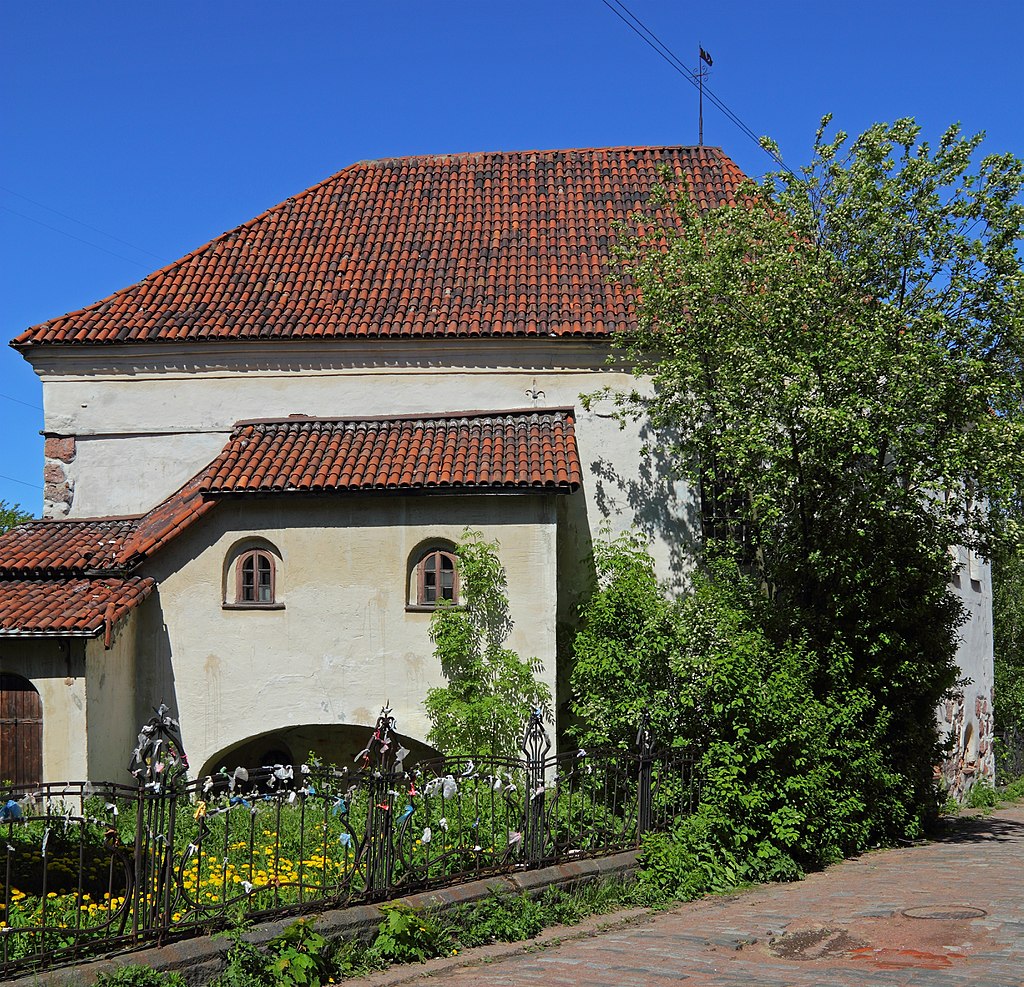
Church of St. Hyacinth in Vyborg

4 Vodnoy Zastavy St., Vyborg, Leningrad Region, Russia, 188800

The building at 4 Vodnaya Zastava Street is sometimes called the Knight's House, but actually, the Knight's House — the noble assembly — was located there for only five years. For much longer, almost a century and a half, there was a Catholic parish here.
The early construction period of the Gothic building’s initial rectangular volume, made of granite boulders and bricks, is considered to be the late 16th — early 17th century. The oldest part of the current building was built before the city’s redevelopment, carried out in the mid-17th century according to the plan of engineer Thorstenson, which is why it is positioned at an angle to the street’s red line. To this day, even some of the oldest walls remain intact and preserved, which is quite strange since the building was rebuilt many times, and originally there was a simple wooden structure here, which was later replaced by a more durable and solid stone building. The reconstruction affected not only the Old Town but also this small wooden structure, which after the changes received a rather beautiful name — the “Knight’s House,” although the Knight’s House — a noble assembly — was located there for only five years. Much longer, almost one and a half centuries, it was a Catholic parish.
The original appearance of the building represented a peculiar regional variant characteristic of residential houses in Hanseatic cities, formed back in the Late Middle Ages. The first information about the building’s owner dates back to the 1650s: it was Arvid Forstadius, a master of theology and lecturer at the Vyborg gymnasium. In 1679, Forstadius became the pastor of the Lutheran parish of the Vyborg Cathedral and remained so until his death in 1683. After Forstadius, the tenant of the building was the councilman and merchant Jakob Boisman. Then, in 1705, the owner once again became a clergyman — provost (archpriest) Ernst Gestrinius.
This is one of the medieval houses preserved in Vyborg. It consists of two parts — the earlier one, located deep inside, at an angle to the street, and a later extension from the 18th century. In the 15th century, a wooden building stood on this site, belonging to the Franciscan monastery. The monastery itself was located nearby, on Skotoprogonnaya Street (now Progonnaya), and owned several city plots. At the beginning of the 16th century, the building was rebuilt in stone as a monastery school. According to legend, this is where the future Finnish enlightener and prominent Reformation figure Mikael Agricola studied.
In the 16th century, when the Reformation was carried out in Sweden, monasteries, including both Vyborg ones (Franciscan and Dominican), were closed, and the property of the Catholic Church was confiscated.
The monastery school building passed to the magistrate and was sold to the burgher Boisman, who rebuilt it into a residential building. Until the second half of the 18th century, this plot belonged to various German merchant families. Its last civilian owner was Peter Janisch, who lost the plot due to a conflict with the city commandant.
The confiscated house was given to the noble assembly — the Swedish-German “Society of Vyborg Knights” (hence the name Knight’s House), established by Catherine the Great’s decree in 1766 during the provincial reform. A hall for meetings and balls was arranged on the second floor, while the lower floors were used for household needs. But in 1797, a New Town Hall was built on Cathedral Square, and all public events were moved there.
Under Paul I, the Knight’s House was transferred to the military department for organizing a Catholic parish: there were many Poles in the Vyborg garrison. Since 1802, the chapel of Saint Hyacinth was located here. After the Grand Duchy of Finland was annexed to Russia in 1809, the Vyborg Catholic parish became the only one in Finland, since Catholicism had been banned in Sweden since the Reformation. In 1856, the chapel received the status of a Roman Catholic church.
During its time as a church until the 1930s, the building was rebuilt several times. Before the war, it looked like a church with a bell tower and an apse. During the Continuation War, it was also used, and in 1943 wall paintings were even made. In Soviet times, it was used as a warehouse for a long time.
In the 1970s, it was restored and adapted for a children’s art school, stylized as a medieval house; the religious features were removed from its appearance: the bell tower and apse disappeared. The wall paintings were lost as well. However, the interior acquired features of the 17th–18th centuries: ceiling beams, a large fireplace, a staircase with carved details. At the same time, a wrought-iron fence was moved to the monument, which previously surrounded the Old Cathedral.
Currently, the Knight’s House is under the jurisdiction of the Vyborg United Museum-Reserve. It houses an exhibition dedicated to the history of the building and a display of knightly armor.

Sources:
https://gazetavyborg.ru/turistu/osnovnaya-kategoriya/kostyol-giatsinta-rytsarskiy-dom/
https://www.tourister.ru/world/europe/russia/city/vyborg/temples/22939
https://ru.wikipedia.org/wiki/Костёл_Гиацинта

Follow us on social media

More stories from Vyborg and Surroundings

Vyborg – Origin of the City and Its Name

3 Severnny Val St., Vyborg, Leningrad Region, Russia, 188800

The Swedish feudal state, from the mid-12th century to the 1320s, conducted crusades to the East, the official goal of which was the spread of Christianity in the lands of pagan peoples.

Legends and Facts about the Dungeons of Vyborg Castle

3 Severnny Val St., Vyborg, Leningrad Region, Russia, 188800

According to available information, in the private houses formerly owned by Mr. Wolf and Mr. Hackman, located near the city guardhouse, there are underground passages leading from the mentioned houses to the guardhouse and further to the embankment near the Abosky Bridge.

Vyborg Thunder

3 Severnny Val St., Vyborg, Leningrad Region, Russia, 188800

The events of November 30, 1495, known to us as the "Vyborg Thunder," are quite well studied and described by Swedish and Finnish historians. Although there are very few sources about them, the picture painted by these researchers seems quite realistic. In my work, I will not describe the stages of the assault in detail but want to focus on the actions of the Russian voivode. Of course, today we do not know what orders the commanders of that time gave; in our conclusions, we can rely only on the events that actually happened, as described in the sources. The Swedes resisted desperately, but numerical superiority and military skill were on the side of the Russian warriors. The city was doomed, but at a certain moment, everything went wrong.

Vyborg Castle

3 Severnny Val St., Vyborg, Leningrad Region, Russia, 188800

Vyborg Castle is the only castle in Russia built in the finest Western European military traditions of the Middle Ages. The castle, also known as the Holy Fortress, is a grand structure around which an entire city grew.

Monument to the Dog Knight

Krepostnaya St., 2, Vyborg, Leningrad Region, Russia, 188800

The history of the monument to Marshal Torgils Knutsson, the founder of Vyborg Castle, is full of adventures, just like his life. In 1203, he ordered the construction of a new outpost of Swedish expansion on the narrow isthmus between Lake Ladoga and the Gulf of Finland with a single purpose — to cut off Novgorod from the trade route to the Baltic Sea. The next step was the construction of the Landskrona fortress at the mouth of the Neva River.

The round tower or Fat Catherine - the place where "Kemska volost" was handed over

Krasnoarmeyskaya St., 17, Vyborg, Leningrad Region, Russia, 188800

One of the most interesting landmarks of Vyborg is the Round Tower. It is located on the Market Square, where in the 16th century there was a wall with towers that surrounded the city with a stone ring.

Vyborg Treaty

Krasnoarmeyskaya St., 17, Vyborg, Leningrad Region, Russia, 188800

How the Window to Europe Was Closed, "Kemska Volost" Was Given Away – Secret Protocols to the Treaty of Charles IX and Vasily Shuisky

Monrepo Landscape Park

Ural Street, 72, Vyborg, Leningrad Region, Russia, 188811

A picturesque landscape park is located on Tverdysh Island on the shore of the Protective Bay of Vyborg Bay.

Vyborg Massacre

Petrovskaya St., 4a, Vyborg, Leningrad Region, Russia, 188807

"At the core of all these noble races, one can discern a predatory beast, a luxurious, lustfully wandering blonde beast in search of prey and victory; this hidden core from time to time requires a discharge, the beast must come out anew, must return anew to the thickets": Nietzsche

Old Town Hall of Vyborg

Krepostnaya St., 2, Vyborg, Leningrad Region, Russia, 188800

One of the most beautiful buildings in Vyborg is the Old Town Hall on the square of the same name. This elegant building was erected back in 1643, and at that time the Town Hall, where the local government bodies met, became the largest structure in the city overall. Usually, the Town Hall refers to the building on Old Town Hall Square, right in front of the entrance to which stands a monument to Torgils Knutsson.

The Horned Fortress of Vyborg

Powder Magazine, P.F. Ladanova St., 3, Vyborg, Leningrad Region, Russia, 188800

The Horn Fortress is a bastion fortification attached to the Vyborg city wall in the 16th century. The territory, once located within the Main Vyborg Fortress, is called the Old Town.

House of the Merchant Guild of the Holy Spirit

8 Vyborgskaya St., Vyborg, Leningrad Region, Russia, 188800

The House of the Merchant Guild of the Holy Spirit is one of the most valuable monuments of Vyborg, as it is one of the few surviving examples of European medieval civil architecture preserved to this day.

The oldest residential building in Russia

Krepostnaya St., 13, Vyborg, Leningrad Region, Russia, 188800

The Citizen's House is an ancient residential building located in the center of Vyborg on Krepostnaya Street (house 13a), a medieval architectural monument. This low two-story tower-type house with a basement and thick walls made of granite boulders, along with a similar burgher estate, the House of the Merchant Guild of the Holy Spirit, and another guild house, is part of a group of four small private "fortresses" from the 14th–17th centuries—medieval burgher houses that can only be seen in Vyborg within the territory of Russia.

Kron-Saint-Anna, Annenkron, Fortress of St. Anna, or simply – the Anneskie fortifications.

Petrovskaya St., 4A, Vyborg, Leningrad Region, Russia, 188807

The construction of the fortifications took place from 1730 to 1742, during the reign of Anna Ioannovna, so it is not surprising that the fortifications were called Kron-Sankt-Anna, Annenkron, or Fortress of St. Anna at different times. Today, we simply call them the Anneskie Fortifications. The construction project was designed by the military engineer and commander B.-Kh. Minikh. The construction work was carried out under the supervision of the Vyborg ober-commander de Coulon. There is information that Abraham Hannibal, the "Moor of Peter the Great," participated in the construction of the Annenkie Fortifications.

New Cathedral (Vyborg)

Sovetskaya St., 16, Vyborg, Leningrad Region, Russia, 188800

It was called the Vyborg Notre-Dame. It was depicted in panoramic photographs and greeting cards. Everyone admired it without exception. The refinement of the Gothic spire, the monumentality of the main building, the spacious hall with painted vaults and a majestic organ. Now, only the foundation and the plinth of the building with the underground part remain of this masterpiece of northern Gothic architecture. This refers to the new cathedral (Finnish: Viipurin tuomiokirkko), the main Lutheran church of Vyborg, which no longer exists. In 1925, it was granted the status of the cathedral of the Vyborg diocese.

Monument to Mikael Agricola

Pionerskaya St., 6, Vyborg, Leningrad Region, Russia, 188800

The monument to Mikael Agricola — humanist and Lutheran bishop — was located at the entrance to the Vyborg Lutheran Cathedral. The monument was lost as a result of the Soviet-Finnish War (1939–1940) and was restored in 2009 on Theater Square, near the Vyborg Lutheran Cathedral of Peter and Paul. He is the creator of Finnish writing, and therefore of the Finnish literary language.

Place of death of Mikael Agricola

7W86+6C Luzhki, Leningrad Oblast, Russia

In the Vyborg district of the Leningrad region, on the shore of the Gulf of Finland at Cape Kyurenniemi, a restored monument to the great Finnish enlightener, founder of the Finnish literary language, and church reformer Mikael Agricola (1510–1557) has been unveiled. This memorial stone with a decorative fence was placed in 1900 by the youth society of the Koivisto settlement (now Primorsk) to mark the place of Agricola's death.

Trongzund - 19th century fortress

JHMF+X7 Vysotsk, Leningrad Oblast, Russia

The Trångsund Fortress — a 19th-century defensive structure, the remains of which have been preserved on the outskirts of the town of Vysotsk. It was built on the islands of the Vyborg Bay to protect the water approaches to Vyborg.

Church of St. Mary Magdalene (Primorsk)

Zavodskaya St., 5, Primorsk, Leningrad Region, Russia, 188910

The Church of St. Mary Magdalene (Finnish name Koiviston kirkko) is a former Lutheran church in Primorsk, built according to the design of Josef Stenbäck in the style of Finnish National Romanticism, a northern variant of Art Nouveau. This building is one of the most remarkable on the Karelian Isthmus. The exterior walls are made of local reddish granite, while the interior walls are brick. The roof is made of galvanically treated tin. The building is shaped like a cross. The length of the building is 37 meters, the width is 28 meters, and the height of the spire is 60 meters.

Labyrinth of Krutoyar Island

9GG9FVF6+HV

On the island of Krutoyar, literally just a few kilometers from the border of the Leningrad region with Finland, one of the strangest structures has been preserved, whose history remains unknown to this day – it is a labyrinth.

The estate "Aholla – Hall," now the "Lesogorskaya" hotel

3V97+R8 Svetogorsk, Leningrad Oblast, Russia

The estate "Aholla – Hall," now the "Lesogorskaya" hotel, is located in the Vyborgsky District of the Leningrad Region, in a pine forest on the shore of a pristine lake. An astonishingly beautiful former estate of Karl Oskar Eugen Wolf, Aholan kartano (Ahola Estate), was built by the outstanding architect Uno Werner Ullberg, the chief architect of Vyborg, between 1921 and 1923.

House Lallukka

Mayakovskogo St., 4, Vyborg, Leningrad Region, Russia, 188800

The former building of the company "Hyakli, Lallukka & Co." in Vyborg, built in 1906 according to the design of architect Allan Schulman (1863–1937) in the style of National Romanticism. The building was heavily damaged during the Soviet-Finnish wars (1939–1944) and was restored in the post-war years. The structure is one of the most famous architectural monuments in the city, created in the style of National Romanticism.

Witch's House in Vyborg

1 Yuzhny Val St., Vyborg, Leningrad Region, Russia, 188800

At the end of the 19th century, after the demolition of the fortifications of the Stone Town and the Horned Fortress, whose memory was preserved in the names of the streets Severnny Val (Northern Rampart) and Yuzhny Val (Southern Rampart), the architects of Vyborg faced the task of creating an attractive maritime facade for the medieval city blocks by developing these coastal streets. Architect Eduard Dippel took an active part in this work, designing the facades of several notable buildings, such as the Vekrut House. In 1898, an irregularly shaped corner plot on Yuzhny Val Street was occupied by the iron-shaped house built according to Dippel’s design.