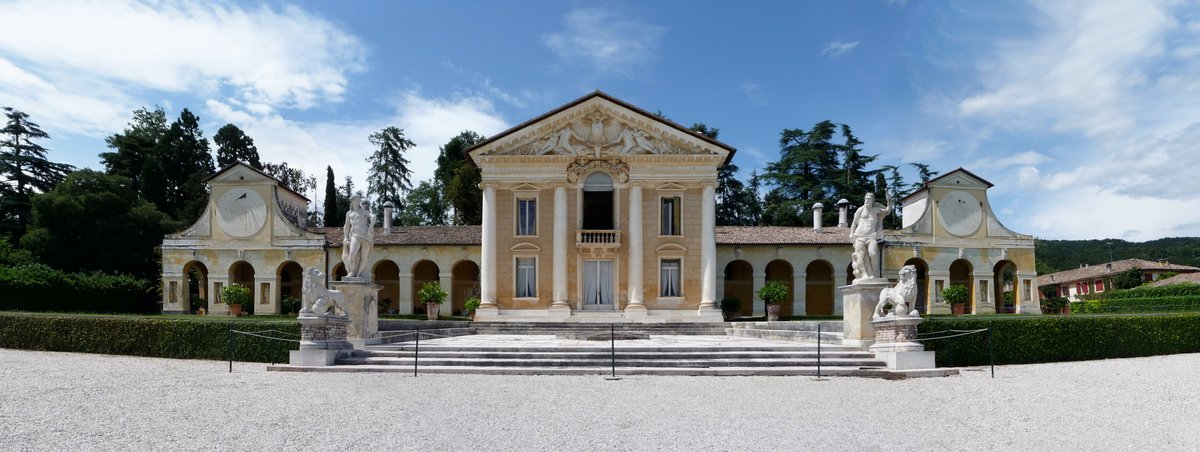

Villa Barbaro, also known as Villa di Maser, is a majestic villa located in Maser, Veneto, Italy. The villa, designed and built by the Italian Renaissance architect Andrea Palladio with frescoes by Paolo Veronese and sculptures by Alessandro Vittoria for Daniele Barbaro, the Patriarch of Aquileia, and his brother Marcantonio, an ambassador to King Charles IX of France, was added to the UNESCO World Heritage Site in 1996, recognizing its importance in the Palladian architecture and the Veneto region.
Built between 1560 and 1570 according to architectural historian Adalbert dal Lago, the villa showcases Palladio's innovative design, with its low lines and complex ground floor plan. The villa's external structure is characterized by a central block, featuring four Ionic columns and decorated with heraldic symbols of the Barbaro family in relief, and wings that terminate with pavilions showcasing large sundials. The frescoes by Veronese can be found in the piano nobile of the villa, including the Hall of Olympus, which depicts Giustiniana, the mistress of the house and wife of Marcantonio Barbaro, and her youngest son, the Crociera room featuring imaginary landscapes and the villa's staff, and the Room of the Oil Lamp highlighting virtuous behavior and strength.
The villa's private living quarters can be found on the upper level of the barchesse. Note: The Tempietto Barbaro is an unfinished church designed by Palladio and features decorations attributed to Alessandro Vittoria and a facade influenced by classical models. However, it is not described in the main body of the story as it was not the main focus of the source material.
Sources: Wikipedia, OpenStreetMap, Wikidata, Wikimedia Commons
Written by Nicolo Ciampini
Discuss this with the author and others
No comments yet. Be the first to start the conversation.