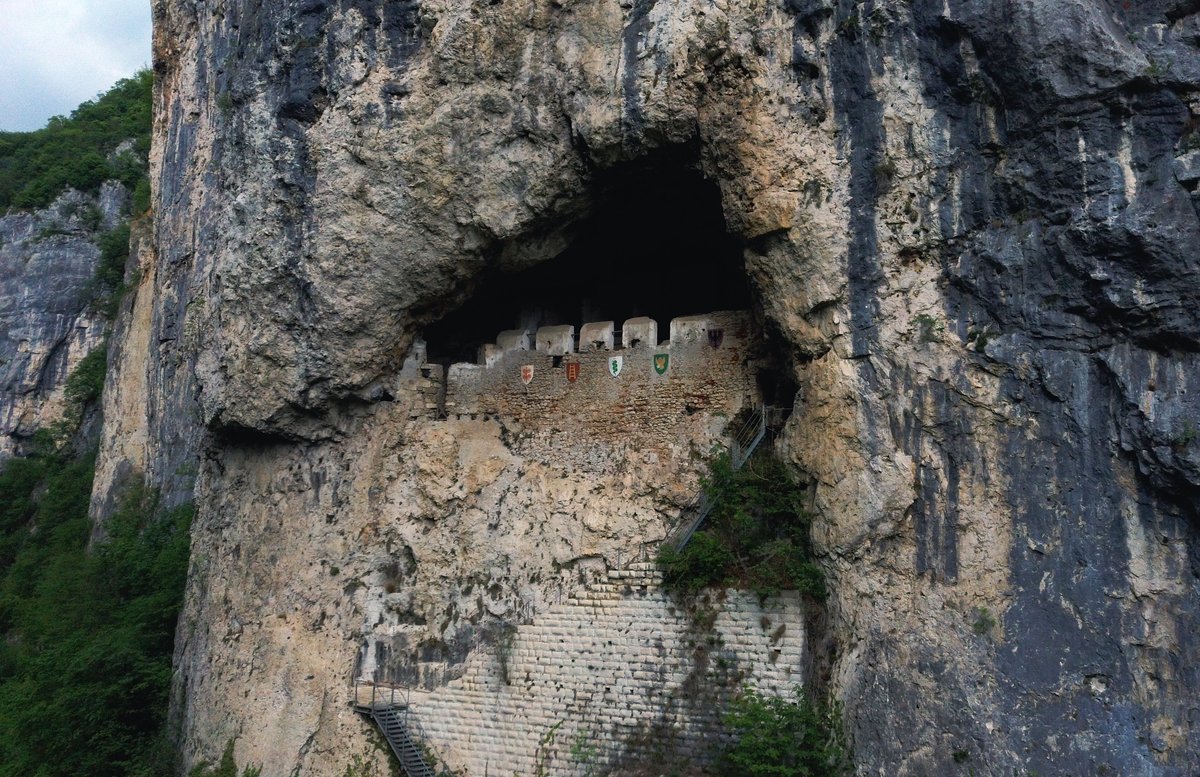

Forcibly concealed by a Venetian cavern, the medieval Covolo di Butistone seems to mysteriously vanish from sight. Its name, reminiscent of Cimbrian origin, assembles 'Buta' - signifying 'wound' - and 'Stone' - meaning 'rock'. 'Covolo', a Venetian term, is used for dolines and caves hollowed into the rock. From the very beginning, the Brenta Valley has been a crucial transit route, connecting the Venetian plain with the Alps. The valley of Stagna-val Frenzela leads to the Asiago highlands, while the valley of Cismon points towards the Feltrino and Belluna.
Brenta provides a hassle-free transit to Padova and the Venetian lagoon. In this region, numerous fortifications have been constructed, including the bastia of Pove del Grappa, the tower of Solanga, the bastia and castle of Enego, the castle of Scala di Primolano, and the covolo of Butistone. It is rumored that its construction started in the Roman era, as Roman coins carrying Emperor Aureliano's image have been unearthed within its walls. The covolo of Butistone was first mentioned historically in 1004, during the Holy Week, when it found itself engulfed in Emperor Henry II's army's descent, as they were at war with King Arduino.
In 1184, the covolo belonged to the Bishop-Count of Feltre, who wielded both spiritual and temporal powers over the nearby Primolano. In the 14th century, this castle became entangled in the conflicts among the Venetian nobility. It was controlled by the Scaligeri from 1321, only to pass to Sicco di Caldonazzo in 1337. The following year, it became property of the Visconti. Occupied by Francesco da Carrara in 1386, it eventually found itself under Venetian rule in 1404.
Sources: Wikipedia, OpenStreetMap, Wikidata, Wikimedia Commons
Written by Nicolo Ciampini
Discuss this with the author and others
No comments yet. Be the first to start the conversation.