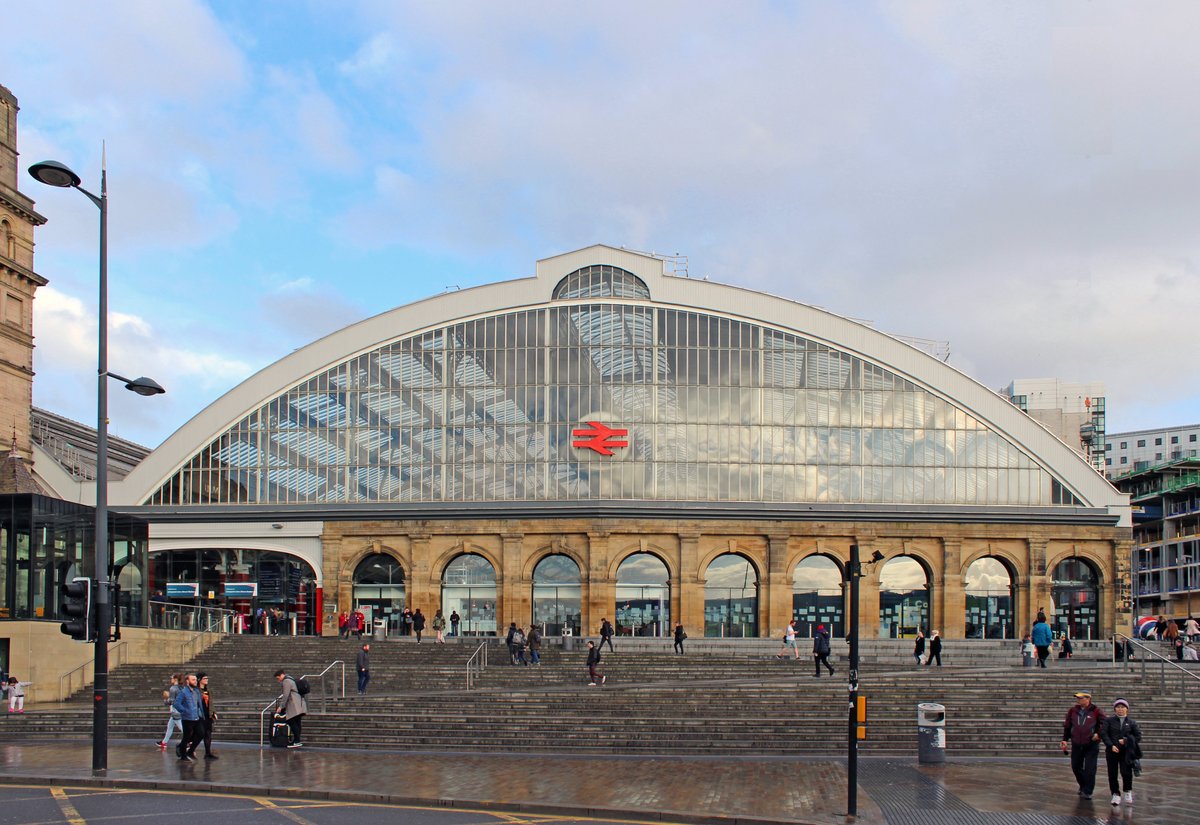

For early operations at Lime Street, the steep incline uphill from Lime Street to Edge Hill required a unique method of transport. Trains would be halted at Edge Hill and the locomotives would be detached from the carriages. The passenger carriages were then taken down the tracks by gravity, with the rate of descent controlled by brakemen located in a brake van.
The return journey was achieved using a stationary steam engine located at Edge Hill, which hauled the carriages back up the hill by rope. This system was constructed by the engineering firm Mather, Dixon and Company under the direction of engineer John Grantham. This practice continued until 1870, when trains began to enter and depart the station by conventional means.
Construction on the station began in October 1833 to replace the terminal at Crown Street, which was considered too far from the city centre. Designed by John Cunningham, Arthur Holme, and John Foster Jr, the station opened in August 1836. It was later expanded in 1867 by William Baker and Francis Stevenson, which included the construction of the world's largest arched train shed at that time.
Today, Liverpool Lime Street remains the largest and oldest railway station in Liverpool. It is the oldest still-operating grand terminus main line station in the world and was awarded 5 stars in Britain's 100 Best Railway Stations by Simon Jenkins. The complex serves both the High Level station and the Low Level underground station, sharing a unified identity and access points.
Sources: Wikipedia, OpenStreetMap, Wikidata, Wikimedia Commons
Written by Nicolo Ciampini
Discuss this with the author and others
No comments yet. Be the first to start the conversation.