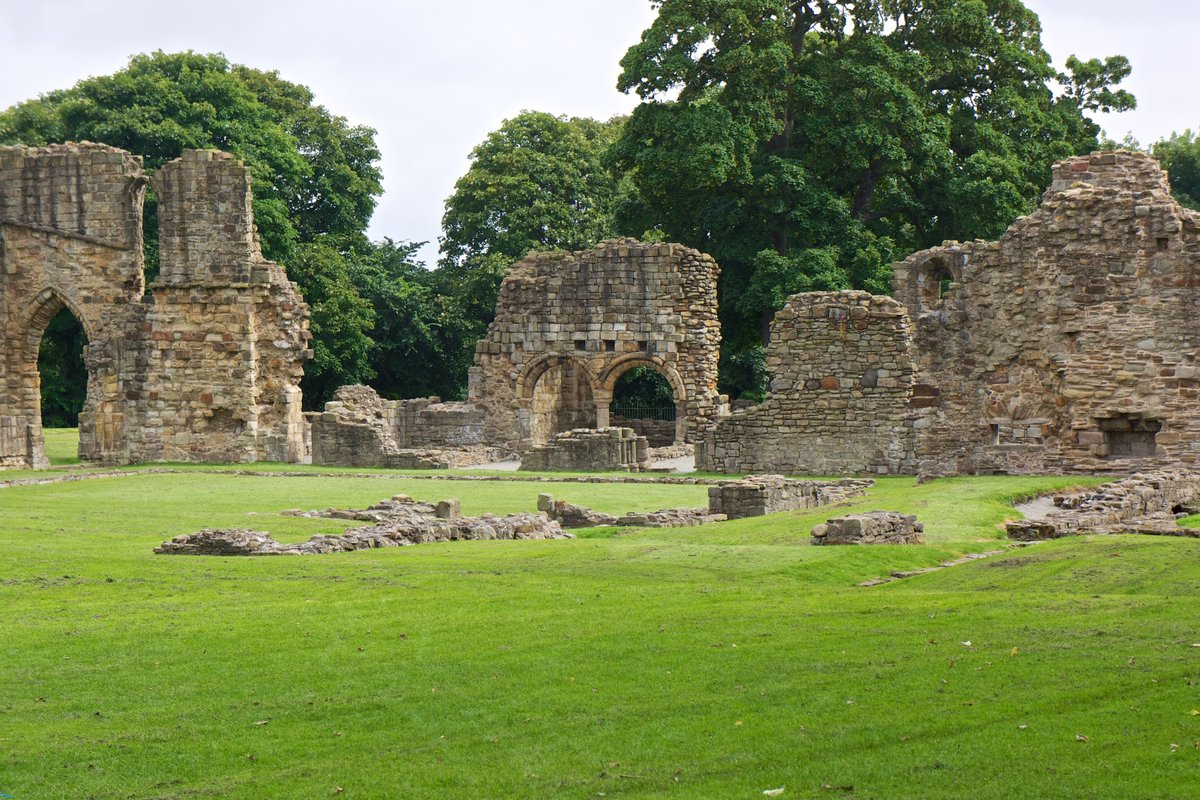

In 1536, Basingwerk Abbey came to an end during the Dissolution of the Monasteries. When the abbey was sold, its parts were distributed to various locations. The roof of the refectory went to a church under Moel Famau, while another section of roof was given to the Collegiate and Parochial Church of St Peter at Ruthin, where it still covers the North Nave. A Jesse window went to the Church of St Dyfnog at Llanrhaeadr-yng-Nghinmeirch, and the choir stalls were sent to St Mary on the Hill in Chester. Some of the roofing lead was even used to repair Holt Castle and several royal castles in Ireland.
The monks of Basingwerk were active managers of significant lands, including a manor near Glossop given by Henry II. By 1290, the abbey held a market charter for Glossop, and they received another for Charlesworth in 1328. They harnessed the power of the Holywell stream to run a corn mill and to treat the wool from their sheep. By the 1430s, the abbey showed signs of increasing worldliness, with the rebuilding of domestic buildings for comfort and the abbot's patronage of bards like Tudor Aled. The final abbot, Nicholas Pennant, was the son of his predecessor, Thomas.
Today, the ruins are managed by Cadw in Greenfield Valley Heritage Park. Visitors can still see the 12th-century chapter house, which features an arcade of two round arches and a stone bench where the monks once sat for meetings. The south transept of the 50m long cruciform church remains, with its west walls standing high. Nearby, the remains of the dormitory undercroft and a mid-13th-century warming room are still visible, showing how the domestic buildings were converted into a house after the dissolution.
Sources: Wikipedia, OpenStreetMap, Wikidata, Wikimedia Commons
Written by Nicolo Ciampini
Discuss this with the author and others
No comments yet. Be the first to start the conversation.