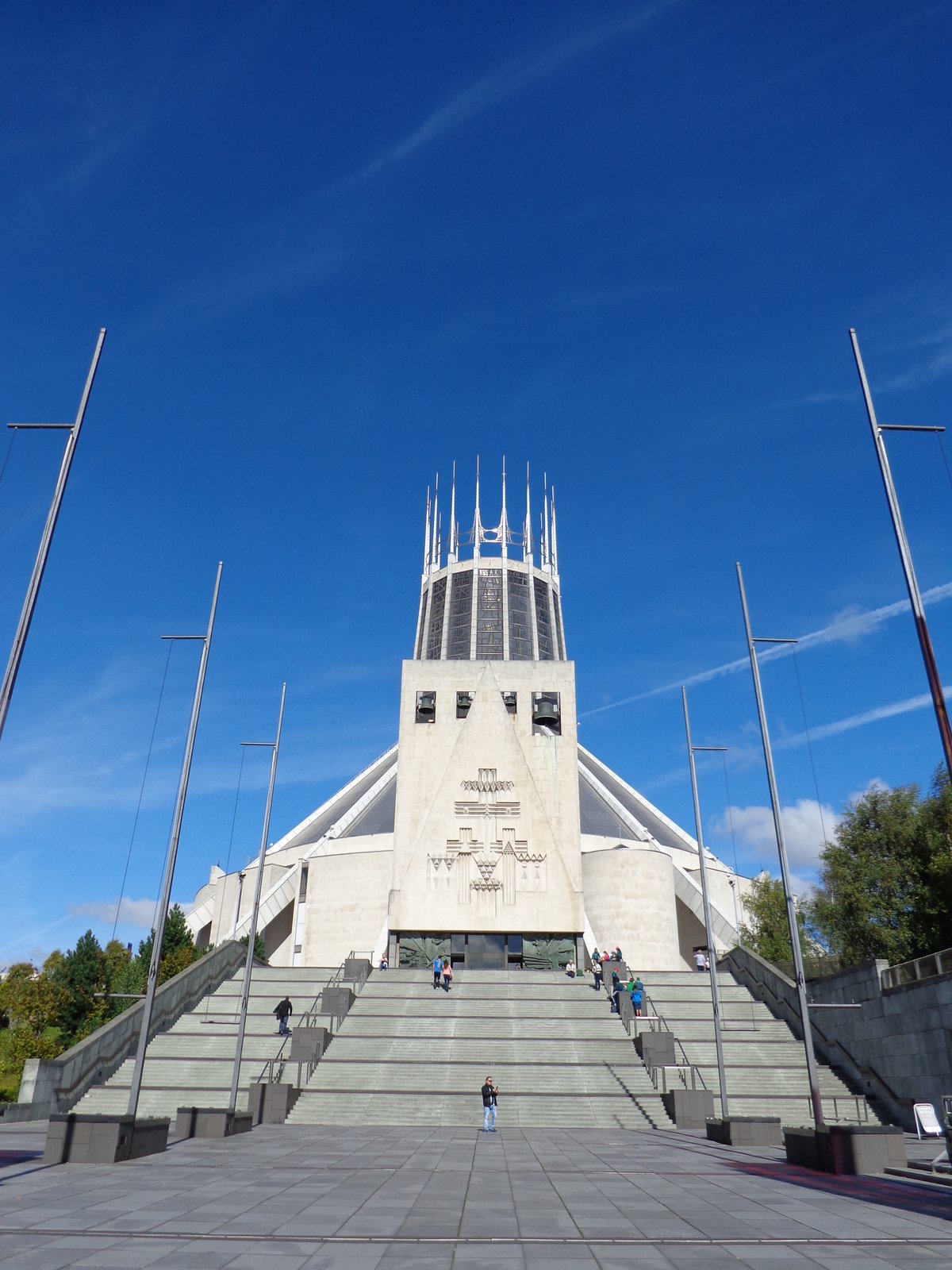

Liverpool Metropolitan Cathedral, officially known as the Metropolitan Cathedral of Christ the King and locally nicknamed "Paddy's Wigwam" or "The Mersey Funnel", is the seat of the Archbishop of Liverpool. This Grade I listed cathedral is a prominent landmark on Mount Pleasant, constructed between 1962 and 1967. The design was won by architect Frederick Gibberd in a worldwide competition. While earlier designs were proposed in 1933 and 1953, the current building was completed and consecrated on 14 May 1967.
The cathedral's unique form is defined by a circular plan with a diameter of 195 feet and a conical shape surmounted by a tower. The building is supported by 16 boomerang-shaped concrete trusses held together by two ring beams. Flying buttresses are attached to these trusses, giving the cathedral its distinctive tent-like appearance. The structure is built in concrete with Portland stone cladding and features an aluminium covering on the roof.
Visitors enter via a wide flight of steps leading from Hope Street, passing under a large wedge-shaped bell tower. The entrance features geometric relief sculptures by William Mitchell and reliefs in fibreglass representing the symbols of the Evangelists. Inside, the focus is on an altar made of white marble from Skopje, North Macedonia, set upon a grey and white marble floor designed by David Atkins. Concentric benches designed by Frank Knight surround the interior, which also houses 13 chapels, a baptistry, and a large organ with a striking front designed by Gibberd.
The cathedral sits atop a crypt designed by Sir Edwin Lutyens, which was the only part of the original project built before construction was interrupted by World War II. This crypt, built of brick and granite, is used annually for the Liverpool Beer Festival and hosts examinations for students at the University of Liverpool. The main cathedral building was constructed upon this historic foundation, blending Lutyens' earlier work with Gibberd's modern vision.
Sources: Wikipedia, OpenStreetMap, Wikidata, Wikimedia Commons
Written by Nicolo Ciampini
Discuss this with the author and others
No comments yet. Be the first to start the conversation.