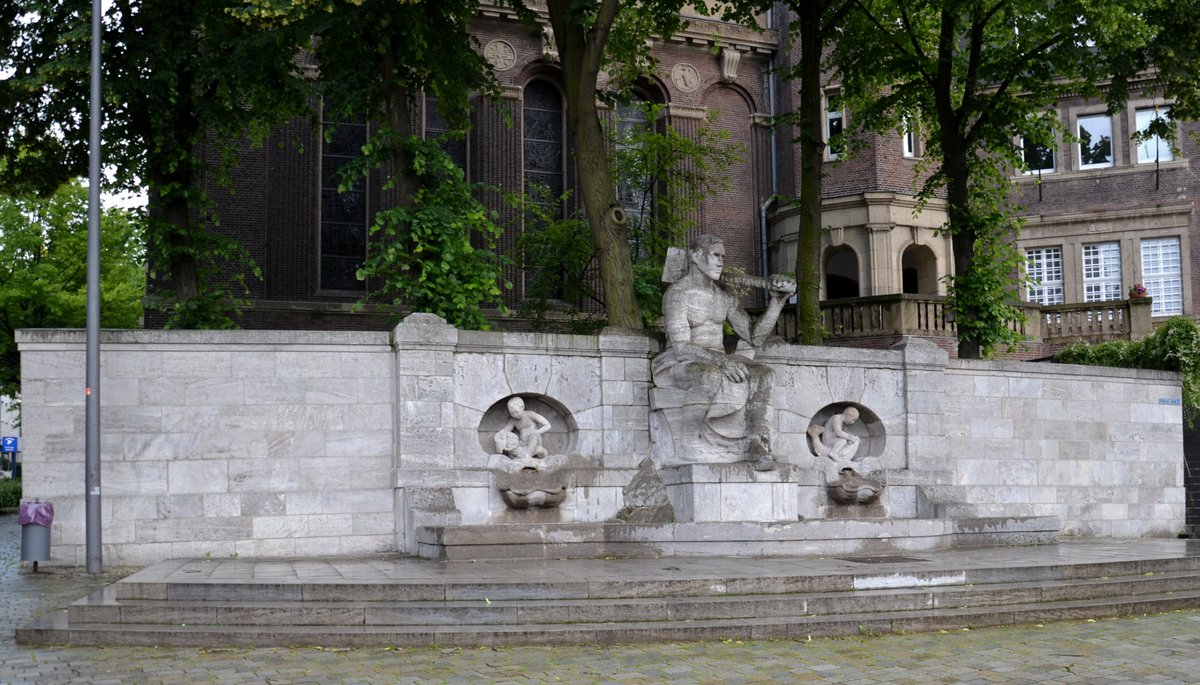
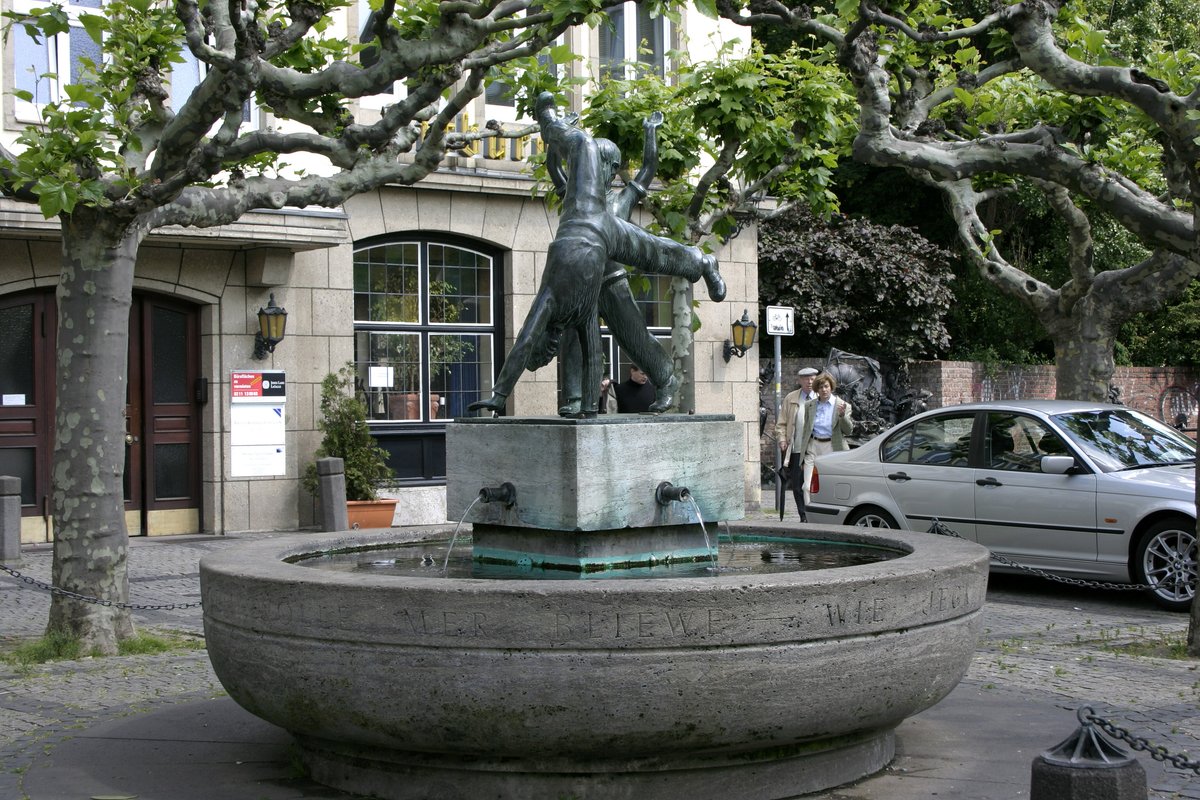
Heavy Muschelkalk limestone forms a colossal laborer whose hands rest upon a blacksmith's tool. He embodies the spirit of toil. Nearby, two oversized putti are depicted playing in the walls as water trickles into a basin. This Jahrhundertbrunnen rose from a contest won by Ulfert Janssen of Munich. He sculpted these figures following Adolf von Hildebrand’s aesthetic using stone from Heidingsfeld in Würzburg. The city received this gift to celebrate a century since 1802, when Prussian forces claimed Essen, the Damenstift, and the Reichsabtei Werden. These lands served as compensation for areas surrendered to France during the Coalition Wars.
On August 3, 1902, the cornerstone descended into the earth. Mayor Erich Zweigert spoke the deed while a military band echoed a prayer from Wagner's Lohengrin. Five years later, in 1907, the final inauguration ignited a festive parade. Warrior societies and choirs led the first wave. Gymnastics and workers' clubs formed the second. Fire departments, guilds, and marksmen's clubs concluded the third. They traversed Kettwiger Straße and Huyssenallee toward the Stadtgarten, where a military band and fireworks were featured.
Niemeyer designed the inscriptions carrying a rhythmic command to be brisk at work but happy in rest. To the left of the worker, the coat of arms of Essen marks 1802. To the right, the Prussian coat of arms marks 1902. These dates tether the stone to the union of the city and monastery of Essen with the Kingdom of Prussia. In 1912, Edmund Körner proposed a move to frame the Old Synagogue. Between 1914 and 1916, the Old Catholic Peace Church rose southeast. Its elevated forecourt wall integrated into the widened Muschelkalk structure seen now.
This protected monument serves as a grounded reference in the modern town center. It stands in Edmund-Körner-Platz. The enclosure received a renewal in 2012. It remains a place where the heavy weight of 19th-century history meets the steady pulse of water.
Sources: Wikipedia, OpenStreetMap, Wikidata, Wikimedia Commons

Written by Aurora
Discuss this with the author and others
No comments yet. Be the first to start the conversation.