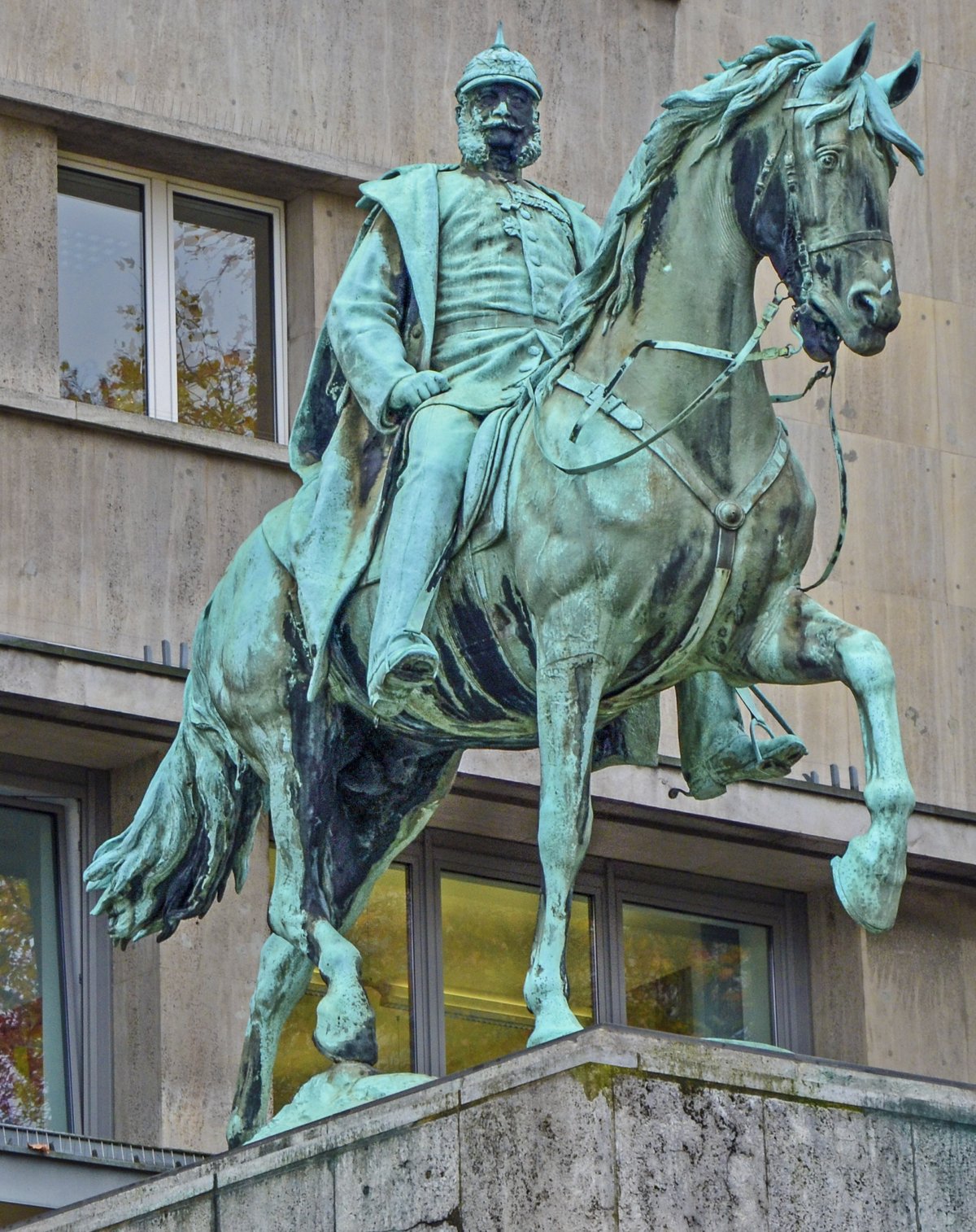
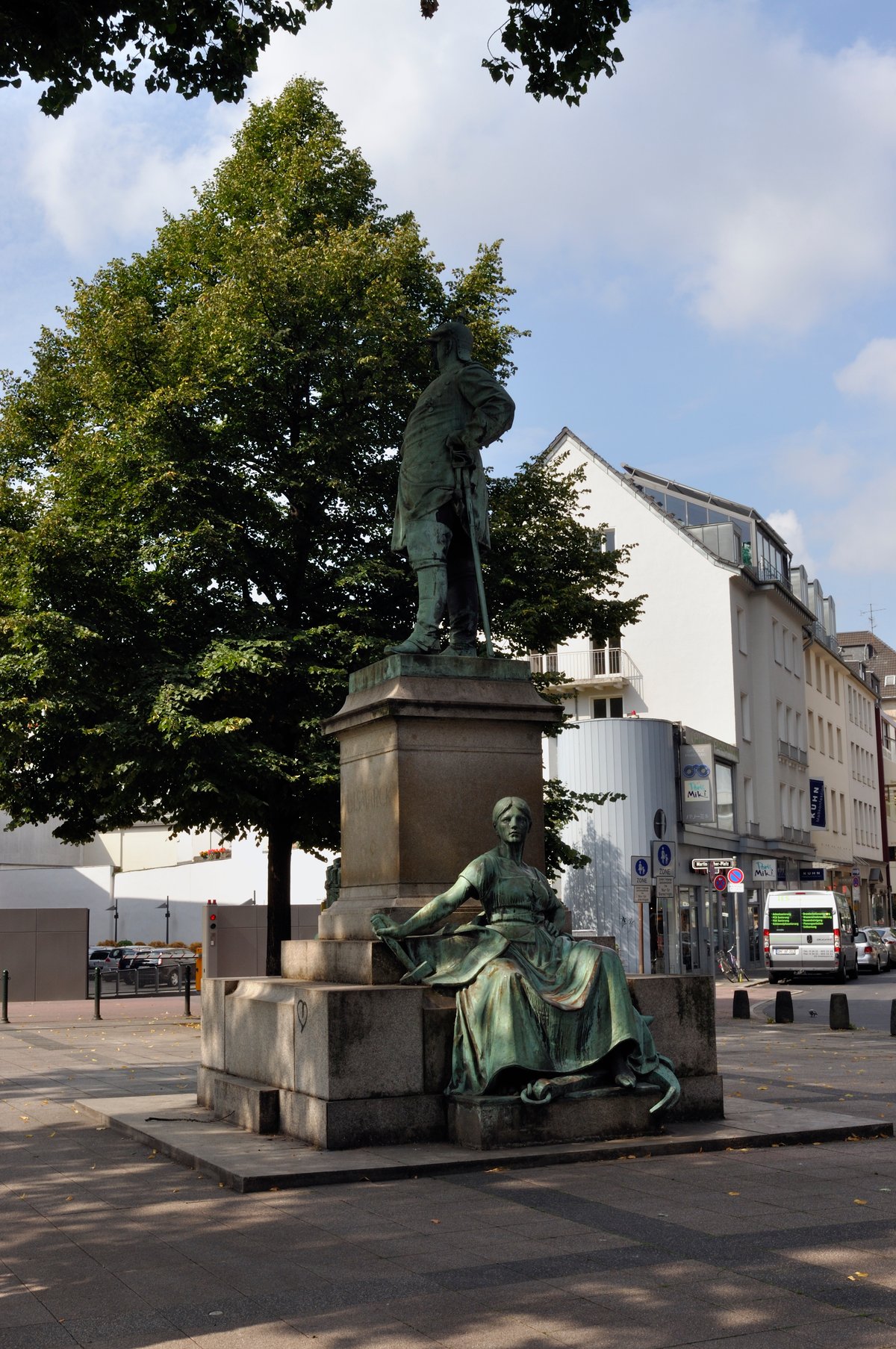
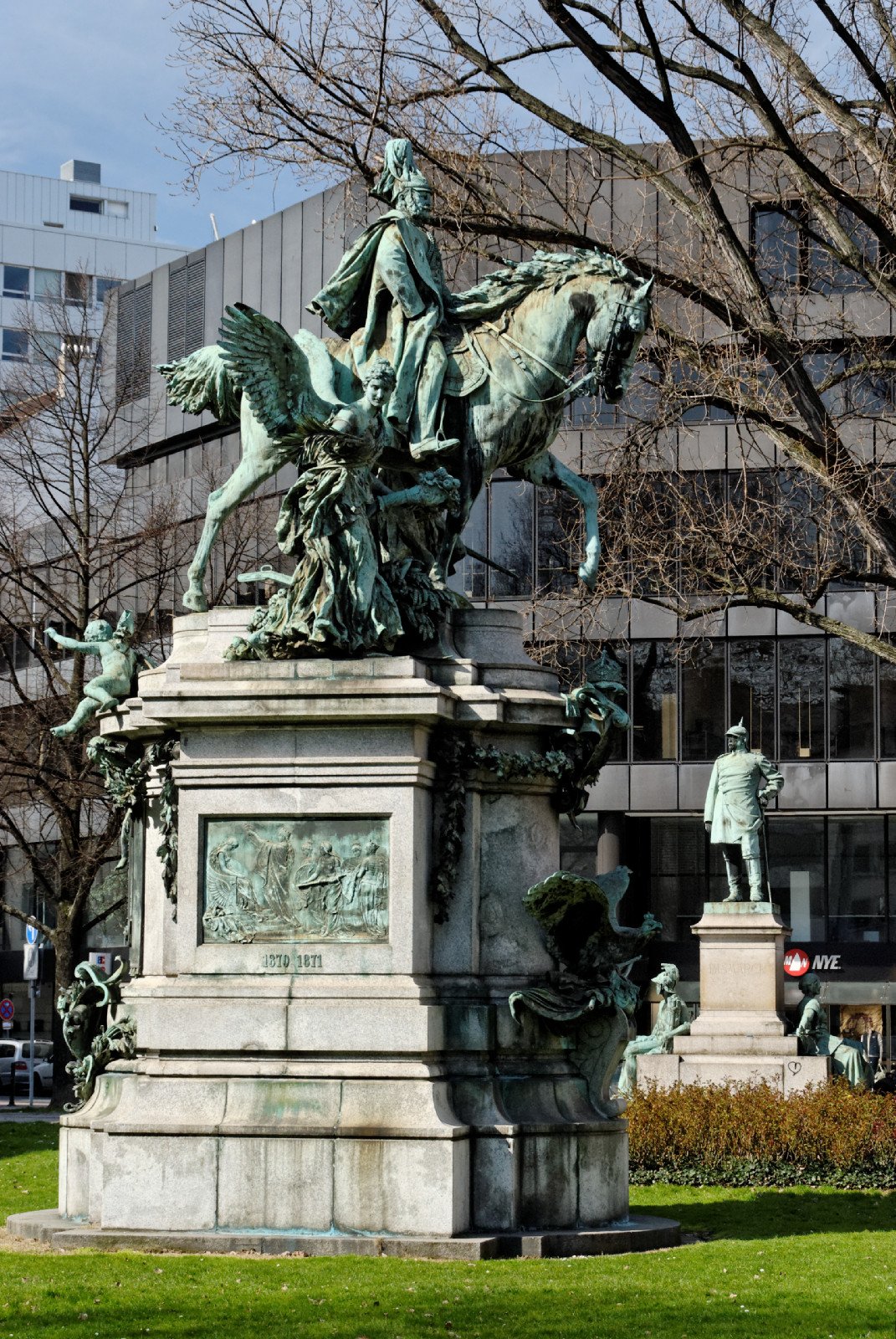
A bronze rider watches over the Burgplatz, his cloak heavy and his Pickelhaube sharp. He is Kaiser Wilhelm I, captured in a general's uniform by the sculptor Hermann Volz. He stands here not just as a man, but as a symbol of the German Empire, a victory over the French, and a crown forged in the fires of local industry.
To understand why he stands in Essen, one must look to the smoke of the nearby west. In the late 19th century, Alfred Krupp’s cast steel factory produced cannons with a reach nearly double that of the French bronze guns. This technological edge was the pivot point of the Franco-Prussian War of 1870–1871. It gave Wilhelm I his empire, and it brought the Kaiser to Essen's doors repeatedly to inspect the steel that secured his reign. His final visit came in 1886, shortly before the city decided to immortalize his legacy in metal.
Building the memorial was a communal act of the Essen bourgeoisie. After two public tenders failed to find a worthy artist, the city commissioned Volz. The project was funded by the city's wealthy families, notably Friedrich Alfred Krupp and the Waldthausen family, who each donated 20,000 Marks. The total collection reached 116,000 Marks, a sum that built the massive terrace of Swedish granite and a pedestal of green Odenwälder Syenit and gray granite.
The inauguration on October 23, 1898, was a choreographed spectacle of sound and movement. Fifty-four local associations gathered at Gerlingsplatz before marching through the market to the Burgplatz. The city center was draped in flags and festive illumination. As the bells rang and cannons fired, the air filled with the singing of 'Deutschland, Deutschland über alles.' From a temporary podium, the Lord Mayor Erich Zweigert gave a speech while the Kaiser's representative, General Karl von Wedel, watched from the terrace.
Today, the monument remains a heavy, grounded presence in the city's heart. Visitors can still see the scale of the original design - the 4.5-meter-high statue sits upon a terrace reached by a sequence of nineteen steps of Odenwald sandstone. The mosaic floor remains, a geometric expanse of 28.4 by 17.6 meters, preserving the footprint of an era that traded steel for sovereignty.
Sources: Wikipedia, OpenStreetMap, Wikidata, Wikimedia Commons

Written by Aurora
Discuss this with the author and others
No comments yet. Be the first to start the conversation.