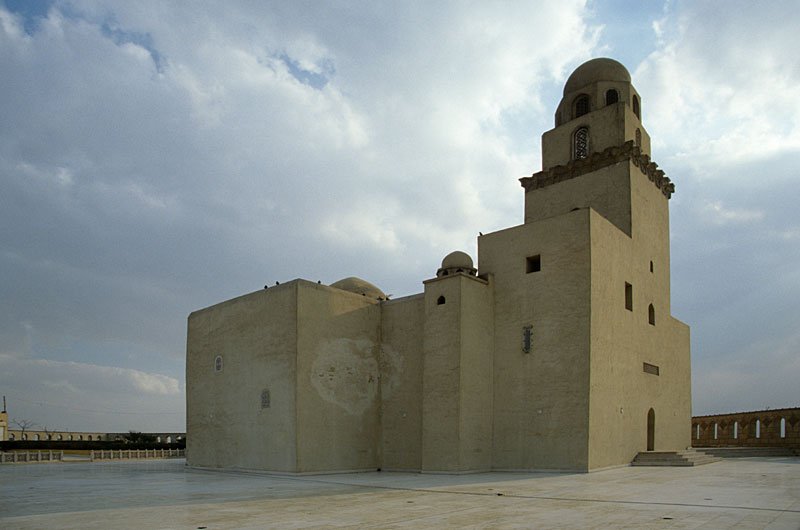

On the Muqattam hills, the Juyushi Mosque overlooks the Southern Cemetery of Cairo. It was built in 1086 CE during the reign of the Fatimid Imam-Caliph al-Mustansir Billah. Its construction was sponsored by Badr al-Jamali, the vizier of al-Mustansir, who held the title Amir al-Juyush, meaning Commander of the Armies.
The building's foundation inscription identifies the structure as a mashhad, a commemorative shrine or mausoleum. While its exact function is not clear, the most plausible theory is that it commemorates the victories of Badr al-Jamali. Because of its isolated setting, one scholarly theory even suggests the structure was actually a watchtower disguised as a mosque.
Centered around a small courtyard, the mosque features a prayer hall where cross-vaults meet a dome resting on an octagonal base. The mihrab is covered in elaborate stucco decoration, though some 18th-century Ottoman painted decorations were removed during a restoration in the 1990s. The minaret features a design similar to that of the Great Mosque of Kairouan.
As of 2018, the mosque was situated inside a military zone. It remained closed to the public, accessible only to those with special permission. This historic monument remains one of the most complete mashhads to survive from the Fatimid period.
Sources: Wikipedia, OpenStreetMap, Wikidata, Wikimedia Commons



Written by Mutabor
Discuss this with the author and others
No comments yet. Be the first to start the conversation.