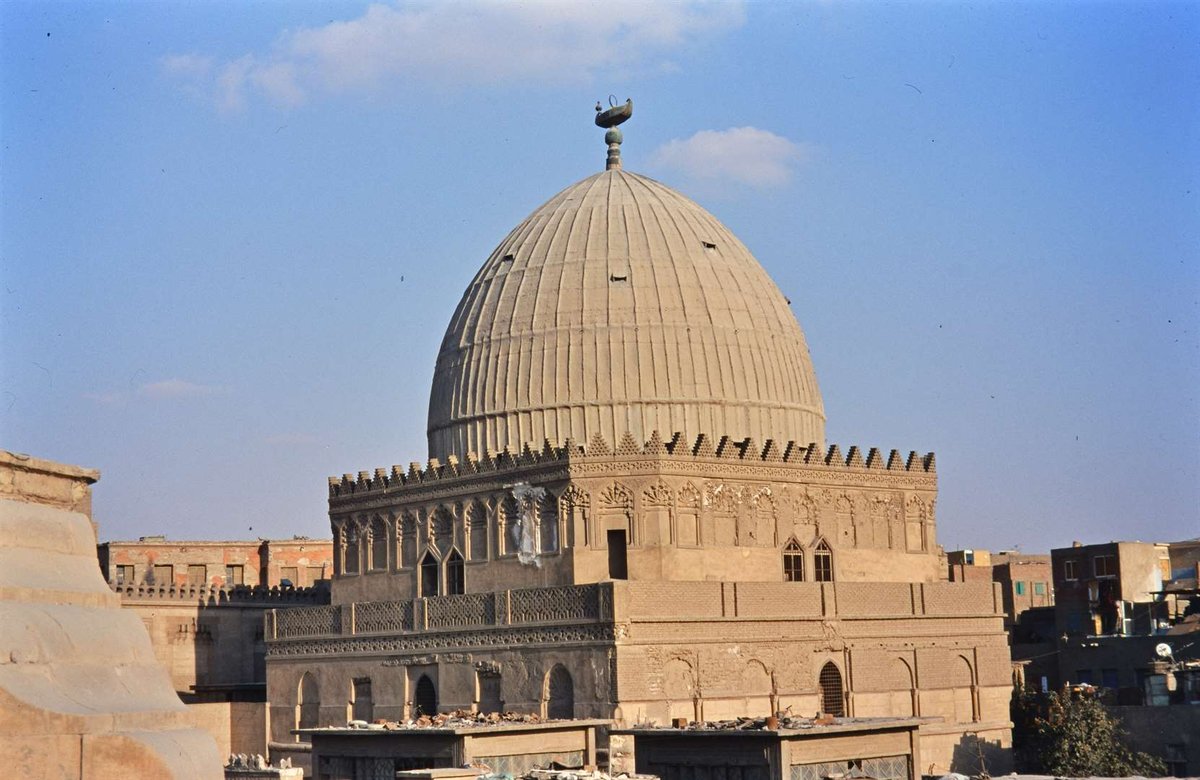

In the heart of Cairo, nestled within the City of the Dead, Ayyubid sultan Salah ad-Din established a sanctuary for Imam al-Shafi'i, the founder of the Shafi’i school of jurisprudence. Nearly four hundred years after the Imam's death in 819, Salah ad-Din built a turbah and a madrasa in 1176. In 1178, a wooden coffin was created by Abid al-Najar, decorated with geometric patterns and inscriptions in Kufic and Ayyub scripts, featuring verses from the Qur'an and accounts of al-Shafi'i's life.
In 1211, Ayyub Sultan al-Malik al-Kamil built a mausoleum for his mother near the site, constructing a dome and a building that covered the entire area as well as the grave of al-Shafi'i. This became the current structure, featuring a wooden dome that was one of the largest constructed during its time, surpassed only by the Dome of the Rock in Jerusalem. The mausoleum is considered the largest freestanding tomb in Egypt. Much of the present structure dates from al-Kamil's time, though Sultan Qaytbay added muqarnas and marble decorations in 1480.
Renovations continued through the centuries, with Sultan Qansuh al-Ghuri making changes between 1501-16 and the governor Ali Bek al-Kabir adding colored decorations in 1772. The building's exterior reflects the Andalusian style with extensive stucco decoration and carved colonnettes. In 2016, a conservation initiative funded by the US Ambassadors’ Fund for Cultural Preservation began to address cracks and masonry deterioration while updating the drainage and lighting systems.
The mausoleum's base is a 15-meter stone square supporting the lead-topped wooden dome. The dome is topped with a copper boat said to be filled with birdseed, a feature from the early Fatimid dynasty. Inside, original Ayyubid details remain, including a wooden frieze along the walls and the wooden beams that once supported lamps, preserving the spiritual and architectural legacy of the Imam's resting place.
Sources: Wikipedia, OpenStreetMap, Wikidata, Wikimedia Commons



Written by Mutabor
Discuss this with the author and others
No comments yet. Be the first to start the conversation.