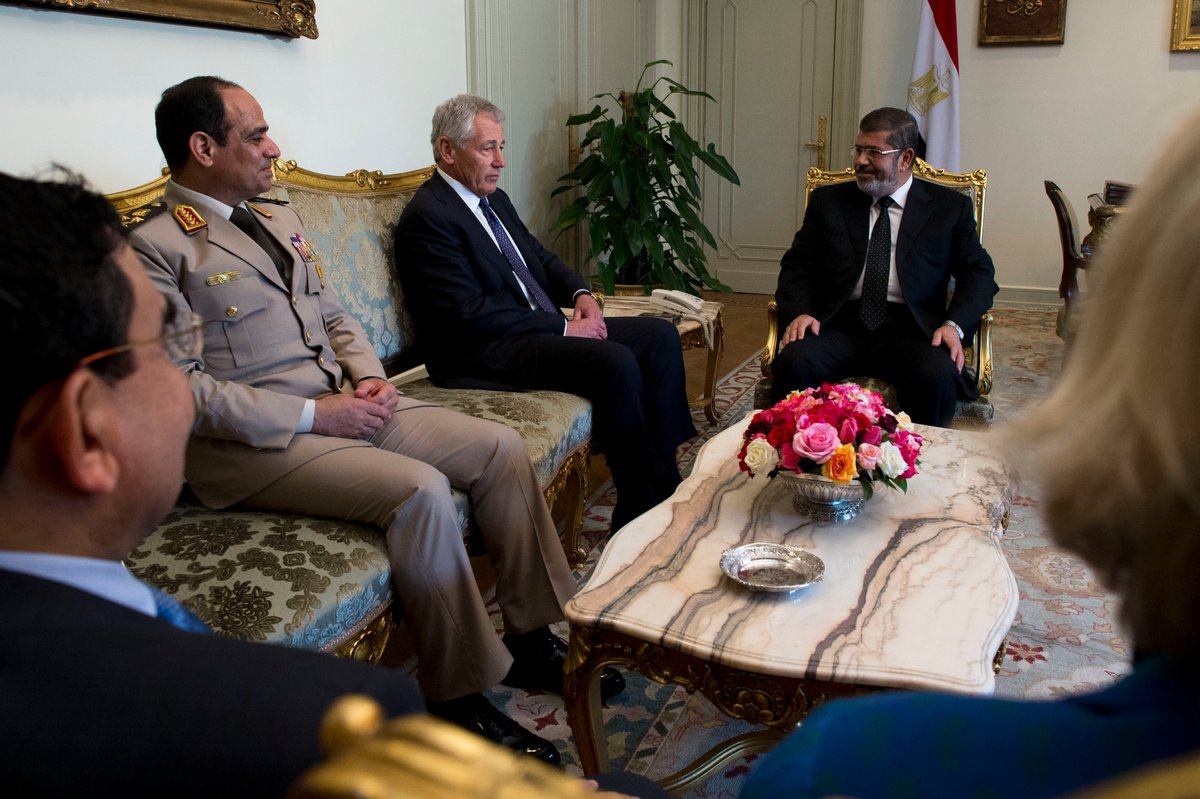

In June 2012, Mohamed Morsi won the presidential election with 51.73% of the total votes, becoming the first democratically elected president of Egypt. However, the country faced significant economic issues and internal friction. By June 2013, a Gallup poll indicated that approval for the national government had dropped from 57% in November 2012 to 24%. During this period, a Supreme Constitutional Court ruled the election law unconstitutional, and the elected parliament found itself unable to pass laws despite continuing to advise on Presidential Decrees.
In November 2012, opposition politicians including Mohamed ElBaradei, Amr Moussa and Hamdeen Sabahi held confidential meetings with army leaders to discuss removing Morsi. By April 2013, a grassroots movement called Tamarod began collecting signatures to remove the president by June 30. Tensions increased when Morsi called for foreign intervention in Syria on June 15, a statement the army rebuked the following day, asserting their role was only to guard the borders. Throughout the early months of 2013, supporters of Morsi held demonstrations at various locations, including El-Hossari Mosque and outside Cairo University.
On July 3, 2013, Egyptian army chief General Abdel Fattah el-Sisi led a coalition to remove Morsi from power and suspend the Egyptian constitution of 2012. Morsi and Muslim Brotherhood leaders were placed under house arrest, and Chief Justice Adly Mansour was declared interim president. The move was followed by demonstrations and clashes across the country. While most Arab leaders were supportive or neutral, Qatar, Tunisia and the SNC strongly condemned the actions. Due to regulations regarding the interruption of constitutional rule, Egypt was suspended from the African Union.
Ensuing protests in favor of Morsi were violently suppressed, culminating in the dispersal and massacre of pro-Morsi sit-ins on August 14, 2013. Police and military force killed hundreds of people. Muslim Brotherhood members claimed 2,600 people were killed, while Human Rights Watch documented a minimum of 904 deaths, describing it as crimes against humanity and one of the world's largest killings of demonstrators in a single day in recent history.
Sources: Wikipedia, OpenStreetMap, Wikidata, Wikimedia Commons
Written by Mutabor
Discuss this with the author and others
No comments yet. Be the first to start the conversation.