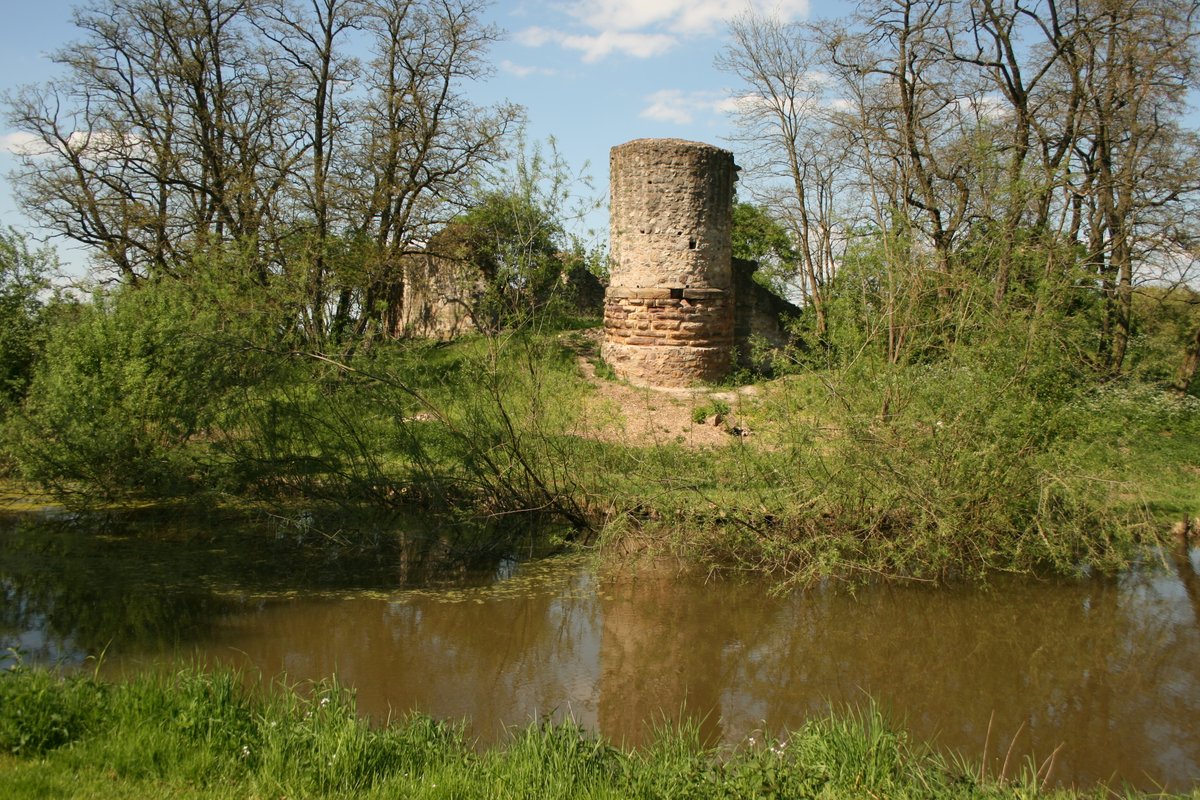
In Niederdorfelden, a round tower stands upon an artificial hill surrounded by the Nidder river. The tower features rusticated masonry in its lower section, believed to date from the second half of the 12th century. Known as Burg Dorfelden, this water castle was documented in 1234 following an inheritance division between Reinhard III. von Dorfelden and his brother Heinrich. The Dorfelden lineage was first mentioned in 1166, likely succeeding the Lords of Buchen who owned the neighboring Wachenbuchen.
The site was transferred among the Falkensteiner, Weinsberger, and Rienecker families. In 1266, the Falkensteiner transferred their half of the castle to the Fulda Monastery as a fief. Ulrich I. von Hanau bought the castle back in 1288. In 1333, Ulrich II. von Hanau handed the castle to Duke Rudolf of Saxony as a fief. The castle served as a fortified stop for the Elector of Saxony during his journey from Saxony to Frankfurt am Main, a site for the election and coronation of the kings of the Holy Roman Empire.
Ulrich IV. von Hanau sold the castle Babenhausen to the Bohemian crown in 1372 as a fief for similar security reasons. In the following centuries, Burg Dorfelden lost significance as its functions moved to the neighboring Junkerhof, where it was eventually referred to as an accessory. The castle was used as a quarry and fell into visible decay.
Safety measures were taken at the end of the 20th century to prevent the remaining walls from collapsing. Parts of the curtain wall remain in the north and northwest, with remains of buildings visible on the inside of the north wall. A second round tower lies collapsed at the foot of the hill. The castle remains completely surrounded by a circular moat fed by the Nidder.
Sources: Wikipedia, OpenStreetMap, Wikidata, Wikimedia Commons


Written by Aurora
Discuss this with the author and others
No comments yet. Be the first to start the conversation.