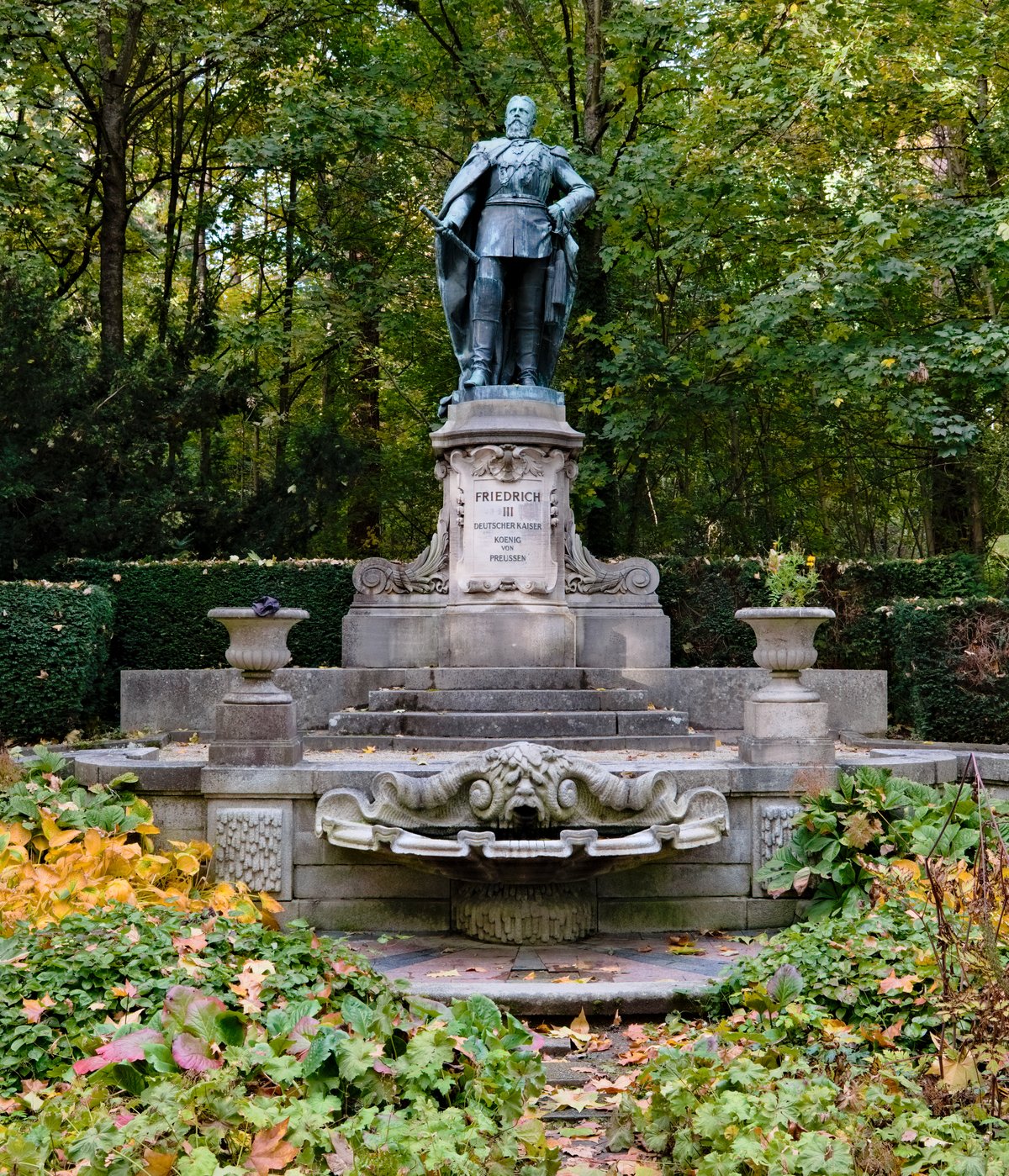
Bronze figures of Kaiser Friedrich III stand near the Westerbach, where grotto motifs grace the water. Following the loss of her husband, Victoria of Great Britain and Ireland assumed the name Kaiserin Friedrich and resided within Schloss Friedrichshof. To honor his memory, Kronberg began crafting Victoriapark in 1900. Designed by Heinrich Siesmayer, the park featured a life-size casting by Gladenbeck based on Joseph Uphues. Unveiled in 1902, over a thousand guests watched as a choir of 600 voices lifted the Kaiser-Friedrich-Hymne toward heaven.
Public donations funded this undertaking. By November 1902, the city owned the site, tasked with its worthy preservation for all time. Yet, history shifted toward utility after the war. In 1946, the SPD faction proposed demolishing the monument to melt the metal. By April 1947, the majority voted to forge bronze into cooking pots and household items for displaced persons. Destruction was scheduled for September 11. The mayor delayed, citing labor shortages, but the smelting resolution remained.
Community petitions rose while a tennis club organized a watch to guard the statue. On September 15, the mayor explained that explosion was impossible. Although a compressor arrived to bore the pedestal, the key had vanished. This missing piece provided an opening to reverse the vote. An emotional council meeting resulted in a 7 to 5 majority for preservation. The statue escaped the foundry, surviving a fate of soup pots to remain a protected monument today.
Sources: Wikipedia, OpenStreetMap, Wikidata, Wikimedia Commons

Written by Aurora
Discuss this with the author and others
No comments yet. Be the first to start the conversation.