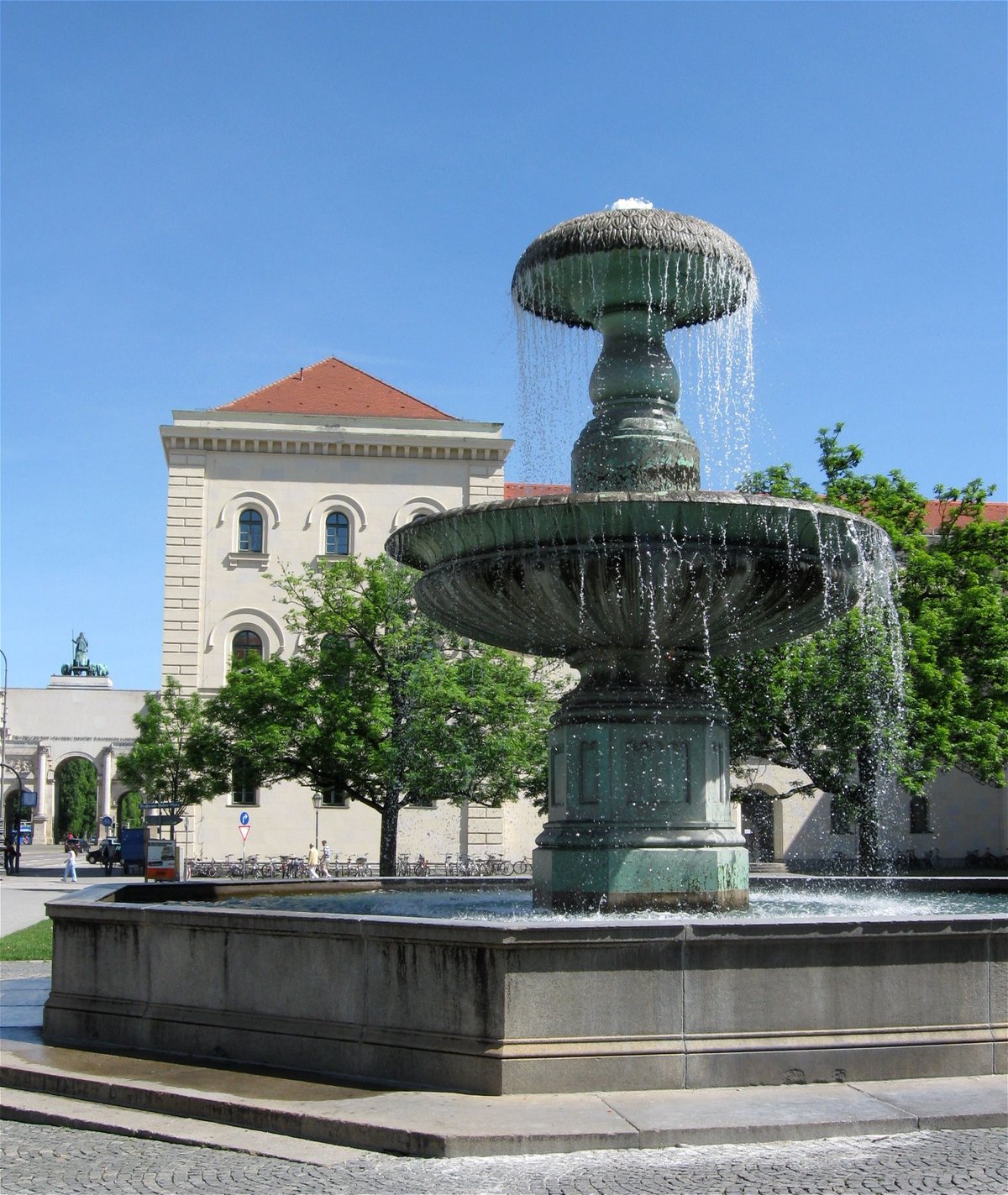
Two massive fountains stand as anchors in the semicircles of Munich's Maxvorstadt, framing the curve of Ludwigstraße. They are heavy, monumental things, cast in iron and set into basins of Hauzenberger granite. Each octagonal base stretches nearly ten meters across, holding a weight of history that predates the modern university surrounding them.
When King Ludwig I commissioned the development of the Ludwigstraße, he envisioned a single, central fountain to mark the axis of his new boulevard. He wanted one grand statement. Friedrich von Gärtner, the architect tasked with building the university’s main building and redesigning the street, steered the king's ambition elsewhere. He convinced the monarch to forgo the single center point and instead create two identical structures. They were modeled after the fountains on the Petersplatz in Rome.
Constructed between 1840 and 1844, the fountains were a gift from the king's private funds, a personal gesture of patronage. The columns rise 8.20 meters high, composed of two shells that work in tandem to direct the water. The liquid falls from the upper shell to the lower, tumbling into the basin like a transparent curtain.
The materials have aged through different eras of aesthetics. Originally, the cast-iron columns were bronzed. During the post-war period, they were coated in a light green paint that eventually darkened under the weight of corrosion. The surrounding buildings of the Maxvorstadt suffered heavily during the war, yet these fountains remained almost entirely intact. While the fountain house at the Haus der Kunst was destroyed and demolished in 1956, these stone and iron giants stayed in place.
There is a hidden world beneath the granite. An underground tunnel connects the two fountains, carrying the water lines and providing a way for workers to access the machinery. In 1848, the university took ownership of the fountains, though the city of Munich retained the land. They have been cared for in waves - once in the 1950s and again recently between 2023 and 2024 - to ensure the water continues to fall in that steady rhythm.
Today, they sit as protected monuments, catching the light as the sun moves across the Ludwigstraße. At night, they are illuminated, turning the transparent curtains of water into glowing veils. They remain a consequence of a king's modified whim and an architect's ability to turn one fountain into two.
Sources: Wikipedia, OpenStreetMap, Wikidata, Wikimedia Commons

Written by Aurora
Discuss this with the author and others
No comments yet. Be the first to start the conversation.