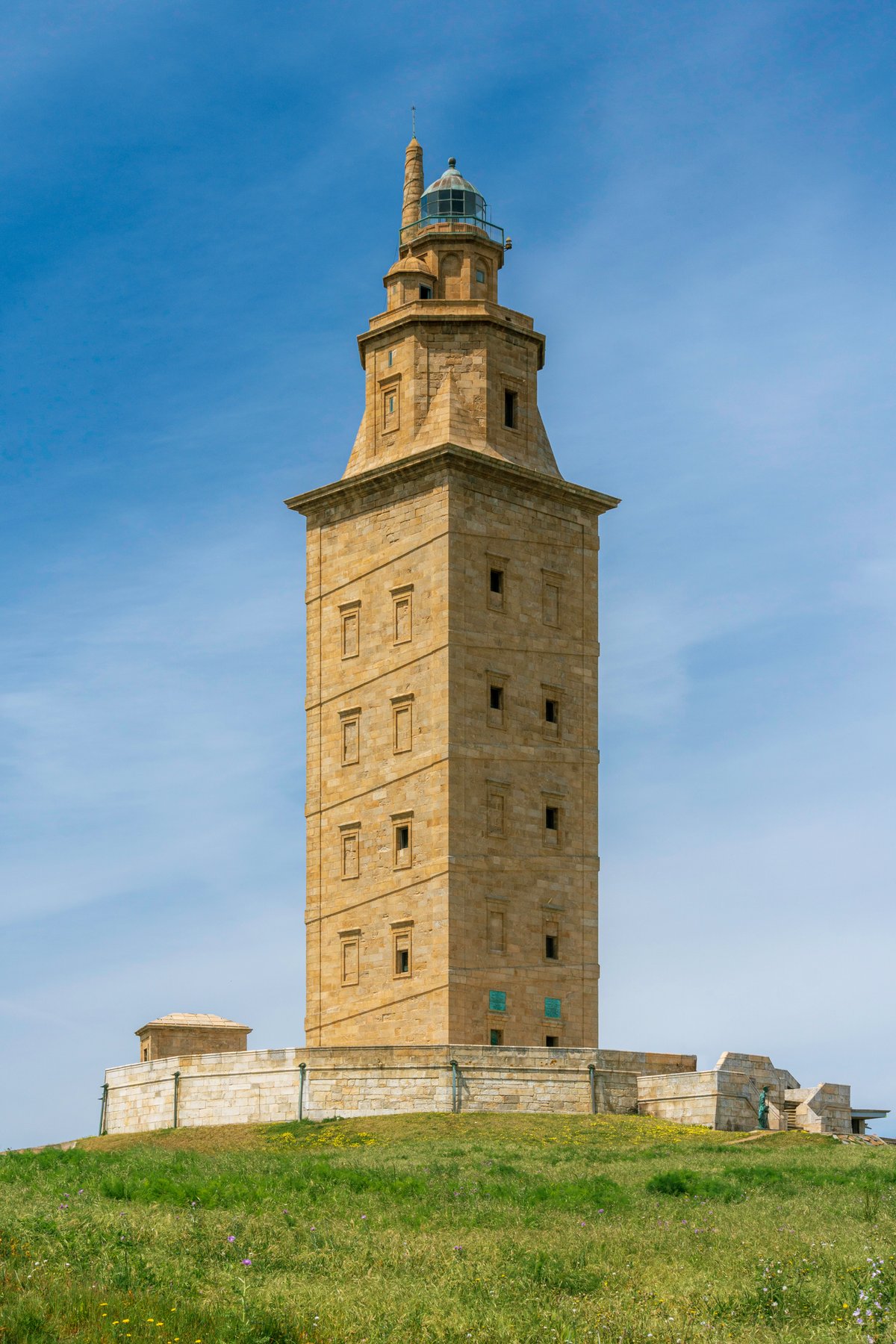

Standing tall on the coast of northwestern Spain, the Tower of Hercules is an ancient Roman lighthouse that has stood for over two thousand years. Built in the late 1st century, it was possibly rebuilt by Emperor Trajan, its design based on the Lighthouse of Alexandria. The tower was designed by Gaius Sevius Lupus, an architect from Aeminium (present-day Coimbra, Portugal), who dedicated it to the Roman god of war, Mars. The tower's original purpose was to serve as a beacon for ships navigating the treacherous waters along the coast of Spain, earning it the name Costa da Morte, or 'Coast of Death. The tower was known as the Farum Brigantium until the 20th century.
The tower was renovated in the 18th century and stands 55 meters (180 feet) tall today. In the Middle Ages, it was a stopover for crusaders, especially for those going to the shrine of the Apostle James the Greater. While there is no specific evidence or record of such visits, the lighthouse stands as a testament to the ingenuity and determination of the ancient Romans, a beacon of hope for sailors in the darkest of days, and a symbol of the rich and complex history of the region.
Sources: Wikipedia, OpenStreetMap, Wikidata, Wikimedia Commons
Written by Nicolo Ciampini
Discuss this with the author and others
No comments yet. Be the first to start the conversation.