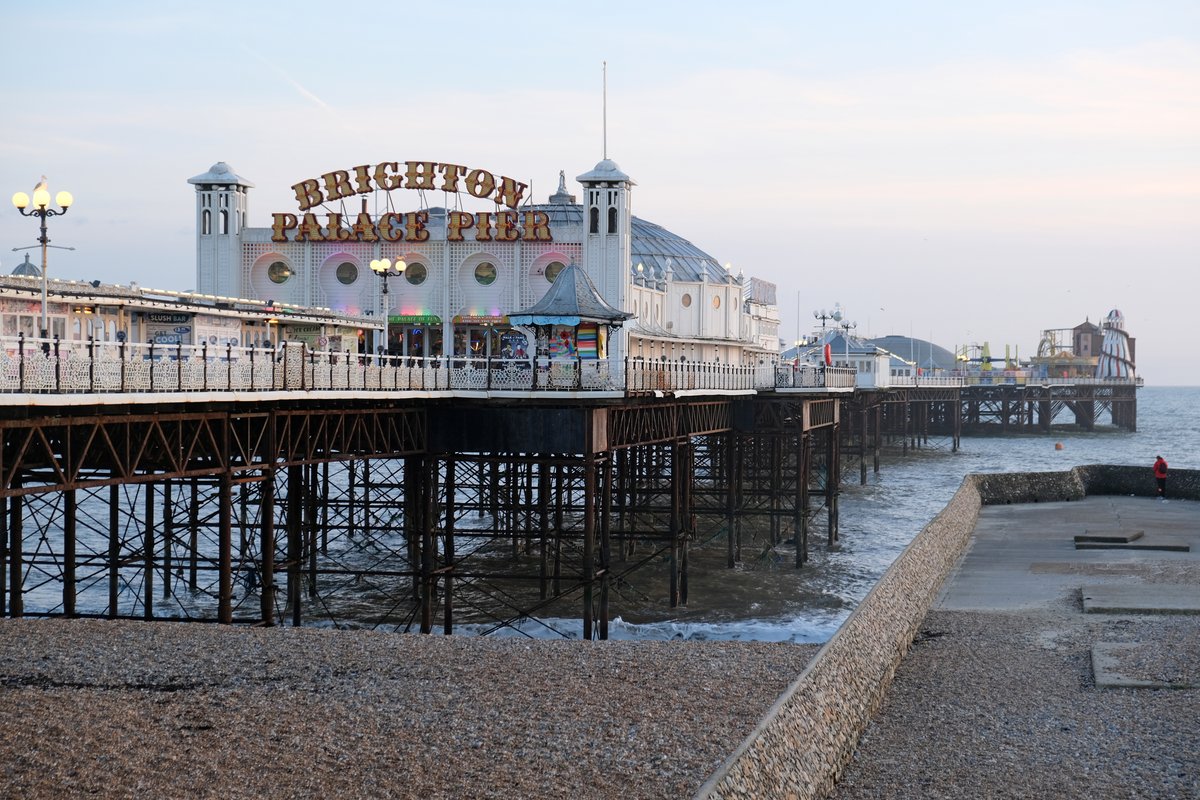

The Brighton Palace Pier, commonly known as Brighton Pier or the Palace Pier, is a Grade II* listed pleasure pier in Brighton, situated opposite the Old Steine (the A23 to London) where it meets Marine Parade and Grand Junction Road. Established in 1899, it was the third pier to be constructed in Brighton after the Royal Suspension Chain Pier and the West Pier, but is now the only one still in operation. It is 1,722 feet (525 m) long and contains 85 miles (137 km) of planking. Because of the pier's length, repainting it takes three months every year. At night, it is illuminated by 67,000 bulbs.
The pier was designed and constructed by R. St George Moore and was intended to resemble kursaals, which were entertainment buildings found near spas on the Continent. It was initially built to replace the Royal Suspension Chain Pier, which collapsed during its construction in 1896. Parts of the collapsed pier, including toll houses, were re-used for the new pier. By 1911, the pier's reading rooms had been converted into a theatre, where performers such as Stan Laurel and Charlie Chaplin performed early in their careers.
During World War II, the pier was closed as a security precaution, and a section of decking was removed to prevent enemy landings. After the war, it regained its popularity and continued to run regular summer shows. The theatre was demolished in 1986, and the seaward end of the pier was filled with fairground rides, including thrill rides, children's rides, and roller coasters. In 2017, the pier was said to be the United Kingdom's most visited tourist attraction outside London, with over 4.5 million visitors the previous year.
Sources: Wikipedia, OpenStreetMap, Wikidata, Wikimedia Commons

Written by Nicolo Ciampini
Discuss this with the author and others
No comments yet. Be the first to start the conversation.