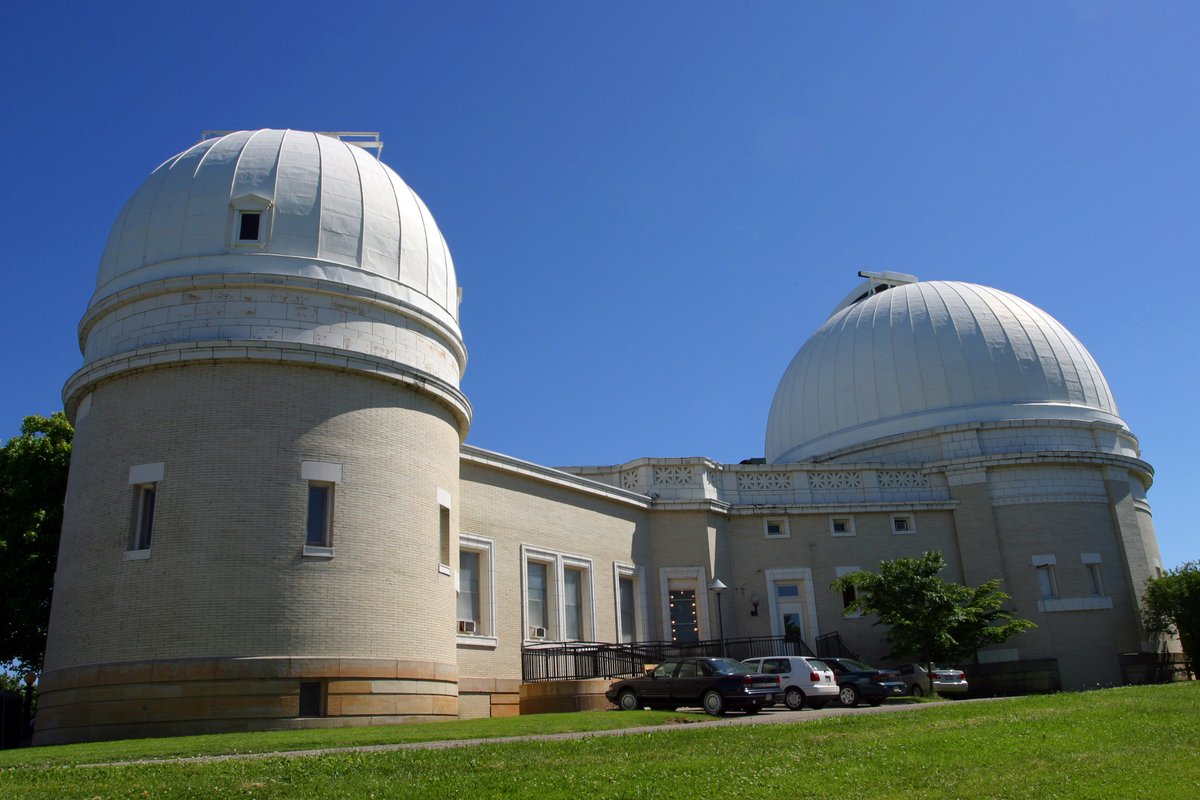
On November 18, 1883, the Allegheny Observatory transmitted a signal marking the first day of railroad standard time in North America. By 1870, this facility was already selling time subscriptions to over 300 telegraph offices, covering 2,500 miles of track. The Pennsylvania Railroad was the most influential subscriber to the Allegheny Time system.
The Allegheny Telescope Association founded the observatory in 1859 for public education but donated the facility to the Western University of Pennsylvania in 1867. The first director, Samuel Pierpont Langley, expanded the building to include dark rooms, classrooms, dormitories, and a lecture hall. He initiated a sunspot research program with detailed drawings still used in astronomical textbooks and engineered a bolometer in 1878 to detect thermal radiation.
That device eventually provided the data used by Arrhenius in 1890 to demonstrate the greenhouse effect. Later, James Keeler used the 13-inch Fitz-Clark Refractor in 1895 to prove Saturn's rings were made of particles, not solid disks. John Brashear, who also produced the optics for the famous Michelson-Morley experiment, manufactured the 30-inch Thaw Refractor. That 47-foot telescope remains in use today.
Currently, the 30-inch Thaw Refractor is undergoing rewiring and upgrades. It previously served as the most successful photographic parallax telescope in the world in the early 20th century. Now, it stands as a historical asset for Pittsburgh's Department of Physics and Astronomy.
Sources: Wikipedia, OpenStreetMap, Wikidata, Wikimedia Commons

Written by Kyle McLonely
Discuss this with the author and others
No comments yet. Be the first to start the conversation.