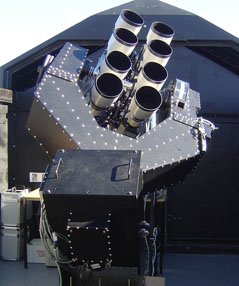

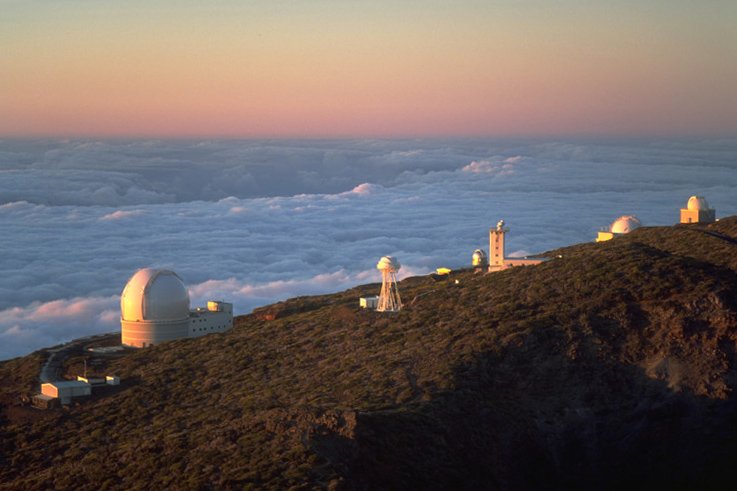
The Wide Angle Search for Planets, or WASP, is an international consortium of academic organisations performing an ultra-wide angle search for exoplanets using transit photometry. The project operates two continuously functioning robotic observatories: SuperWASP-North and WASP-South. SuperWASP-North is located at the Roque de los Muchachos Observatory on the mountain of that name which dominates La Palma in the Canary Islands. WASP-South is situated at the South African Astronomical Observatory in Sutherland, South Africa.
These observatories use an array of eight wide-angle cameras to monitor the sky for planetary transit events. Each observatory uses Canon 200 mm f1.8 lenses backed by high quality 2048 x 2048 science-grade CCDs. These instruments provide a sky coverage of 490 square degrees per pointing. The telescopes gather up to 100 gigabytes of data per night, allowing the team to measure the brightness of each star and search for small dips caused by large planets passing in front of their parent stars.
WASP is operated by a consortium including the Isaac Newton Group of Telescopes, the Instituto de Astrofisica de Canarias, and six universities from the United Kingdom. One of the main purposes of WASP was to revolutionize the understanding of planet formation and pave the way for future space missions searching for Earth-like worlds. As of 2016, the Extrasolar Planets Encyclopaedia database contained a total of 2,107 extrasolar planets, of which 118 were discoveries by WASP.
Sources: Wikipedia, OpenStreetMap, Wikidata, Wikimedia Commons

Written by Mutabor
Discuss this with the author and others
No comments yet. Be the first to start the conversation.