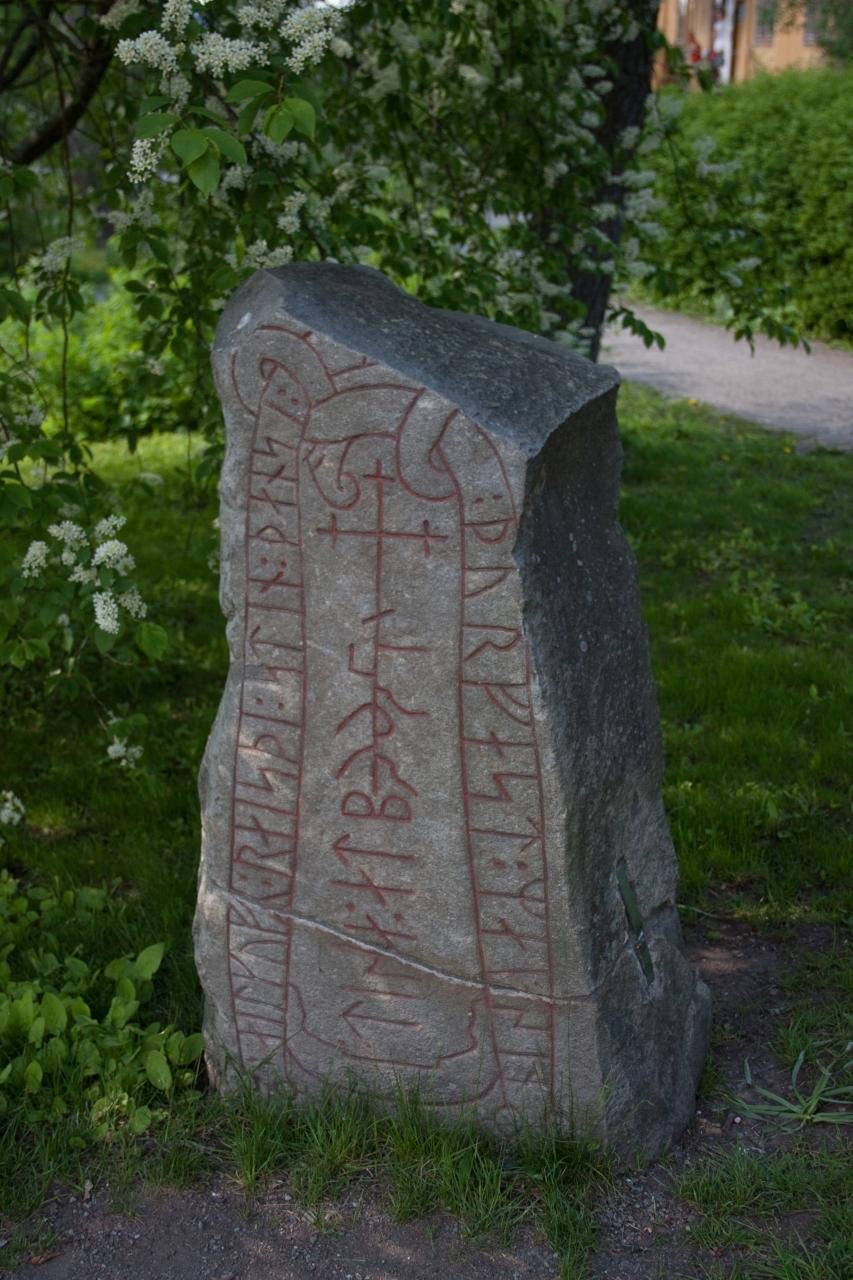

Södermanland Runic Inscription 352 is a Viking era memorial runestone located about two kilometers south of Järna, near the village of Järna, Stockholm County, Sweden, which was in the historic province of Södermanland. The inscription depicts a ship with an anchor and a portion of the runic text uses same-stave bind runes on the ship mast. Although the stone is considered to be Christian due to the cross and ship imagery, two of the names in the text have theophoric name elements, with Þorfastr referring to the Norse pagan god Thor and Dísa a nickname related to Dís, which refers to a protective female deity. The stone does not name the village; only the location (Linga, near Järna) is mentioned in the inscription.
A man named Helgulfr raised the stone as a memorial to his kinsman by marriage named Þorfastr, and by Dísa, the sister of Þorfastr. The runic text, in the younger futhark, is inscribed on two serpents that bracket the image of ship, whose upper mast forms a Christian cross, with the text continued on the top and back of the stone.
Sources: Wikipedia, OpenStreetMap, Wikidata, Wikimedia Commons
Written by Nik Frost
Discuss this with the author and others
No comments yet. Be the first to start the conversation.