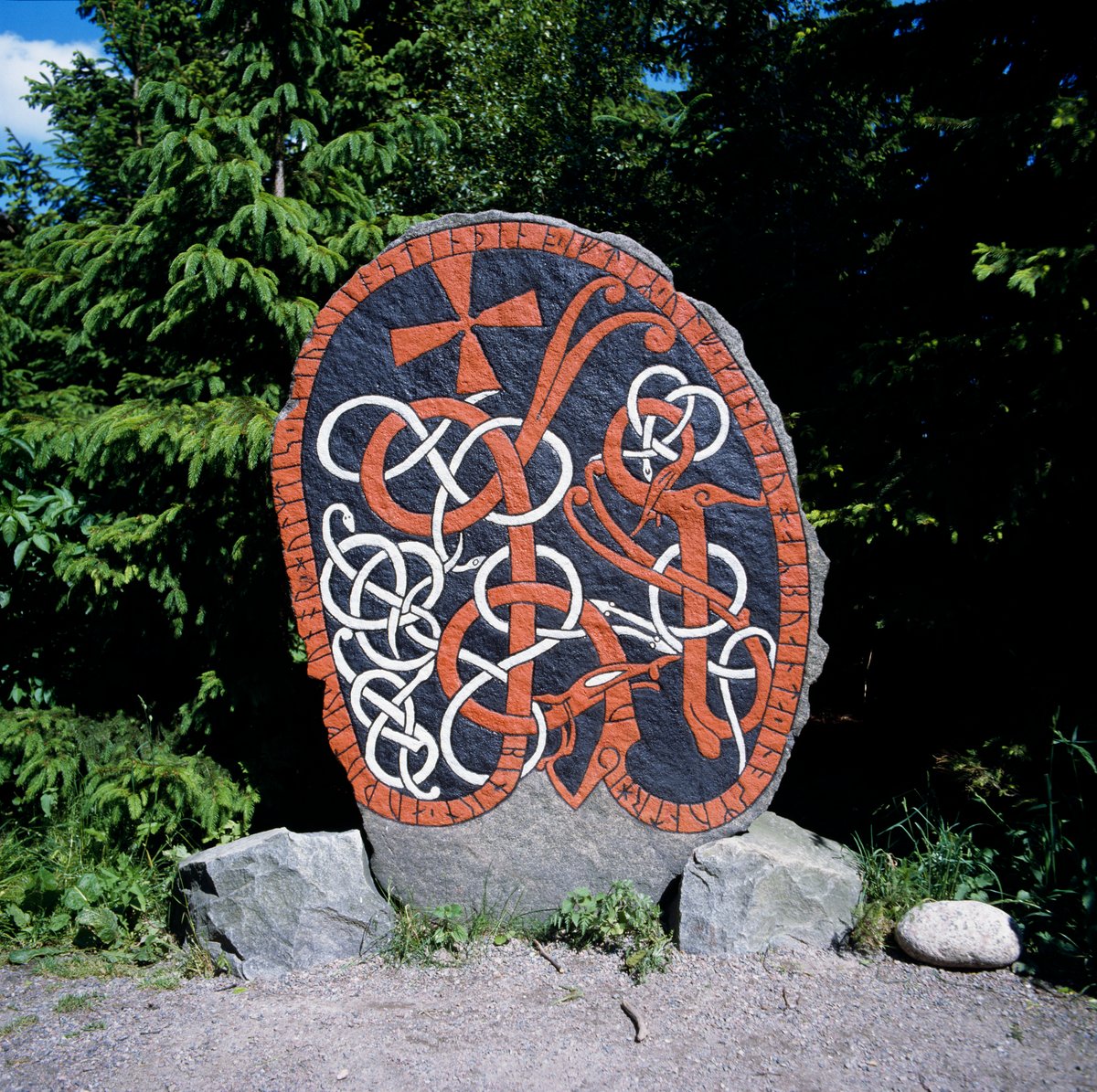

U 871, a runestone dating back to the 12th century, has been a part of Sweden's history for centuries. Originally from Ölsta in Uppland, it now resides at Skansen, located near Stockholm. Its journey is as captivating as the history it encompasses. Situated close to, but not strategically placed, near the Eriksgata, the road traveled by the Swedish king after his election at the Stone of Mora, the inscription is classified as being carved in runestone style Pr4, also known as the Urnes style, characterized by slim and stylized lindworms that are interwoven into tight patterns.
This runestone is among over twenty inscriptions signed by the runemaster Åsmund Kåresson, active during the first half of the 11th century in Uppland. It was purchased for 50 Swedish kronor in 1896 by Artur Hazelius, the founder of Skansen, where it remains to this day. In 1991, the Swedish Rune Authority colorized the stone as an experiment, with the hope that the colorization would protect it from moss and the weather for at least 50 more years. The inscription, read from Latin to Runic Swedish, is a fascinating piece of Sweden’s ancient history.
Sources: Wikipedia, OpenStreetMap, Wikidata, Wikimedia Commons
Written by Nik Frost
Discuss this with the author and others
No comments yet. Be the first to start the conversation.