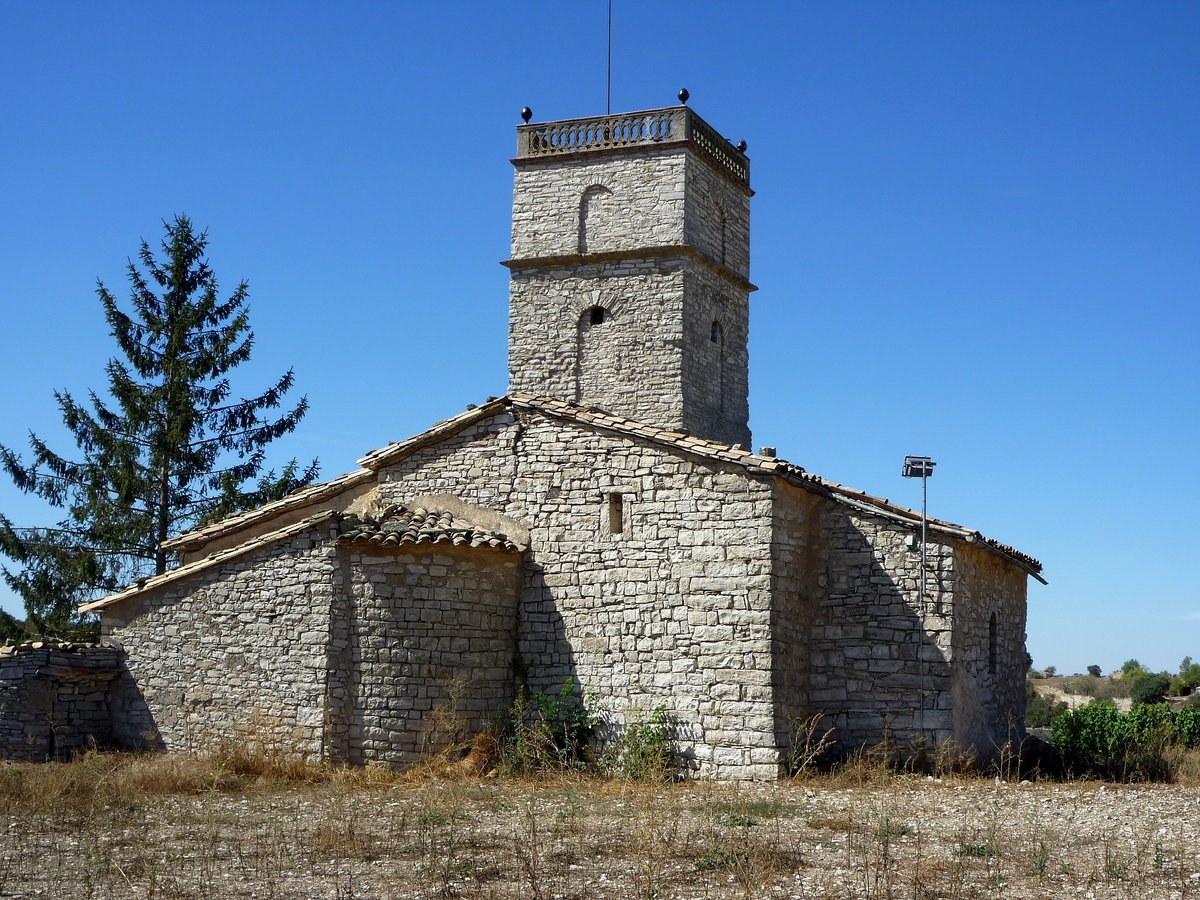

Perched in Sant Ramon, Spain, Sant Jaume de Portell boasts an intriguing name that challenges general assumptions. Despite being the principal patron of the parish, with its history dating back to 1072, the church is called Sant Jaume, rather than Saint Cugat. In its early days, Sant Jaume de Portell was a Romanic church, characterized by a single nave, enclosed in a canon vault and a semicircular apse at the east, preceded by a narrow arch presbyterial.
Although no original openings remain, it's plausible that the main entrance was located on the southern wall, in a fashion similar to the current arrangement, boasting a neoclassical door, flanked by two pilasters and capped by a flat roof, displaying a medallion with the construction and renovation years of the old church, 1883. The facades are devoid of decoration, embellished with rows of Caribbean blocks, the carreres segarrencs, a construction method prevalent in the comarca, traceable to the twelfth century.
In the 19th century, a second nave was added to the north of the original, and a sacristy was constructed to the south, adjacent to the apse, covering the southern half. A campanar de torre, a bell tower, was erected at the western end of the original nave. The bell tower encases an old campanar d'espadanya with two openings. Four openings are sealed at the lower body of the bell tower, and four more at the upper body, two of which are closed, while the remaining two accommodate the bell.
Sources: Wikipedia, OpenStreetMap, Wikidata, Wikimedia Commons
Written by Nik Frost
Discuss this with the author and others
No comments yet. Be the first to start the conversation.