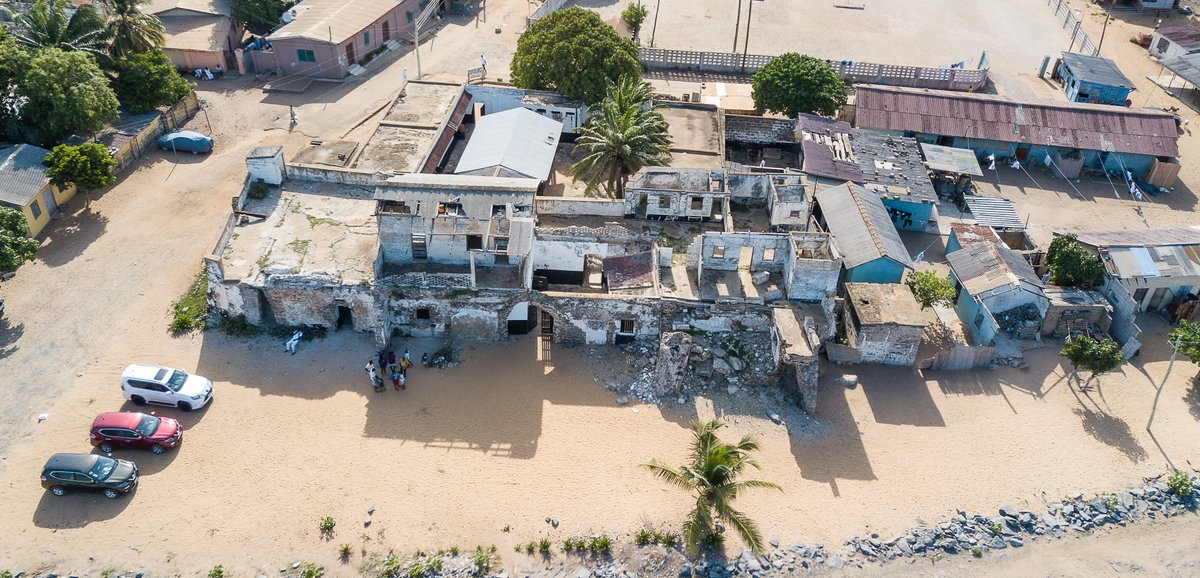

Fort Prinzenstein, known in Danish as Fort Prinsensten, is a historic fort located at Keta, Ghana. It is one of the few forts of its kind situated east of the Volta River. Keta served as an open port until the Tema Harbour began operations to the west in 1962. Today, the fort is designated as a World Heritage Site due to its historical importance and its role as a testimony to the Atlantic slave trade.
The fort was built by Danish traders in 1784 for defensive purposes following the Sagbadre War against the Anlo Ewe. It was constructed to keep the area safe from other colonial powers, with the majority of its stone materials coming from Accra. Beyond the slave trade, the fort was an active hub for the exchange of goods including gold, ivory, muskets, brandy, iron rods, textiles, and cowrie shells.
Before the Danish arrived, the Dutch West India Company had built Fort Singelenburgh on the site in 1734, but they abandoned it in 1737. The Danish established a presence in Keta, the commercial capital of the Anlo people, after defeating the Anlo in 1784 and imposing a treaty that required the Anlo to trade only with them. Up until 1803, the fort was used as a dungeon for slaves awaiting transport to the Caribbean. In 1850, the fort and the Danish Gold Coast were sold to Britain, and the fort served as a prison for a period before being partially destroyed by the sea in 1980.
In 1991, ICOMOS Ghana, the Ghana Museum and Monuments Board, and the Danish Embassy worked to preserve the remains of the fort. Despite the ongoing impact of the sea, the ruins are now visited by tourists from many countries, including the United Kingdom, United States, Germany, Benin, France, Ireland, Norway, Switzerland, Sweden, Denmark, and Finland.
Sources: Wikipedia, OpenStreetMap, Wikidata, Wikimedia Commons

Written by Mutabor
Discuss this with the author and others
No comments yet. Be the first to start the conversation.