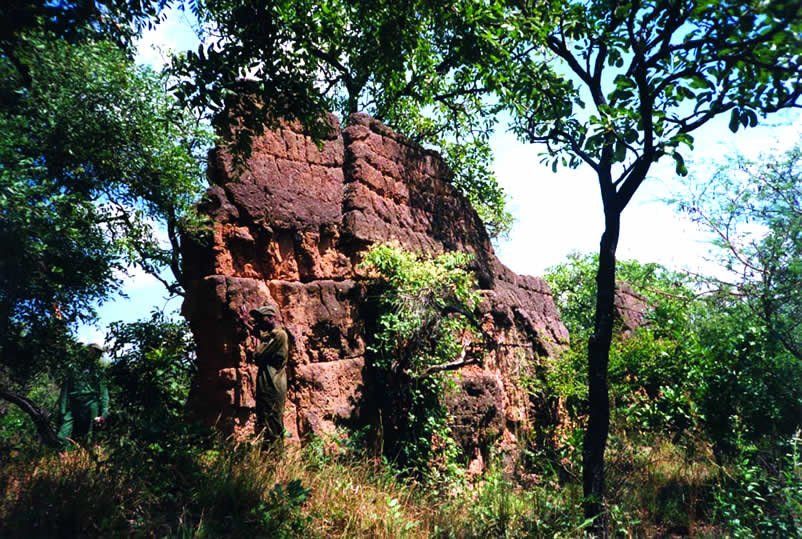

Sungbo's Eredo is a system of defensive walls and ditches located to the southwest of the Yoruba town of Ijebu Ode in Ogun State, southwest Nigeria. Built in honour of the Ijebu noblewoman Oloye Bilikisu Sungbo, the site is currently on Nigeria's tentative list of potential UNESCO World Heritage Sites.
The total length of the fortifications is more than 160 kilometres (99 miles). The ditch forms an uneven ring around the area of the ancient Ijebu Kingdom, approximately 40 kilometres wide in north–south. The fortifications consist of a ditch with unusually smooth walls and a bank on the inner side, where the height difference can reach 20 metres (66 feet). The walls are flanked by trees and other vegetation, turning the ditch into a green tunnel.
The dating of the Eredo is disputed due to its massive scale. Carbon dates go as far back as 2000 BCE, although this does not necessarily indicate the date of construction. Other estimates place the work in the 10th and 11th centuries, while more recent excavations point to the end of the 14th and beginning of the 15th century. The site served a defensive purpose during a period of political confrontation and consolidation in the southern Nigerian rainforest.
Local legends link the Eredo to a fabled wealthy and childless widow named Bilikisu Sungbo, who is believed to have a grave in the town of Oke-Eiri. Christians and Muslims attend an annual pilgrimage to the site. While some believe it was built in honour of the Queen of Sheba, archaeologists note that the local belief is what remains most important to the community.
The impressive size of the Eredo drew worldwide media attention in September 1999. During this time, archaeologist Dr. Patrick Darling surveyed the site, noting that in terms of sheer size, it is larger than any of the Egyptian pyramids.
Sources: Wikipedia, OpenStreetMap, Wikidata, Wikimedia Commons
Written by Mutabor
Discuss this with the author and others
No comments yet. Be the first to start the conversation.