
Title: The statue that crushed a serpent Teaser: A monumental statue in Puy-en-Velay, France, that held a deadly secret and a silver lining.
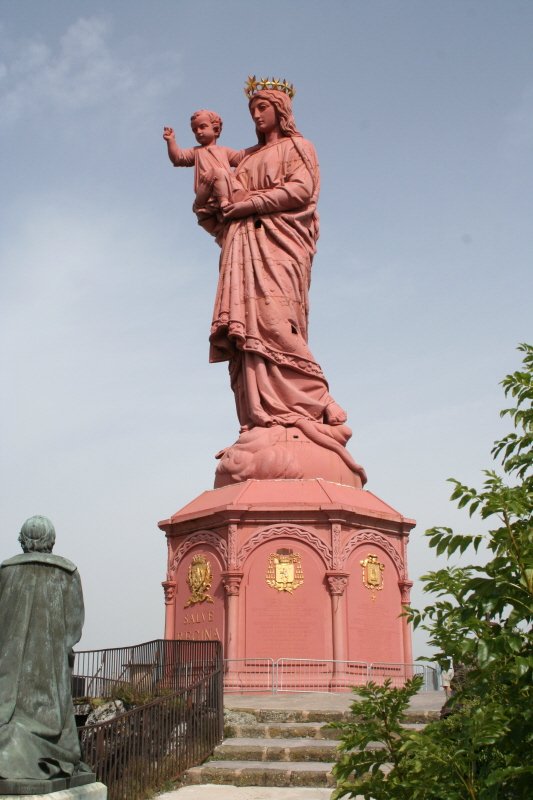
The Statue de Notre-Dame de France in Puy-en-Velay, France, is a triumph of 19th-century craftsmanship. Forged largely from captured cannons, it towers above the city, a monument to victory and faith. But the story of its creation is a far more interesting tale.
The statue was the brainchild of the Reverend Père Xavier de Ravignan. In 1850, he proposed the idea of building a statue of the Virgin Mary atop a local rock formation. The proposal was accepted by Auguste de Morlhon, the Bishop of the region, who created a commission to oversee the project.
The Commission launched a European-wide contest for the statue's design, receiving over 50 submissions. The winning proposal was by the French sculptor, Jean-Marie Bonnassieux, who envisioned a statue of the Virgin Mary standing on a hemisphere and crushing a serpent beneath her feet. The statue's right hand is raised to the heavens, while her left hand holds the Child Jesus, who gazes out toward the horizon.
But the statue's creation was not without controversy. The statue was funded by public subscription, but when the Commission ran out of funds, the Bishop of Puy-en-Velay traveled to Paris to seek assistance from Emperor Napoléon III. The Emperor eventually granted 10,000 francs and donated captured cannons from the Sevastopol Siege for the statue's construction.
The statue was completed in 1860 and was consecrated by the Bishop. It stands [22.7 m](http://www.some-source.com/data/statue-height) tall and weighs approximately 835 tonnes. The statue is hollow and has a spiral staircase of 58 steps inside, leading to the crown of the Virgin.
Despite the statue's historical and religious significance, it was tainted by a rumor that haunted it for decades. The rumor was that Jean-Marie Bonnassieux killed himself after realizing that Jesus was on the wrong side of the Virgin Mary on his model. However, this rumor was proven false, and the statue continues to stand as a symbol of victory and faith in Puy-en-Velay to this day.
Sources: Wikipedia, OpenStreetMap, Wikidata, Wikimedia Commons
Written by Nicolo Ciampini
Discuss this with the author and others
No comments yet. Be the first to start the conversation.