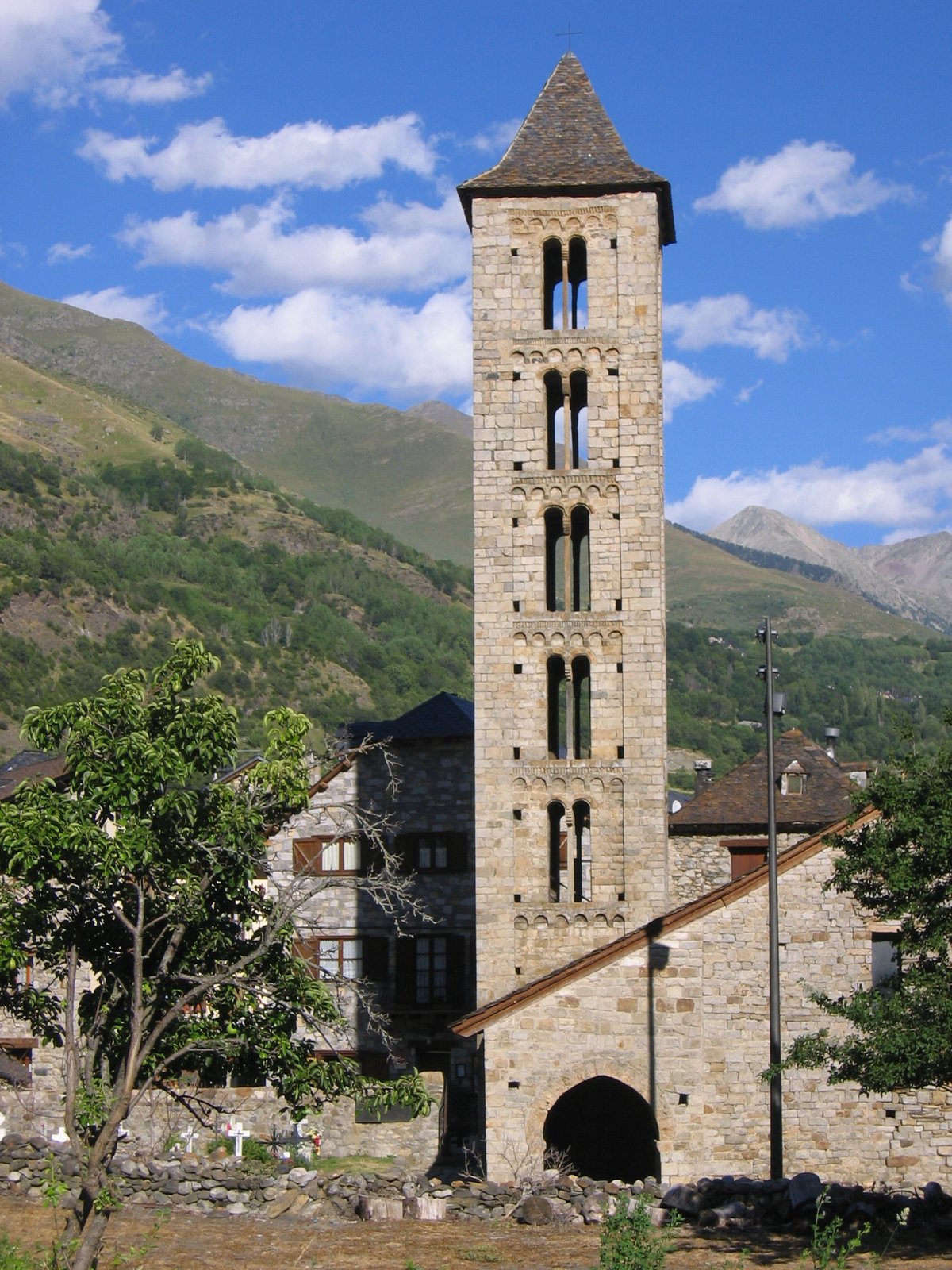

Santa Eulàlia d'Erill la Vall is a [Romanesque](https://en.wikipedia.org/wiki/Romanesque_architecture) church situated in [Erill la Vall](https://en.wikipedia.org/wiki/Erill_la_Vall) in the territory of [Vall de Boí](https://en.wikipedia.org/wiki/Vall_de_Bo%C3%AD), a commune in the valley with the same name and in Comarca of [Alta Ribagorça](https://en.wikipedia.org/wiki/Alta_Ribagorça) in the north of [Province of Lleida](https://en.wikipedia.org/wiki/Province_of_Lleida) and the [autonomous communities](https://en.wikipedia.org/wiki/Autonomous_communities_of_Spain) of [Catalonia](https://en.wikipedia.org/wiki/Catalonia) in [Spain](https://en.wikipedia.org/wiki/Spain).
Santa Eulàlia d'Erill la Vall is one of the [Romanesque churches of the Boí Valley](https://en.wikipedia.org/wiki/Catalan_Romanesque_Churches_of_the_Vall_de_Bo%C3%AD). It became part of the World Heritage Site of [UNESCO](https://en.wikipedia.org/wiki/UNESCO_World_Heritage_Site) in 2000. Its construction is believed to have taken place in the 11th century, around the same time as other churches in the valley such as [Sant Climent, Taüll](https://en.wikipedia.org/wiki/Sant_Climent,_Ta%C3%B9ll), [Sant Joan de Boí](https://en.wikipedia.org/wiki/Sant_Joan_de_Bo%C3%AD), [Sant Feliu de Barruera](https://en.wikipedia.org/wiki/Sant_Feliu_de_Barruera), [Santa Maria de Taüll](https://en.wikipedia.org/wiki/Santa_Maria_de_Ta%C3%B9ll) and [Santa Maria, Cardet](https://en.wikipedia.org/wiki/Santa_Maria,_Cardet).
The church is modest from the outside, but it is thought that the nuns who once lived here hid from invaders, seeking refuge in the church and preserving precious religious art. The frescoes that once lined the walls are still visible today. They provide glimpses into the lives of the nuns and their religious teachings.
Sources: Wikipedia, OpenStreetMap, Wikidata, Wikimedia Commons
Written by Nicolo Ciampini
Discuss this with the author and others
No comments yet. Be the first to start the conversation.