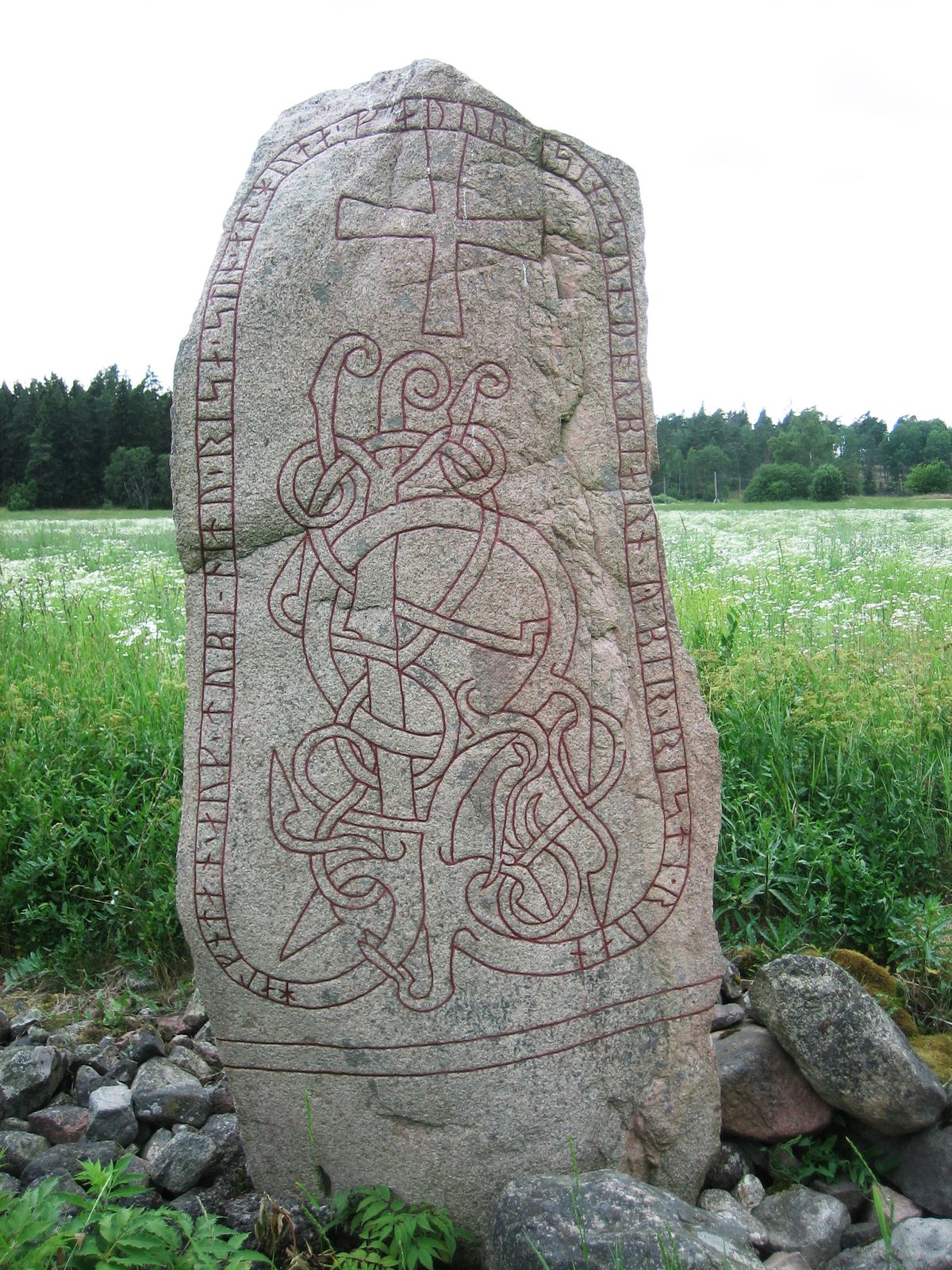

Upplands runic inscription 229, popularly known as the rune stone of Udde, stands in a field near the road between Gällsta and Grana in Vallentuna socken, Sweden. It is 2.75 meters high, 1.2 meters wide, and 0.6 meters thick, with runes that are 7-8 centimeters in height. The stone, discovered in 1633, is believed to have originally been in a different location in the field. The stone was carved by the renowned rune engraver Öpir, employing elements from the Ringerike style and the Urnes style.
The decoration consists of a rune band with several upward-pointing extensions, which enclose a larger circle and several smaller rings. Above the rune band, a Christian cross hangs down. Below the decoration, a horizontal, flat band can be found near the ground. The two nearby runestones U 231 and U 232 were also raised by the children of Udde's sons, Halvdan and Tobbe, in memory of their father. With the rune stone of Udde, these sons aimed to preserve the memory of their father, Udde, and their inheritance.
Sources: Wikipedia, OpenStreetMap, Wikidata, Wikimedia Commons
Written by Nik Frost
Discuss this with the author and others
No comments yet. Be the first to start the conversation.