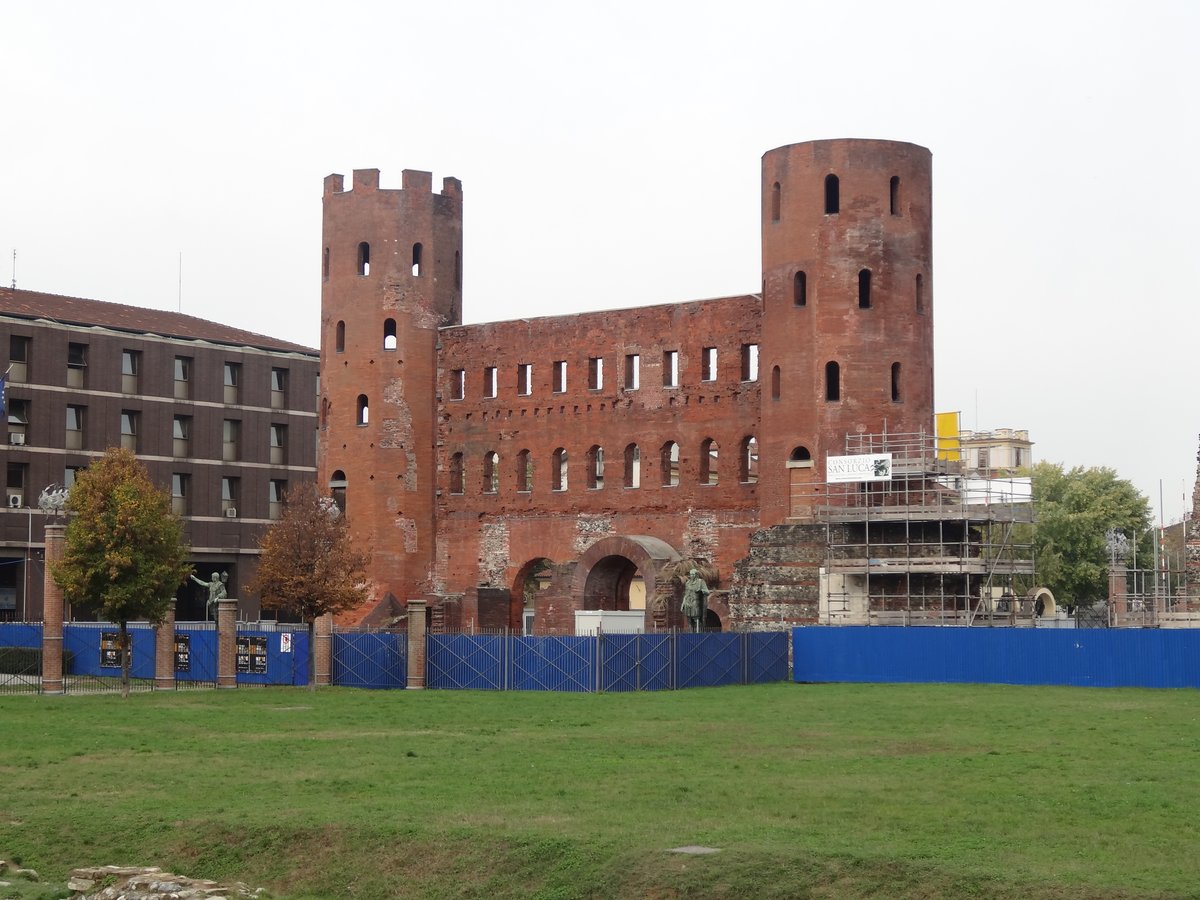

Why is this gate still standing while so much of the rest of the Roman city vanished? It is one of the world's best-preserved 1st-century AD gateways. It served as the Porta Principalis Dextra for Julia Augusta Taurinorum, providing access to the north side of the city walls.
In the early 18th century, local authorities planned to tear it down as part of an urban renewal project. However, the dismantling was not implemented thanks to the architect and engineer Antonio Bertola, who convinced the duke to preserve the ancient architectural work. It survived until the 2006 restoration project, which turned the surrounding area into an archaeological park.
Take a look at the two sixteen-sided towers. They stand more than thirty metres high. You can still see the furrows on the stones caused by the transit of wagons near the guardhouse. There is even a mystery about the name - some say it refers to a palace, while others think it might have been named after a nearby amphitheatre that fell into disrepair so quickly the ancients might have dubbed it a building.
Today, you can walk right up to the gate in Piazza Cesare Augusto. The archaeological park is open to the public, and the park area includes the remains of an ancient theatre nearby. It is a heavy piece of history that was almost just another pile of rubble.
Sources: Wikipedia, OpenStreetMap, Wikidata, Wikimedia Commons
Written by Nicolo Ciampini
Discuss this with the author and others
No comments yet. Be the first to start the conversation.